Plate 010 — Wargames
REF: BF-GME-010How BattleFleet: Pacific War Extends the Battleship Rules
BattleFleet: Pacific War kept the hidden-fleet premise of classic Battleship but added ship and aircraft movement, radar-based fog of war, dozens of purchasable unit types, and mission objectives beyond simple elimination.
The playable Battleship grid on this page uses the classic rules: five stationary ships hidden on a 10x10 board, found only by guessing coordinates. BattleFleet: Pacific War kept that same hidden-fleet premise but rebuilt almost everything else around it, extending a single fixed grid into a full naval campaign where movement, detection range and unit type all became variables rather than constants.

Movement Instead of a Fixed Grid
In the board game, a ship's position is fixed for the entire match: once placed, it neither moves nor benefits from repositioning.


In Pacific War, every ship, submarine and aircraft type can move across the map each turn, and the map itself can measure up to 96x96 squares, compared with the standard 10x10 Battleship board shown above.
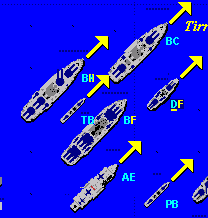
That difference changes the core problem a player is solving: instead of pure elimination through guesswork, a match becomes an exercise in tracking a moving target across open water while also managing the movement of an entire fleet, around islands, land, and major and minor ports scattered across the map. Pacific War's campaign structure carried that fleet movement across four playable navies:


Search and Fog of War
Classic Battleship removes fog of war almost entirely from one side of the board: a player's own fleet is fully visible at all times, and the only hidden information is the opponent's ship placement, revealed square by square as shots land. Pacific War instead gives every unit a radar range, so a ship or aircraft can only detect and fire on enemy units within range of its own current position rather than anywhere on the map. That single rule reproduces the fog of war a real naval commander faced: a fleet has to close the distance, or fly reconnaissance, before it can begin to fight, and an enemy force can pass unnoticed through open squares outside every friendly unit's detection radius.
Aircraft and Submarines as New Unit Classes
The standard Battleship fleet is five ships and nothing else: a Carrier, Battleship, Cruiser, Submarine and Destroyer, distinguished only by length. Pacific War replaced that fixed roster with a purchasable pool of more than fifty unit types, including several classes each of aircraft carrier, cruiser, battleship, destroyer and submarine, together with bombers, fighters, long-range naval aircraft, port artillery and radar units of varying range. Submarines and aircraft in particular behave nothing like their board-game namesake: a carrier's fighters and bombers can strike targets well outside the carrier's own detection radius, and a submarine can be built, deployed and lost as a purchasable unit during a mission rather than being one of five ships placed once at the start.
Objectives Beyond Sinking Every Ship
Classic Battleship has exactly one win condition: sink every ship the opponent placed. Pacific War missions instead assign one of several objectives, among them conquering all enemy major ports, defending friendly ports for a set number of turns, destroying a set number of a particular ship class, escorting a convoy safely to a friendly port, or eliminating as many enemy units as possible before a time limit expires. Only the Death-Match format keeps the board game's original all-or-nothing logic, requiring the destruction of every enemy ship, plane and artillery piece to win. Among its own scenarios were sixteen Free Hunt battles, including Free Hunt: Andrews, German on Pacific, Submarines, Return to Midway, Free Hunt: Spruance, Free Hunt: Halsey, Free Hunt: Doenitz, Royal Australian AF Hunt, Free Hunt: U-Boats, Free Hunt: Carriers, Free Hunt: Hawaii, Free Hunt: Yamato, Free Hunt: Iwo Jima, Free Hunt: Pacific, Free Hunt: Convoy and one built around Pearl Harbor.
In practice, a single well-placed aircraft carrier group could cover far more of the map than an equivalent surface fleet confined to its own radar range, since a carrier's fighters and bombers extend detection and firing range well beyond the carrier's own position. That made carrier placement, rather than raw fleet size, one of the more consequential early decisions in a mission.
Play Battleship against the computer
Five ships a side on a 10 × 10 chart: carrier (5 squares), battleship (4), cruiser (3), submarine (3) and destroyer (2). Each salvo is answered by one from the computer, which hunts on a checkerboard pattern and closes in along the line once it has two hits.
Own fleet
Enemy waters
The game loads when this section scrolls into view; it needs JavaScript.