Plate 023 — Aircraft
REF: BF-AIR-023F-15 Eagle
F-15 Eagle

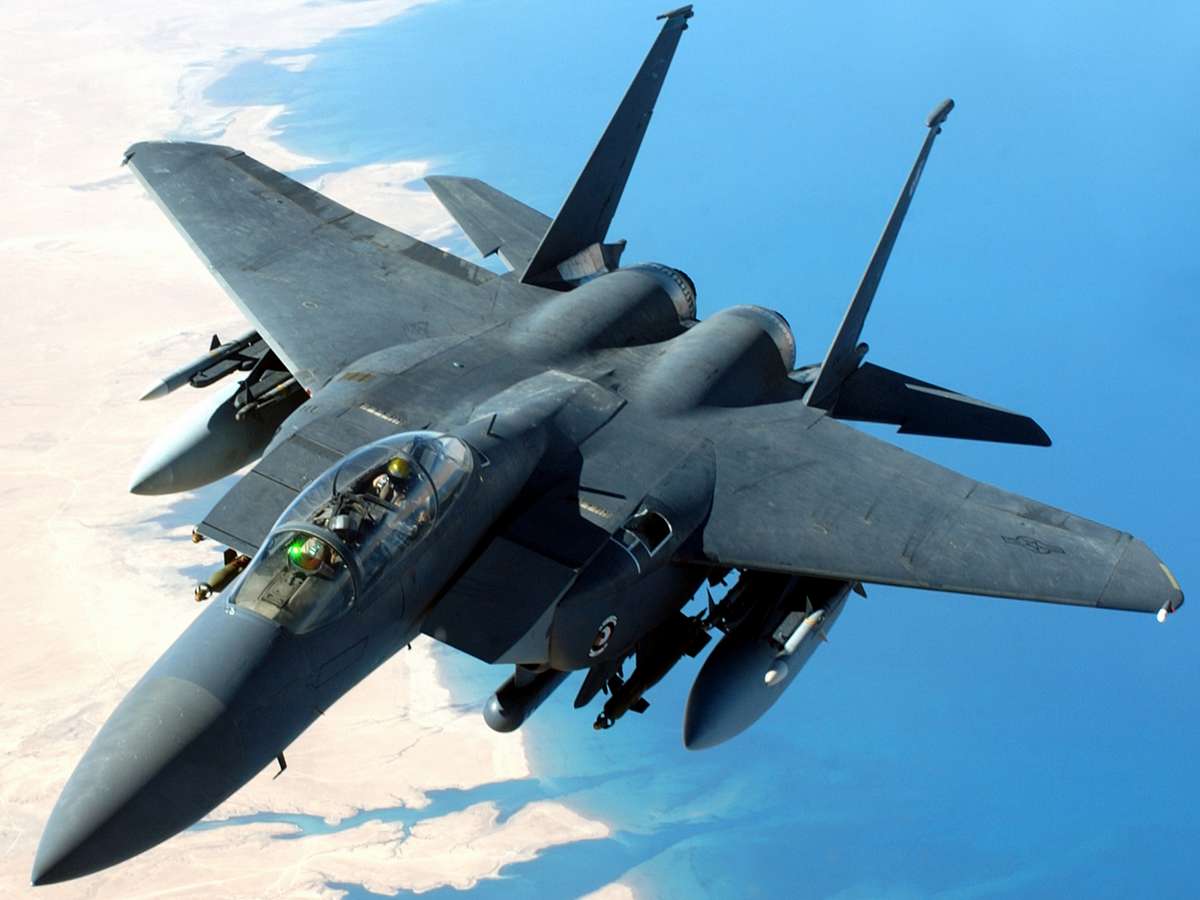
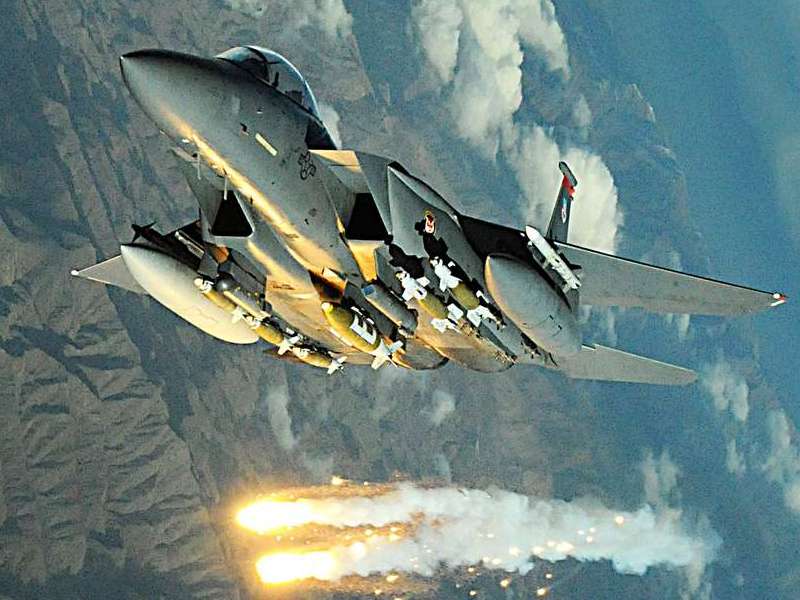 F15 Eagle
F15-D
F-15 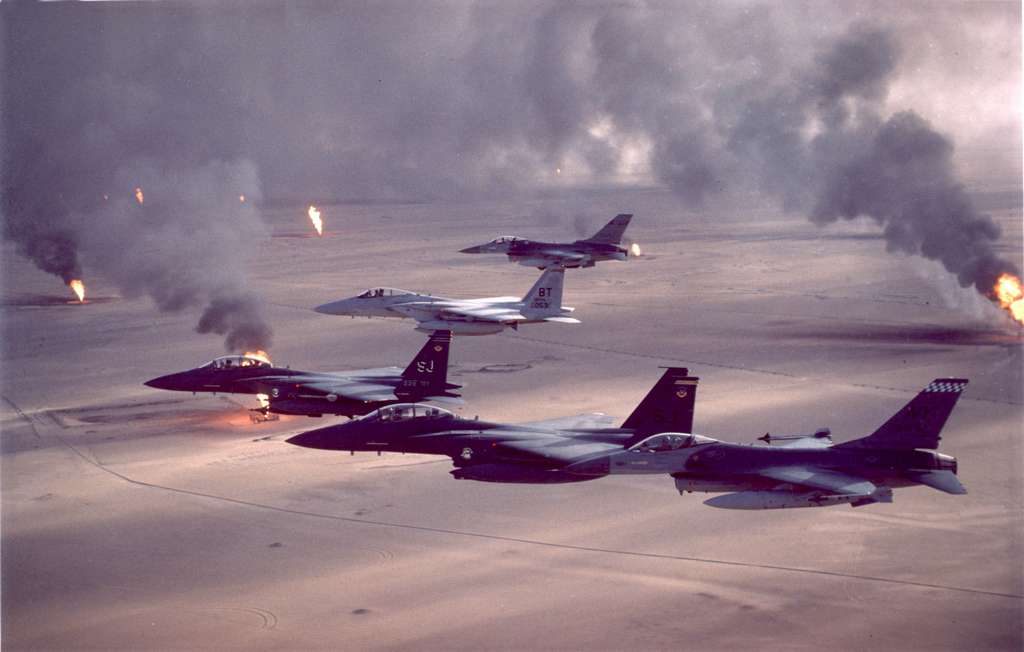
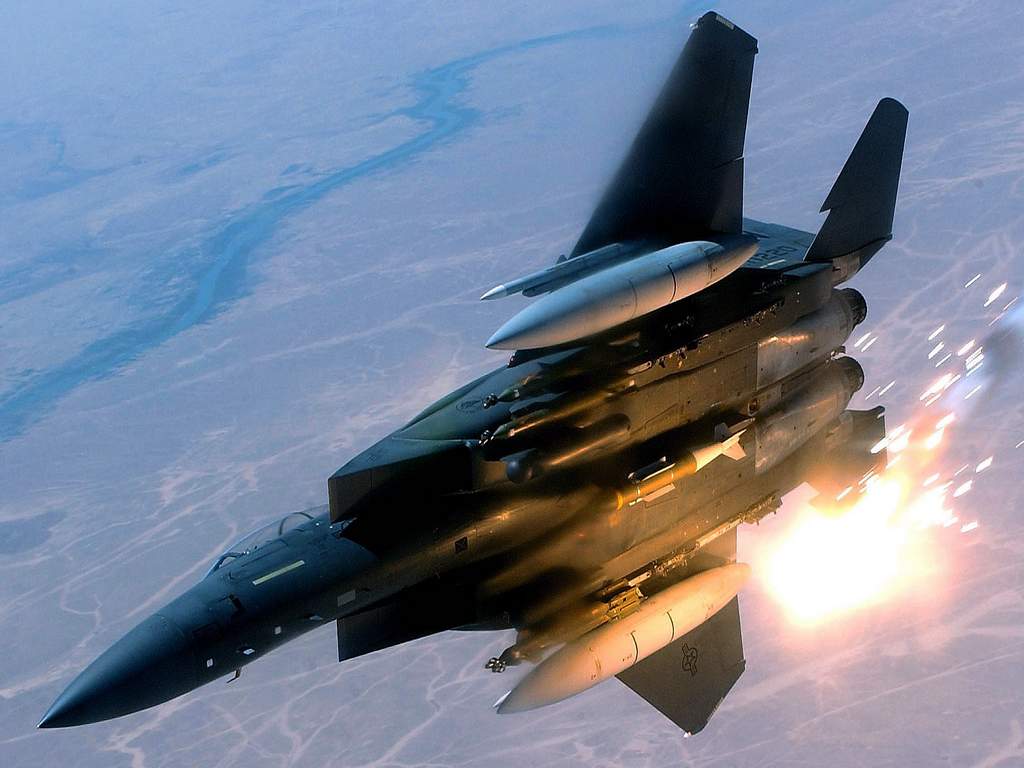
 F15 with F16s
F-15 launching
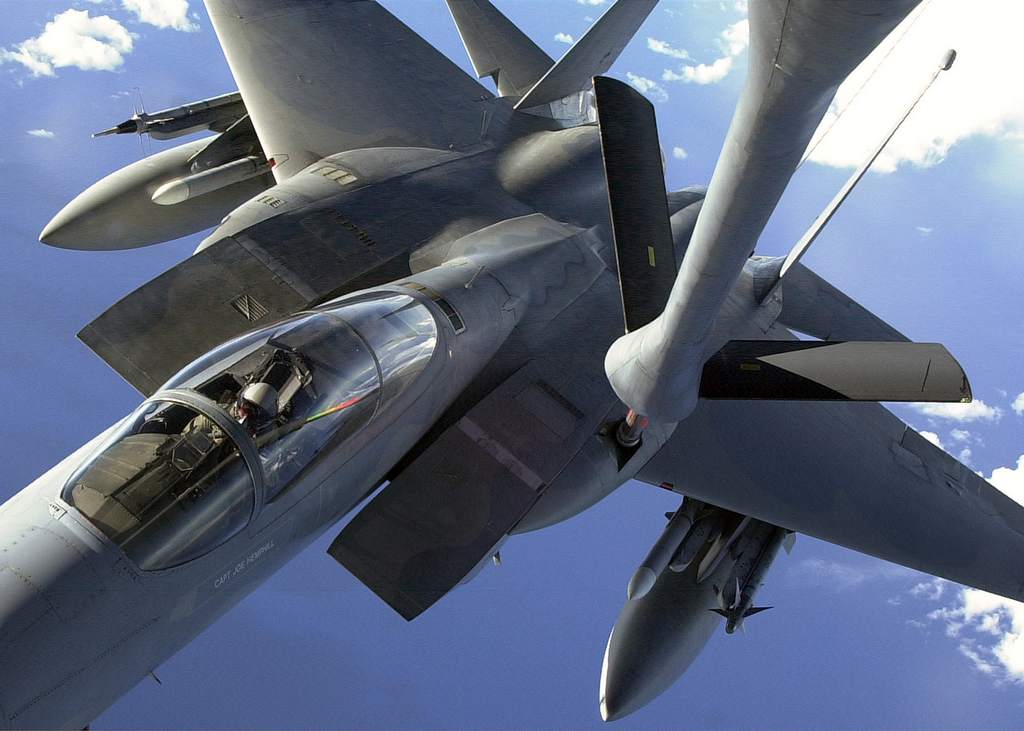
F15 fueling
The F-15 Eagle is an all-weather, extremely maneuverable, tactical fighter designed to permit the US Air Force to gain and maintain air superiority in aerial combat.
The Eagle's air superiority is achieved through maneuverability and acceleration, range, weapons and avionics. The F-15 has electronic systems and weaponry to detect, acquire, track and attack enemy aircraft while operating in friendly or enemy-controlled airspace. The weapons and flight control systems are designed so one person can safely and effectively perform air-to-air combat.
United States Air Force F-15 Eagle
The F-15's maneuverability and acceleration are achieved through high engine thrust-to-weight ratio and low wing loading. Low wing-loading (the ratio of aircraft weight to its wing area) is a vital factor in maneuverability and, combined with the high thrust-to-weight ratio, enables the aircraft to turn tightly without losing airspeed.
A F15 multimission avionics system includes a head-up display, advanced radar, inertial navigation system, flight instruments, ultrahigh frequency communications, tactical navigation system and instrument landing system. It also has an internally mounted, tactical electronic-warfare system, "identification friend or foe" system, electronic countermeasures set and a central digital computer.
The head-up display projects through a combiner, all essential flight information gathered by the integrated avionics system. This display, visible in any light condition, provides the pilot information necessary to track and destroy an enemy aircraft without having to look down at cockpit instruments.
The F-15's versatile pulse-Doppler radar system can look up at high-flying targets and down at low-flying targets without being confused by ground clutter. It can detect and track aircraft and small high-speed targets at distances beyond visual range down to close range, and at altitudes down to treetop level. The radar feeds target information into the central computer for effective weapons delivery. For close-in dogfights, the radar automatically acquires enemy aircraft, and this information is projected on the head-up display. The F-15's electronic warfare system provides both threat warning and automatic countermeasures against selected threats.
A variety of air-to-air weaponry can be carried by the F-15. An automated weapon system enables the pilot to perform aerial combat safely and effectively, using the head-up display and the avionics and weapons controls located on the engine throttles or control stick. When the pilot changes from one weapon system to another, visual guidance for the required weapon automatically appears on the head-up display.
The Eagle can be armed with combinations of four different air-to-air weapons: AIM-7F/M Sparrow missiles or AIM-120 AMRAAM advanced medium range air-to-air missiles on its lower fuselage corners, AIM-9L/M Sidewinder or AIM-120 missiles on two pylons under the wings, and an internal 20mm Gatling gun in the right wing root.
Low-drag, conformal fuel tanks were especially developed for the F15-C and F15-D models. Conformal fuel tanks can be attached to the sides of the engine air intake trunks under each wing and are designed to the same load factors and airspeed limits as the basic aircraft. Each conformal fuel tank contains about 114 cubic feet of usable space. These tanks reduce the need for in-flight refueling on global missions and increase time in the combat area. All external stations for munitions remain available with the tanks in use. AIM-7F/M Sparrow missiles, moreover, can be attached to the corners of the conformal fuel tanks.
The F-15E is a two-seat, dual-role, totally integrated fighter for all-weather, air-to-air and deep interdiction missions. The rear cockpit is upgraded to include four multi-purpose CRT displays for aircraft systems and weapons management. The digital, triple-redundant Lear Siegler flight control system permits coupled automatic terrain following, enhanced by a ring-laser gyro inertial navigation system.
For low-altitude, high-speed penetration and precision attack on tactical targets at night or in adverse weather, the F-15E carries a high-resolution APG-70 radar and low-altitude navigation and targeting infrared for night pods.
The first F-15A flight was made in July 1972, and the first flight of the two-seat F-15B (formerly TF-15A) trainer was made in July 1973. The first Eagle (F-15B) was delivered in November 1974. In January 1976, the first Eagle destined for a combat squadron was delivered.
The single-seat F-15C and two-seat F15-D models entered the Air Force inventory beginning in 1979. These new models have Production Eagle Package (PEP 2000) improvements, including 2,000 pounds (900 kilograms) of additional internal fuel, provision for carrying exterior conformal fuel tanks and increased maximum takeoff weight of up to 68,000 pounds (30,600 kilograms).
The F-15 Multistage Improvement Program was initiated in February 1983, with the first production MSIP F-15C produced in 1985. Improvements included an upgraded central computer; a Programmable Armament Control Set, allowing for advanced versions of the AIM-7, AIM-9, and AIM-120A missiles; and an expanded Tactical Electronic Warfare System that provides improvements to the ALR-56C radar warning receiver and ALQ-135 countermeasure set. The final 43 included a Hughes APG-70 radar.
F-15C, D and E models were deployed to the Persian Gulf in 1991 in support of Operation Desert Storm where they proved their superior combat capability with a confirmed 26:0 kill ratio. F-15 fighters accounted for 36 of the 39 Air Force air-to-air victories. F15-Es were operated mainly at night, hunting SCUD missile launchers and artillery sites using the LANTIRN system.
They have since been deployed to support Operation Southern Watch, the patrolling of the No-Fly Zone in Southern Iraq; Operation Provide Comfort in Turkey; in support of NATO operations in Bosnia, and recent air expeditionary force deployments.
F15 General Characteristics
Primary function: Tactical fighter
Contractor: McDonnell Douglas Corporation
Power plant: Two Pratt and Whitney F100-PW-220 or 229 turbofan engines with afterburners
Thrust: (C/D models) 23,450 pounds each engine
Wing span: 42.8 feet (13 meters)
Length: 63.8 feet (19.44 meters)
Height: 18.5 feet (5.6 meters)
Speed: 1,875 mph (Mach 2.5 plus)
Maximum takeoff weight: (C/D models) 68,000 pounds (30,844 kilograms)
Ceiling: 65,000 feet (19,812 meters)
Range: 3,450 miles (3,000 nautical miles) ferry range with conformal fuel tanks and three external fuel tanks
Crew: F-15 A/C: one; F15-B/D/E: two
Armament: One internally mounted M61 Vulcan 20mm six-barrel cannon with 940 rounds of ammunition; four AIM-9L/M Sidewinder and four AIM-7F/M Sparrow air-to-air missiles, or eight AIM-120 AMRAAMs, carried externally. F-15E can carry any combination of the above missiles, as well as GBU16/27/28 Laser Guibed Bombs (LGBs), GBU-15 EO-guided (Electro-Optically guided, i.e. TV guided) glide bombs, and rocket powered versions of these (AGM-130), laser guided AGM-65 Maverick Air-to Ground Missiles, Rockeye and CBU-49 Cluster Bombs, Fuel Air Explosives, 'Dumb bombs' )or 'Iron bombs', i.e. unguided bombs), and (although this is unlikely to be required) B61 nuclear bombs.
Unit Cost: A/B models - US$30.1 million; C/D models - US$34.3 million (flyaway costs)
Date deployed: July 1972
Inventory (USAF): Active force, 396; Reserve, 0; ANG, 126.
F-15 Variants
F-15 A
Single-seat all-weather air-superiority fighter version, 384 built 1972-79.
F-15 B
Two-seat training version, formerly designated TF-15A, 61 built 1972-79.
F-15 C
Improved single-seat all-weather air-superiority fighter version, 483 built 1979-85.
F-15 D
Two-seat training version, 92 built 1979-85.
F-15 J
Single-seat all-weather air-superiority fighter version for the Japan Air Self-Defense Force 139 built under license in Japan by Mitsubishi 1981-97, 2 built in St. Louis.
F-15 DJ
Two-seat training version for the Japan Air Self-Defence Force. 25 Built under license in Japan by Mitsubishi 1981-97, 12 built in St. Louis.
F-15 N Sea Eagle
The F15 N was a carrier-capable variant proposed in the early 1970s to the U.S. Navy as an alternative to the heavier and, at the time, considered as "riskier" technology program: F-14 Tomcat. The F-15N-PHX was another proposed naval version capable of carrying the AIM-54 Phoenix missile. These featured folding wingtips, reinforced landing gear and a stronger tail hook for shipboard operation.
F-15 Streak Eagle
One stripped and unpainted F-15A, demonstrated the fighter's acceleration – broke eight time-to-climb world records between 16 January and 1 February 1975. It was delivered to the National Museum of the United States Air Force in December 1980.
F15 S/MTD
The first F15 B was converted into a short takeoff and landing, maneuver technology demonstrator aircraft.In the late 1980s it received canard flight surfaces in addition to its usual horizontal tail, along with square thrust-vectoring nozzles. It was used as a short-takeoff/maneuver-technology (SMTD) demonstrator.
F-15 ACTIVE
The F-15 S/MTD was later converted into an advanced flight control technology research aircraft with thrust vectoring nozzles.
F-15 IFCS
The F-15 ACTIVE was then converted into an intelligent flight control systems research aircraft. F-15B 71-0290 is the oldest F-15 still flying as of January 2009.
F15 MANX
Concept name for a tailless variant of the F-15 ACTIVE, but the NASA ACTIVE experimental aircraft was never modified to be tailless.
F-15 Flight Research Facility
Two F-15A aircraft were acquired in 1976 for use by NASA's Dryden Flight Research Center for numerous experiments such as: Highly Integrated Digital Electronic Control (HiDEC), Adaptive Engine Control System (ADECS), Self-Repairing and Self-Diagnostic Flight Control System (SRFCS) and Propulsion Controlled Aircraft System (PCA). F15 was returned to the Air Force and became a static display at Langley AFB in 1983.
F15 Operators
Israel
* Israeli Air Force has operated F-15 since 1977, received under Peace Fox I, II and III. These aircraft are currently organized into two F15-A/B squadrons and one F15 C/D squadron. The first 25 F-15A/Bs were early USAF production airframes, equipping 133 Squadron. The second batch was temporarily embargoed as a result of the 1982 Lebanon War. The IAF had 42 F-15 A/C and 25 F-15 I aircraft in service as of November 2008.
Japan
* Japan Air Self-Defence Force acquired 203 F-15 J and 20 F-15 DJ from 1981, of which 2 F-15 Js and 12 F15-D were made in U.S. and the rest by Mitsubishi under license. These aircraft are currently operated by 2 Hikotai (squadron) of 2. Kokudan (Air Wing), Chitose Air Base, 1 Hikotai of 5. Kokudan, Nyutabaru AB, 1 Hikotai of 6. Kokudan, Komatsu AB, 2 Hikotais of 7. Kokudan, Hyakuri AB and 1 Hikotai of 8. Kokudan, Tsuiki AB. In June 2007, the Air Self-Defense Force decided to upgrade certain F-15 aircraft with synthetic aperture radar pods; these aircraft will replace RF-4 aircraft currently in service. Japan had 157 F-15Js in use as of November 2008.
Saudi Arabia
* Royal Saudi Air Force has operated 4 squadrons of F-15 C/D (55/19) since 1981, received under Peace Sun. They are based at Dhahran, Khamis Mushayt and Taif air bases. A stipulation in the Camp David Peace Agreement limited the number of Saudi F15 to 60, holding surplus air frames in Luke AFB for RSAF pilot training. This limitation was later abandoned. The RSAF had 139 F15 C/S Eagles in operation as of November 2008.
United States
* United States Air Force operated 630 F15 aircraft (499 in active duty and 131 in ANG, all variants) as of September 2008. The F-15 is being replaced by the newer F-22 Raptor.
- * F-15 Eagle Active Duty
- o Air Combat Command
- + F15 1st Fighter Wing - Langley AFB, Virginia
- # 71st Fighter Squadron
- + F15 33d Fighter Wing - Eglin AFB, Florida
- # 58th Fighter Squadron
- + F15 53d Wing - Eglin Air Force Base, Florida
- # 85th Test and Evaluation Squadron
- # 422d Test and Evaluation Squadron, Nellis AFB, Nevada
- + F-15 57th Wing - Nellis AFB, Nevada
- # 65th Aggressor Squadron
- + F15 366th Fighter Wing - Mountain Home AFB, Idaho
- # 390th Fighter Squadron
- o Air Education and Training Command
- + F15 325th Fighter Wing - Tyndall AFB, Florida
- # F-15 2d Fighter Squadron
- # F-15 95th Fighter Squadron
- o Pacific Air Forces
- + F15 3d Wing - Elmendorf AFB, Alaska
- # F-15 19th Fighter Squadron
- + F15 18th Wing - Kadena AB, Japan
- # 44th Fighter Squadron
- # 67th Fighter Squadron
- o United States Air Forces in Europe
- + F15 48th Fighter Wing - RAF Lakenheath, England
- # 493d Fighter Squadron
- * F-15 Air National Guard
- o Florida Air National Guard
- + F15 125th Fighter Wing - Jacksonville International Airport/Jacksonville ANGB
- # 159th Fighter Squadron
- o Hawaii Air National Guard
- + F-15 154th Wing - Hickam AFB
- # 199th Fighter Squadron
- o Louisiana Air National Guard
- + F-15 159th Fighter Wing - NAS/JRB New Orleans
- # 122d Fighter Squadron
- o Massachusetts Air National Guard
- + F15 104th Fighter Wing - Barnes Municipal Airport/Barnes ANGB
- # 131st Fighter Squadron
- o Montana Air National Guard
- + F15 120th Fighter Wing - Great Falls International Airport/Great Falls ANGB
- # 186th Fighter Squadron
- o Oregon Air National Guard
- + F15 142d Fighter Wing - Portland International Airport/Portland ANGS
- # 123d Fighter Squadron
- + F15 173d Fighter Wing - Kingsley Field
On 1 May 1983, during an Israeli Air Force training dogfight, an F15-D collided with an A-4 Skyhawk. Unknown to pilot Zivi Nedivi and his copilot, the right wing of the Eagle was sheared off roughly two feet (60 cm) from the fuselage. The F-15 entered an uncontrollable spin after the collision. Zivi decided to attempt recovery and engaged afterburner to increase speed, allowing him to regain control of the aircraft. The pilot was able to prevent stalling and maintain control because of the lift generated by the large horizontal surface area of the fuselage, the stabilators and remaining wing areas
The F-15 landed at twice the normal speed to maintain the necessary lift, and its tailhook was torn off completely during the landing. Zivi managed to bring his F-15 to a complete stop approximately 20 ft (6 m) from the end of the runway. He was later quoted as saying "(I) probably would have ejected if I knew what had happened." The fuel leak and vapors along the wing had prevented him from seeing what had happened to the wing itself.
On 19 March 1990, an F-15 from the 3rd Wing stationed at Elmendorf AFB, AK accidentally fired an AIM-9M Sidewinder missile at another F-15. The damaged aircraft was able to make an emergency landing; it was subsequently repaired and returned to service.
On 22 November 1995, during air-intercept training over the Sea of Japan, a Japanese F-15J flown by Lt. Tatsumi Higuchi was shot down by a AIM-9L Sidewinder missile accidentally fired by his wingman in an incident similar to the one that occurred on 19 March 1990. The pilot ejected safely. Both F-15Js involved were from JASDF 303rd Squadron, Komatsu AFB.
On 26 March 2006 during a low flying training exercise over the Scottish Highlands, two US Air Force F-15Cs crashed near the summit of Ben Macdui in the Cairngorms. Both, Lieutenant Colonel Kenneth John Hyvonen and Captain Kirk Jones died in the accident which would later result in a court martial for an RAF air traffic controller, who was later found not guilty.
On 2 November 2007, a 27-year-old F-15C (s/n 80-0034 of the 131st Fighter Wing) crashed during air combat maneuvering training near St. Louis, Missouri. The pilot, Maj. Stephen W. Stilwell, ejected but suffered serious injuries. The crash was the result of an in-flight breakup due to structural failure. On 3 November 2007, all non-mission critical models of the F-15 were grounded pending the outcome of the crash investigation, and on the following day, grounded non-mission critical F-15s engaged in combat missions in the Middle East. By 13 November 2007 over 1,100 were grounded worldwide after Israel, Japan and Saudi Arabia grounded their aircraft as well. F15-Es were cleared on 15 November 2007 pending aircraft passing inspections. On 8 January 2008, the USAF cleared 60 percent of the F-15A-D fleet for return to flight. On 10 January 2008, the accident review board released its report stating the 2 November crash was related to the longeron not meeting drawing specifications. The Air Force cleared all its grounded F-15A-D fighters for flight on 15 February 2008 pending inspections, reviews and any needed repairs. In March 2008, Stilwell, the injured pilot, filed a lawsuit against Boeing, the F-15's manufacturer.