Plate 027 — Battles
REF: BF-BTL-027Battle of Midway, 4-7 June 1942
Fought northeast of Midway Atoll from 4 to 7 June 1942, the battle broke Japan's carrier strength six months after Pearl Harbor. American codebreakers gave Admiral Chester Nimitz the time and place in advance, and dive bombers from Enterprise and Yorktown sank three Japanese carriers within five minutes on the morning of 4 June.

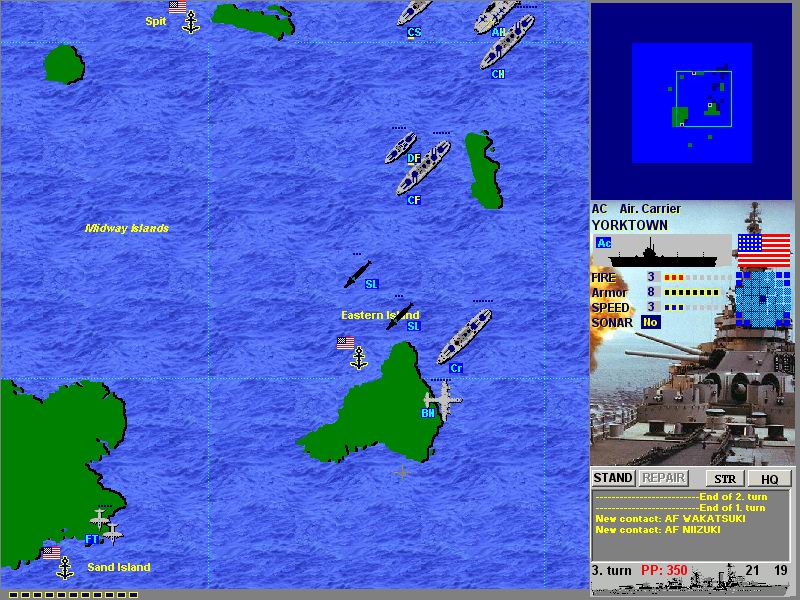
Battle of Midway: the action on the chart
3–7 June 1942. Times are local (Midway, zone description +12, i.e. UTC−12), as used in the US Navy's wartime Office of Naval Intelligence Combat Narrative. The narrative focuses on 4 June, the day of the decisive carrier air battle.
- 04:30
Nagumo launches first strike
Vice Admiral Chuichi Nagumo launched a first wave of 108 aircraft – 36 dive bombers, 36 level bombers and 36 Zero fighters – from Akagi, Kaga, Soryu and Hiryu against Midway atoll. The Japanese striking force approached from the northwest under cover of a weather front, still undetected by the atoll's search planes.
- 06:30
First bombs fall on Midway
Marine fighters had intercepted the incoming raid thirty miles out at 06:16, but were overwhelmed by escorting Zeros. The first Japanese bombs fell on Midway at 06:30, wrecking the powerhouse, the hangar and the fuel system on Eastern Island; the raid was over by about 07:15.
- 07:00
US carriers launch their strike
With the Japanese carriers estimated 155 miles away on bearing 239°, Task Force 16's Enterprise and Hornet began launching 67 dive bombers, 29 torpedo planes and 20 fighters. Yorktown's group stood by until it was clear no more than two enemy carriers had been reported.
- 09:20
Torpedo Eight attacks alone
Separated from its fighter escort, Hornet's Torpedo Squadron Eight found all four Japanese carriers and pressed home an unsupported attack. Every one of its 15 TBD Devastators was shot down; only Ensign George H. Gay survived, hiding under a floating seat cushion.
- 10:22–10:25
Dive bombers hit three carriers
Minutes after the torpedo attacks had drawn the Japanese combat air patrol down to wave-top height, dive bombers from Enterprise (VS-6/VB-6) and Yorktown (VB-3) caught Akagi, Kaga and Soryu with their flight decks crowded with fully armed, fuelled aircraft. Repeated 500- and 1,000-pound bomb hits set all three ablaze within minutes; none survived the day.
- 12:08
Hiryu's dive bombers hit Yorktown
The still-undamaged fourth carrier, Hiryu, launched a counterstrike; about eighteen Aichi dive bombers broke through Yorktown's fighters and scored three bomb hits, starting fires and stopping the ship. Her damage-control parties had her back underway within the hour.
- 13:59
Nautilus torpedoes the burning Soryu
The submarine USS Nautilus, which had been trailing the Japanese force since morning, found the abandoned Soryu still smoking but on an even keel and fired three torpedoes into her. Soryu sank that evening at 18:40.
- 14:30
Yorktown scout finds Hiryu
A Yorktown scout bomber, part of a ten-plane search launched at 11:30, reported the Hiryu's position – roughly latitude 31°15'N, longitude 179°05'W – with an escort of one carrier, two battleships, three heavy cruisers and four destroyers, enabling Enterprise and Hornet to target the last operational Japanese carrier.
- 14:41–14:45
Hiryu's torpedo bombers cripple Yorktown
A second strike from Hiryu, roughly a dozen torpedo bombers, put two torpedoes into Yorktown's port side about thirty seconds apart. The ship lost all power, listed to 26 degrees, and was abandoned at 14:55 on the belief she would soon capsize.
- 17:05
Enterprise and Hornet dive bombers hit Hiryu
Twenty-four Enterprise scout bombers (fourteen of them Yorktown's own, flying from Enterprise) attacked first, scoring six direct hits that left Hiryu a mass of flames; a Hornet squadron of sixteen arrived less than half an hour later and shifted its attack to an escorting battleship and cruiser. Hiryu was scuttled by her own escorts before dawn on 5 June.
- 13:35 (6 June)
Submarine sinks the Hammann, dooms Yorktown
While under tow toward Pearl Harbor, the damaged Yorktown was hit by two torpedoes from the Japanese submarine I-168; a third torpedo struck the destroyer Hammann, moored alongside with a salvage party aboard. Hammann broke in two and sank in three to four minutes.
- 05:01 (7 June)
Yorktown sinks
Her list increasing overnight as flooding spread through weakened bulkheads, Yorktown rolled onto her port side and sank at 05:01 on 7 June in about 3,000 fathoms of water, at approximately latitude 30°46'N, longitude 167°24'W, with her battle flags still flying.
Outcome. The United States sank all four Japanese fleet carriers committed to the operation – Akagi, Kaga, Soryu and Hiryu – for the loss of the carrier Yorktown and the destroyer Hammann. Modern accounting puts Japanese dead at roughly 3,057 (an Office of Naval Intelligence report compiled during the war estimated about 2,400) against 307 American dead, a figure confirmed in both the wartime report and later scholarship. The defeat cost Japan four of its six large fleet carriers and ended its offensive naval initiative in the Pacific.
The Battle of Midway, fought between 4 and 7 June 1942 near the tiny American base at Midway Atoll, marks the strategic high-water point of Japan's advance across the Pacific. Before the battle, Japan held general naval superiority and could usually choose where and when to attack; afterward, the two fleets were roughly equal in carrier strength, and the United States began moving onto the offensive. Six months after Pearl Harbor and one month after the Battle of the Coral Sea, the United States Navy destroyed four Japanese fleet carriers for the loss of one of its own, a result the military historian John Keegan called "the most stunning and decisive blow in the history of naval warfare".
Strategic Background: Yamamoto's Plan for a Decisive Battle
Japanese naval doctrine before the war rested on kantai kessen, the idea of a single decisive fleet battle in which a smaller but better-trained Imperial Navy would destroy an approaching American fleet the way it had crushed the Russians at Tsushima in 1905. The mid-April Doolittle Raid on Tokyo, launched from carriers the Japanese had believed were far from home waters, and the inconclusive carrier duel at Coral Sea a month later convinced Combined Fleet commander Admiral Isoroku Yamamoto that a fight for Midway Atoll, at the far western end of the Hawaiian chain, would draw the U.S. Pacific Fleet's surviving carriers into the open where his own carrier air groups could finish them.
Operation MI was elaborate rather than simple. A diversionary attack on the Aleutian Islands, Operation AL, was meant to pull American attention north, while Yamamoto's main force split into Vice Admiral Chuichi Nagumo's First Carrier Striking Force, a separate invasion convoy, and a battleship main body that trailed Nagumo by several hundred miles and could not reinforce him quickly if the plan went wrong. The scheme also rested on the assumption that only two American carriers, Enterprise and Hornet, remained in the Pacific; Yorktown, badly damaged at Coral Sea, was believed to need weeks or months in dry dock.
Codebreaking and the "AF" Deception
Yamamoto's surprise was undone by superior American communications intelligence. Navy cryptanalysts at Station HYPO in Hawaii, under Commander Joseph Rochefort, had broken enough of the Japanese JN-25 naval code to identify Midway as the target and to establish the approximate date and axis of the Japanese attack. That intelligence let Admiral Chester W. Nimitz, commander of the U.S. Pacific Fleet, position his carriers in ambush northeast of Midway before the Japanese task force arrived, rather than reacting to it.
Rochefort's team still needed to confirm that the Japanese designator "AF" referred to Midway rather than some other Pacific location. Station HYPO had Midway's garrison send an uncoded radio message reporting a fake shortage of fresh water; when Japanese intercepts shortly afterward referred to "AF" having a water shortage, HYPO had its confirmation, and Nimitz committed his three available carriers to the ambush with confidence in the target and the date.
Repairing Yorktown in Three Days
Yorktown herself was only available for the battle because of an extraordinary repair effort. She limped into Pearl Harbor Naval Shipyard on 27 May 1942, badly holed and burned from the Coral Sea action three weeks earlier; yard inspectors' first look at the damage put the repair at two weeks or more. Working around the clock, yard crews instead had her patched, watertight and fit to fight within three days, though her damaged superheater boilers were left untouched and capped her top speed below normal. She sailed on 30 May with Rear Admiral Frank Jack Fletcher's task force, reaching the ambush position northeast of Midway alongside Enterprise and Hornet in time for the battle.
Order of Battle
U.S. Pacific Fleet (Admiral Chester W. Nimitz)
| Task force | Commander | Ships / air groups |
|---|---|---|
| TF 17 – Carrier Group | Rear Admiral Frank Jack Fletcher; Capt. Elliott Buckmaster | USS Yorktown (CV): VF-3 (25 F4F-4), VB-3 (18 SBD-3), VS-3 (19 SBD-3), VT-3 (13 TBD-1) |
| TF 17 – Cruiser Group | Rear Admiral William Smith | Astoria (CA), Portland (CA) |
| TF 17 – Destroyer Squadron | Capt. Gilbert C. Hoover (ComDesRon 2) | 6 destroyers (a 7th joined 1 June) |
| TF 16 – Carrier Group | Rear Admiral Raymond A. Spruance; Capt. George D. Murray | USS Enterprise (CV): VF-6 (27 F4F-4), VB-6 and VS-6 (19 SBD-2/3 each), VT-6 (14 TBD-1) |
| TF 16 – Carrier Group | Capt. Marc A. Mitscher | USS Hornet (CV): VF-8 (27 F4F-4), VB-8 (19 SBD-2/3), VS-8 (18 SBD-2/3), VT-8 (15 TBD) |
| TF 16 – Cruiser Group | Rear Admiral Thomas C. Kinkaid (ComCruDiv 6) | New Orleans, Minneapolis, Vincennes, Northampton, Pensacola (CA), Atlanta (CL) |
| TF 16 – Destroyer Screen | Capt. Alexander D. Early (ComDesRon 1) | 9 destroyers plus an oiler group of 2 oilers and 2 destroyers |
| Submarines (Pacific) | Rear Admiral R.H. English | 12 boats in the Midway patrol group, 3 on roving assignment, 4 north of Oahu |
| Midway shore-based air | Capt. Cyril T. Simard | 32 PBY-5/5A Catalinas; VT-8 detachment (6 TBF); Marine Air Group 22: VMF-221 (20 F2A-3, 7 F4F-3), VMSB-241 (11 SB2U-3, 16 SBD-2); 7th Army Air Force detachment (4 B-26, 19 B-17) |
| Midway local defense | Capt. Simard | 6th Marine Battalion (reinforced); Motor Torpedo Squadron 1 (8 PT boats at Midway, 2 at Kure) |
| Aleutian Force (TF 8) | Rear Admiral Robert A. Theobald, in USS Nashville | Main body: 2 heavy cruisers, 3 light cruisers, DesDiv 11 (4 destroyers). Air Search Group: 3 tenders with 20 PBYs, 1 B-17. Surface Search Group: 1 gunboat, 1 oiler, 14 patrol yachts, 5 Coast Guard cutters. Air Striking Group based at Ft. Randall, Ft. Glenn/Umnak, Kodiak and Anchorage (fighters and bombers). Destroyer Striking Group: 9 destroyers. Submarine Group: 6 boats. Tanker Group: 2 oilers plus SS Comet |
Imperial Japanese Navy (Admiral Isoroku Yamamoto)
| Force | Commander | Ships / air groups |
|---|---|---|
| Main Body | Admiral Yamamoto | Yamato (flagship), Nagato, Mutsu; light carrier Hosho; screen of DesRon 3 |
| First Carrier Striking Force (1st Air Fleet) | Vice Admiral Chuichi Nagumo | Akagi (CV, flagship) and Kaga (CarDiv 1); Hiryu (CV, flagship) and Soryu (CarDiv 2, Rear Admiral Tamon Yamaguchi), each carrier with roughly 21 Zero fighters, 21 dive bombers and 21-30 torpedo bombers |
| Support and Screen (1st Air Fleet) | Rear Admiral Hiroaki Abe; Rear Admiral Susumu Kimura | Heavy cruisers Tone, Chikuma; battleships Haruna, Kirishima; light cruiser Nagara and 11 destroyers |
| Midway Invasion Force – Main Body (2nd Fleet) | Vice Admiral Nobutake Kondo | Heavy cruisers Atago (flagship), Chokai, Myoko, Haguro; battleships Kongo, Hiei; screen (DesRon 4, 7 destroyers) under Rear Admiral Shoji Nishimura |
| Invasion Force – Carrier and Transport Groups | Rear Admiral Raizo Tanaka | Light carrier Zuiho (12 Zero fighters, 12 torpedo bombers); 12 transports and 3 patrol boats carrying troops, escorted by light cruiser Jintsu and 3 destroyer divisions |
| Close Support Group | Vice Admiral Takeo Kurita | Heavy cruisers Kumano (flagship), Suzuya, Mikuma, Mogami; 2 destroyers |
| Seaplane Tender and Minesweeper Groups | Rear Admiral Ruitaro Fujita | Seaplane tenders Chitose and Kamikawa Maru (fighter and scout seaplanes); 4 minesweepers, 3 submarine chasers and supply/cargo ships |
| Northern (Aleutians) Force (5th Fleet) | Vice Admiral Moshiro Hosogaya | Second Carrier Striking Force: light carrier Ryujo and carrier Junyo (Rear Admiral Kakuji Kakuta); Attu Invasion Force and Kiska Invasion Force, each with a light-cruiser escort and troop transports |
| Advance Submarine Force (6th Fleet) | Vice Admiral Teruhisa Komatsu | SubRon 1 and SubRon 3, roughly 15 submarines based at Kwajalein, plus a separate submarine detachment supporting the Aleutians force |
| Shore-based air (11th Air Fleet) | Vice Admiral Nishizo Tsukahara | Midway Expeditionary Force air group (36 Zero fighters embarked on Nagumo's carriers) and the 24th Air Flotilla: Zero fighters, torpedo bombers and flying boats staged through Wake, Jaluit, Kwajalein and Wotje |
4 June: The Japanese Strike on Midway
At 04:30 on 4 June 1942, some 240 miles northwest of Midway, Nagumo's four carriers began launching 108 aircraft against the American base. Unknown to Nagumo, three American carriers were steaming only 215 miles to his east. Both sides launched search aircraft that morning, the Americans to pinpoint an enemy they knew was near and the Japanese as routine precaution. A Midway-based PBY Catalina sighted and reported the Japanese carrier force at about 05:30.
The same Catalina also reported the inbound Japanese strike, confirmed shortly afterward by radar, and Midway scrambled its own aircraft. Marine Fighting Squadron 221 intercepted the Japanese formation at about 06:15 but was overwhelmed by escorting A6M Zero fighters, shooting down only a handful of bombers while suffering heavy losses of its own. The Japanese strike hit Midway's two islands at 06:30; twenty minutes of bombing and strafing damaged installations on Eastern Island without disabling the airfield, and set fire to Sand Island's fuel tanks and seaplane hangar. As the Japanese aircraft turned back, strike leader Lieutenant Joichi Tomonaga radioed Nagumo that a second strike on Midway was needed to finish the job.
American Counterattacks and Nagumo's Fatal Delay
While Tomonaga's aircraft returned, Nagumo's carriers absorbed a string of uncoordinated counterattacks launched from Midway itself. Against overwhelming fighter cover these attacks achieved nothing but heavy losses: six Navy TBF Avengers and four Army Air Forces B-26 Marauders made torpedo runs shortly after 07:00, followed between 07:55 and 08:20 by Marine dive bombers and a formation of Army B-17 Flying Fortresses. The only useful result was a set of photographs of three Japanese carriers taken by the high-flying B-17s, the sole surviving images of that day's American attacks on Nagumo's force.
A tardy Japanese scout plane finally spotted the American fleet just as Midway's counterattacks were ending, reporting a carrier present. Japanese doctrine called for launching fully formed, escorted strikes rather than sending aircraft up piecemeal, so Nagumo, who had begun rearming his reserve strike aircraft with bombs for a second attack on Midway, now had to reverse that order, rearm for a strike against ships, recover his returning Midway strike aircraft and respot his flight decks, all in sequence rather than at once. He came within minutes of having enough time to launch before the American carrier aircraft arrived overhead.
The Dive-Bomber Attack, 10:22–10:26
Starting around 09:30, torpedo squadrons from USS Hornet (CV-8), USS Enterprise (CV-6) and USS Yorktown attacked in succession, and were nearly annihilated without scoring a single hit; their sacrifice nonetheless pulled the Japanese combat air patrol down to low altitude and disrupted Nagumo's launch preparations. That left the skies above the Japanese carriers clear when, beginning at 10:22 and lasting only a few minutes, dive bombers from Enterprise and Yorktown arrived almost unopposed. By 10:26, squadrons led by Lieutenant Commander Clarence Wade McClusky had put Akagi and Kaga out of action, while Yorktown's dive bombers under Lieutenant Commander Maxwell Leslie hit Soryu; all three carriers, their decks crowded with fully armed and fuelled aircraft for the abandoned second strike, were ablaze within minutes.
Hiryu's Counterstrikes and the Loss of Yorktown
Of Nagumo's four carriers, only Hiryu remained operational, and Rear Admiral Tamon Yamaguchi used her aggressively rather than withdrawing. At 10:54 she launched eighteen dive bombers with a Zero escort; only seven survived Yorktown's fighters and flak long enough to attack, but three direct hits set her ablaze, and she lay dead in the water by 14:40. Damage-control teams worked fast enough that her engineers had her making twenty knots again within the hour, and Captain Elliott Buckmaster ran up a fresh, oversized battle ensign to signal she was still in the fight.
Believing Yorktown sunk, Yamaguchi launched a second wave of ten torpedo bombers at 13:30. Finding her instead patched up and underway, the Japanese pilots attacked anyway; two torpedoes struck her port side within minutes of each other around 16:20, jamming her rudder and flooding her engineering spaces. As the list reached 26 degrees, Buckmaster ordered the crew to abandon ship. Search planes from Enterprise found Hiryu at 16:45, and dive bombers put four bombs into her forward flight deck and hangar at 16:56, setting fires no damage-control party could put out. Yamaguchi and Hiryu's captain, Kaku, chose to stay aboard when a Japanese destroyer scuttled her before dawn on 5 June; Akagi, equally beyond saving, was scuttled by four destroyers at 05:20 the same morning, having cost only 267 lives, the lightest toll of the four Japanese carriers lost. Deprived of carrier air cover and after hours of indecision, Yamamoto called off the Midway invasion and ordered a general retirement.
Pursuit, 5–7 June
Withdrawing overnight, the heavy cruisers Mikuma and Mogami of Vice Admiral Takeo Kurita's Close Support Group turned hard to avoid a reported American submarine and collided with each other; Mogami's bow crushed into Mikuma's port side, and Mikuma's ruptured fuel tanks left an oil slick that guided American search planes to her the next day. On 6 June, dive bombers from Hornet and Enterprise found the crippled pair; Hornet's aircraft hit Mogami twice, and Enterprise's put two bombs into Mikuma, one of which touched off her own stored torpedoes in a chain of explosions that tore the ship apart. She rolled over and sank that evening, the first Japanese cruiser lost in the Pacific War; escorting destroyers pulled 239 survivors from the water before withdrawing. Mogami, her bow crushed and her deck bombed, nonetheless made it back to Japan under her own power for rebuilding.
Yorktown, still afloat after being abandoned on 4 June, was reboarded on 6 June by a salvage party under Commander Clarence Kiefer while the fleet tug USS Vireo took her under tow. That afternoon the Japanese submarine I-168 slipped through the destroyer screen and fired four torpedoes: one broke the destroyer USS Hammann in two, killing 80 of her crew as she sank in about four minutes, and two more struck Yorktown. She stayed afloat through the night, but her list grew steadily, and at 07:01 on 7 June she rolled over and sank stern-first, the second American fleet carrier lost in the war after Lexington at Coral Sea.
Casualties and Losses
| Side | Carriers sunk | Other ships sunk | Aircraft lost | Personnel killed |
|---|---|---|---|---|
| Japan | 4 (Akagi, Kaga, Soryu, Hiryu) | 1 heavy cruiser (Mikuma) | ~248 (estimates range up to around 322 depending on how operational losses are counted) | 3,057 |
| United States | 1 (Yorktown) | 1 destroyer (Hammann) | ~150 | ~307 |
By the time the battle ended, the four sunk Japanese carriers accounted for most of the 3,057 Japanese dead: Akagi lost 267 men, Kaga 811, Hiryu 392 and Soryu 711, a combined 2,181. The heavy cruisers Mikuma, sunk, and Mogami, badly damaged in the same collision-and-air-attack sequence during the retreat, together lost about 792 men. The destroyers Arashio and Asashio, hit while escorting the two cruisers, lost 35 and 21 men respectively, and further losses were suffered aboard the cruisers Chikuma and Tone (floatplanes lost) and the destroyers Tanikaze, Arashi and Kazagumo and the oiler Akebono Maru. On the American side, most of the 307 dead were lost with Yorktown or, in the last hours of the battle, aboard Hammann, whose 80 casualties came in the roughly four minutes it took the destroyer to sink.
Why Japan Lost
Several structural weaknesses, not just bad luck, decided the battle. Japanese reconnaissance was thin from the outset: a submarine picket line meant to detect any American sortie from Pearl Harbor reached its stations late, so Fletcher's and Spruance's task forces crossed undetected, and a planned long-range flying-boat reconnaissance of Pearl Harbor, Operation K, failed outright when its refuelling point at French Frigate Shoals turned out to be occupied by American ships. Nagumo went into the battle with too few search aircraft assigned to cover his own flanks.
Doctrine compounded the problem. Japanese carrier strikes were meant to go out fully formed and escorted rather than in small waves, which is why Nagumo could not simply launch whatever mix of bombs and torpedoes he had loaded the moment an American carrier was reported; rearming, respotting and recovering the Midway strike all had to happen in sequence, and that sequence consumed the hour that decided the battle. His four carriers also steamed close together rather than dispersed, so McClusky's and Leslie's dive bombers found three of them in the same patch of ocean within the same few minutes.
Japanese carrier construction and firefighting practice turned that hour into a catastrophe. Aviation fuel lines ran exposed through the hangar decks, armed and fuelled aircraft for the abandoned second strike crowded the flight and hangar decks, and damage-control parties had no firefighting foam, only water and hand-hauled hoses. American carriers, hit just as hard in places, had better compartmentalization, foam systems and trained repair parties, which is why Yorktown's engineers could restore twenty knots within an hour of the attack that eventually sank her.
Secrecy and the Cost of Defeat
On 10 June, the Japanese Navy gave the military liaison conference only an incomplete account of the battle's results. Nagumo's full report, submitted on 15 June, was restricted to the highest levels of the Navy and government and guarded closely for the rest of the war; it noted his own staff's mistaken confidence that "the enemy is not aware of our plans", when in fact Allied codebreaking had compromised the operation from the start. The Japanese public was told of a great victory, and only Emperor Hirohito and the most senior naval officers were informed accurately of the carrier and pilot losses, so much so that the Imperial Japanese Army continued for a time to believe the fleet remained in good condition.
When the fleet returned to Hashirajima on 14 June, the wounded were placed in isolation as "secret patients", cut off from their own families to keep the scale of the defeat hidden, while surviving officers and men were quietly dispersed to other units, many of them later killed in the fighting in the South Pacific. No flag officer or staff member of the Combined Fleet was penalised; Nagumo himself was later given command of the rebuilt carrier force.
The Japanese Navy drew some operational lessons from Midway, refuelling and rearming aircraft on the flight deck rather than in the hangars and adopting stricter fuel-line draining procedures; new carriers under construction were redesigned with fewer flight-deck elevators and better firefighting equipment, and more crew were trained in damage control. The losses later in the war of the carriers Shokaku, Hiyo and especially Taiho suggest these fixes only went so far. A shortage of experienced aircrew proved just as damaging: replacement pilots were pushed through abbreviated training to meet the fleet's short-term needs, producing a marked decline in quality even as the surviving Midway veterans were worked harder rather than rotated to rest, and Japanese naval air groups deteriorated in relative quality for the rest of the war while their American counterparts kept improving.
Consequences: The Road to Guadalcanal
Midway did not end the Pacific war, but it ended Japan's ability to dictate its course. Four of the Imperial Navy's finest fleet carriers were gone in a single morning, along with trained aircrew who could not be replaced quickly. American shipyards, meanwhile, already had the first of what would grow into twenty-four Essex-class fleet carriers under construction; the lead ship, USS Essex, was commissioned that December, and by mid-1943 the class was reaching the Pacific in numbers Japan had no way to match.
The shift in initiative showed within weeks. American forces landed on Guadalcanal in the southern Solomon Islands on 7 August 1942, opening a six-month campaign that turned into a grinding contest of attrition on land, at sea and in the air, one that Japan, its carrier strength broken at Midway, could no longer expect to win outright.

Midway followed directly from the carrier duel at the Battle of the Coral Sea a month earlier, and the detailed unit-by-unit order of battle is also catalogued separately on the Midway order of battle reference. The wider Pacific campaign continued through the Guadalcanal campaign, the Battle of the Philippine Sea, and the amphibious assaults on Iwo Jima and Okinawa. Yamamoto's earlier surprise attack on the U.S. fleet is covered on the Pearl Harbor overview, and the carriers and aircraft that fought at Midway are detailed on the list of aircraft carriers and the US Navy WW2 fighters page.
Frequently asked questions
How many aircraft carriers did Japan lose at the Battle of Midway?
Japan lost all four fleet carriers committed to the operation: Akagi and Kaga, sunk by dive bombers from USS Enterprise around 10:26 on 4 June 1942, and Soryu and Hiryu, hit within the same hour and that evening respectively. Akagi and Hiryu were later scuttled by their own escorts rather than left to sink on their own. Roughly 2,181 men died aboard the four ships.
Why is Midway considered the turning point of the Pacific War?
Before Midway, Japan held general naval superiority and chose where and when to fight; after it, the two carrier fleets were roughly equal, and Japan could not quickly replace either its lost carriers or its trained aircrew. American shipbuilding, including the new Essex-class carriers entering service from December 1942, widened that gap through the rest of the war, letting the United States move onto the offensive at Guadalcanal two months later.
How did the United States know Japan was going to attack Midway?
Navy cryptanalysts at Station HYPO in Hawaii, led by Commander Joseph Rochefort, had broken enough of the Japanese JN-25 naval code to identify an attack on a target coded "AF". To confirm it meant Midway, Midway's garrison broadcast an uncoded false report of a water shortage; when Japanese radio traffic soon repeated the same detail about "AF", Admiral Nimitz had his confirmation and positioned his three carriers in ambush before the Japanese fleet arrived.
What happened to USS Yorktown after the battle?
Hit by two waves of aircraft from the Japanese carrier Hiryu on the afternoon of 4 June, Yorktown was abandoned once her list reached 26 degrees. A salvage party reboarded her on 6 June and had her under tow when the Japanese submarine I-168 torpedoed both her and the escorting destroyer USS Hammann, which sank in about four minutes with 80 dead. Yorktown herself rolled over and sank on the morning of 7 June.
How long did Yorktown's Coral Sea repairs actually take?
Yorktown reached Pearl Harbor Naval Shipyard on 27 May 1942 with damage that inspectors first estimated would take two weeks or more to fix. Round-the-clock work by yard crews had her seaworthy and combat-ready in three days, though her damaged superheater boilers were left unrepaired and capped her top speed. She sailed on 30 May, in time to reach the ambush position for Midway.
Who commanded the American and Japanese forces at Midway?
Admiral Chester W. Nimitz commanded the U.S. Pacific Fleet from Pearl Harbor, with the carrier task forces led at sea by Rear Admiral Frank Jack Fletcher (Yorktown, overall tactical command) and Rear Admiral Raymond A. Spruance (Enterprise and Hornet). On the Japanese side, Admiral Isoroku Yamamoto commanded the Combined Fleet, with Vice Admiral Chuichi Nagumo leading the First Carrier Striking Force that attacked Midway.
What was Operation AL and how did it relate to Midway?
Operation AL was Japan's simultaneous invasion of Attu and Kiska in the Aleutian Islands, intended to divert American attention and forces away from Midway and to satisfy the Imperial Army's wish for a role in the operation. It began a day before the main attack on Midway because of a one-day delay in Nagumo's sailing, and it drew off two Japanese carriers, Ryujo and Junyo, that might otherwise have reinforced Nagumo's strike force.