Plate 007 — Wargames
REF: BF-GME-007Battleship Game Variants Compared
From the fixed 10x10 grid of classic Battleship and its Salvo variant to the 96x96 maps of BattleFleet 1939 and Pacific War, this table compares board size, fleet composition and game modes across the naval titles covered on this site.
Battleship as an idea spans everything from a two-minute pencil-and-paper guessing game to a full turn-based naval campaign. The table below lines up the classic board game, its Salvo variant, and the computer titles described elsewhere on this site, comparing board size, fleet composition, movement and game modes.

| Title | Grid or map | Fleet or units | Movement | Modes |
|---|---|---|---|---|
| Classic Battleship | 10x10 grid | 5 fixed ships (lengths 2-5) | None | Single elimination |
| Salvo variant | 10x10 grid | Same 5 ships | None | Multiple simultaneous shots per turn |
| Battleship Game WW2 | Map with radar-limited visibility | 50+ unit types (45 enumerated) | Ships, subs and aircraft move | Campaign, missions, Death-Match, Free Hunt |
| BattleFleet 1939 | Up to 96x96 squares | 45 ship/sub/plane types | Full movement, in-mission production | 4 campaigns, standalone missions, death-matches, Free Hunt |
| BattleFleet: Pacific War | Up to 96x96 squares | 50+ purchasable unit types | Full movement, in-mission production | Pacific-themed missions, Death-Match, Free Hunt |
| Battleship PC Game | Grid-based board | 4 ships, per its own feature description | None | 48 single-player missions |
| Battleship Chess Game | Chess-style board | 7 warship types | Chess-like piece movement | Five chapters of escalating battles |
| Armada Battleship Game | Grid-based board (Java) | Standard-style fleet | None | Single elimination, random or manual placement |
| Battleships General Quarters II | Two 10x10-style grids (offensive and defensive) | 5 ships: Minesweeper (2), Submarine (3), Frigate (3), Battleship (4), Aircraft Carrier (5) | None | Single elimination |
| SeaWar: The Battleship Game | 3D grid-based arena | Standard-style fleet | None | Single elimination |
| SeaWar 2: The Battleship Game | 3D grid across four battle arenas | Arena-specific fleets and weapons | None | Single elimination, head-to-head on one computer, LAN/Internet multiplayer |
Board Size and Maps


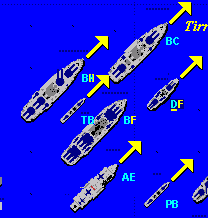
Every grid-only title on this list, from the classic board game through Battleship PC Game, Armada, General Quarters II and the SeaWar pair, keeps roughly the same 10x10 footprint the 1943 Milton Bradley pad established, whether rendered as flat squares or, in SeaWar's case, as a 3D arena viewed from above. BattleFleet 1939 and BattleFleet: Pacific War abandon that fixed footprint entirely: their maps scale up to 96x96 squares and include land, islands, and major and minor ports, and visibility is no longer total across the board but limited to each unit's own radar range.
Fleet Composition Differences
The classic five-ship fleet, Carrier down to Destroyer, is not universal even among the titles that kept a static grid. Battleship PC Game's own feature description calls for deploying four ships rather than five. Battleships General Quarters II keeps five ships but changes the roster to a Minesweeper, Submarine, Frigate, Battleship and Aircraft Carrier. Battleship Chess Game replaces grid guessing with seven warship types moved across a chessboard-style layout over five chapters. At the other end of the scale, BattleFleet 1939's enumerated roster runs to 45 ship, submarine and aircraft types, and Pacific War's feature list advertises more than fifty, both purchasable during play rather than fixed at the start.


Game Modes: From Single Elimination to Campaigns
Most of the titles above keep the board game's original win condition: sink the opponent's fleet first, whether over a single match, Battleship PC Game's 48 missions, or Battleship Chess Game's five chapters. Salvo changes the pacing rather than the objective, letting each side fire several shots per turn instead of one. BattleFleet 1939 and Pacific War go further still, wrapping mission-based objectives such as conquering ports or escorting convoys into scripted campaigns organized by playable navy, on top of standalone missions, Death-Match battles and open-ended Free Hunt scenarios. SeaWar 2 added a different kind of expansion, letting two players face off on a single computer in a head-to-head mode or connect over a LAN or the Internet.
The two BattleFleet titles also differ from the rest of the list in how a fleet grows during play. Rather than starting a mission fully equipped, a player earns Production Points and spends them on new ships, submarines and aircraft as the mission unfolds, a mechanic none of the fixed-fleet titles above offer.
Play Battleship against the computer
Five ships a side on a 10 × 10 chart: carrier (5 squares), battleship (4), cruiser (3), submarine (3) and destroyer (2). Each salvo is answered by one from the computer, which hunts on a checkerboard pattern and closes in along the line once it has two hits.
Own fleet
Enemy waters
The game loads when this section scrolls into view; it needs JavaScript.