Plate 011 — Wargames
REF: BF-GME-011BattleFleet 1939: WW2 Naval Strategy Game
BattleFleet 1939 extended the classic Battleship game into a turn-based WW2 naval strategy title with four historical campaigns, a 45-type unit roster, and a 112-rank career ladder across four navies.
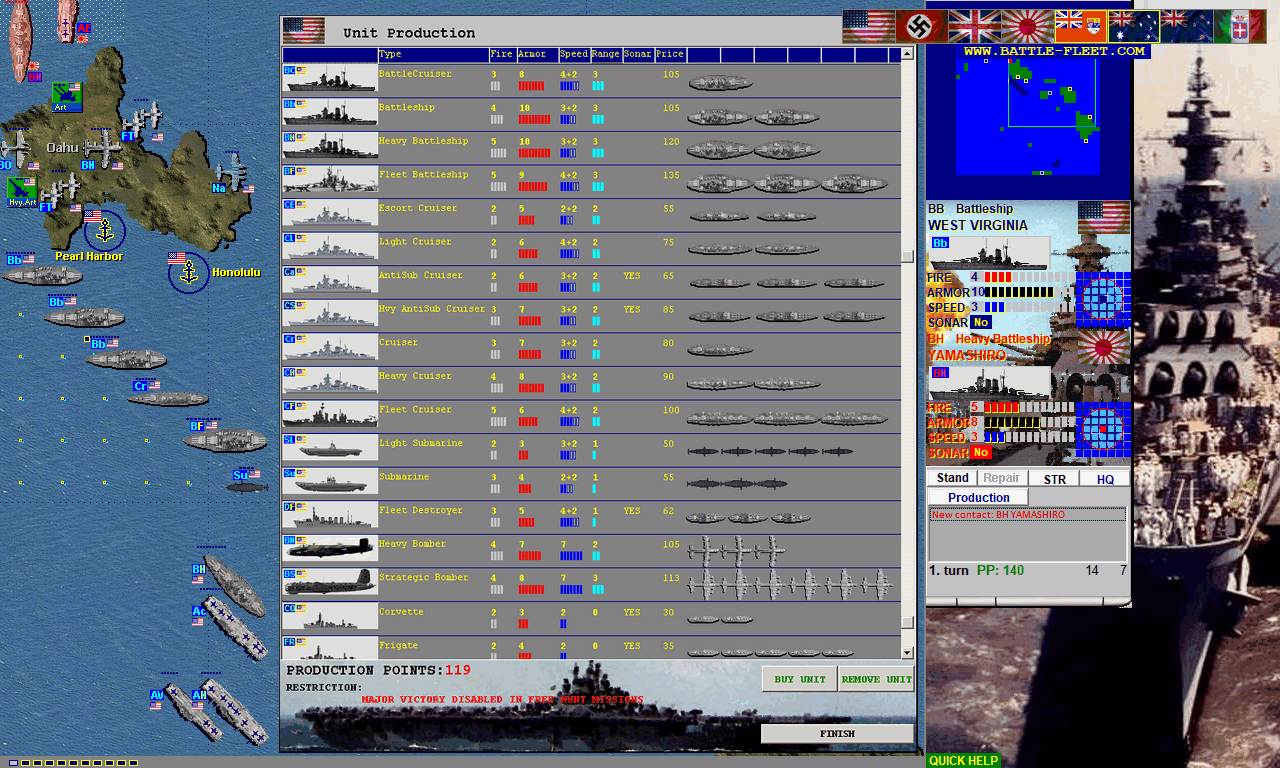
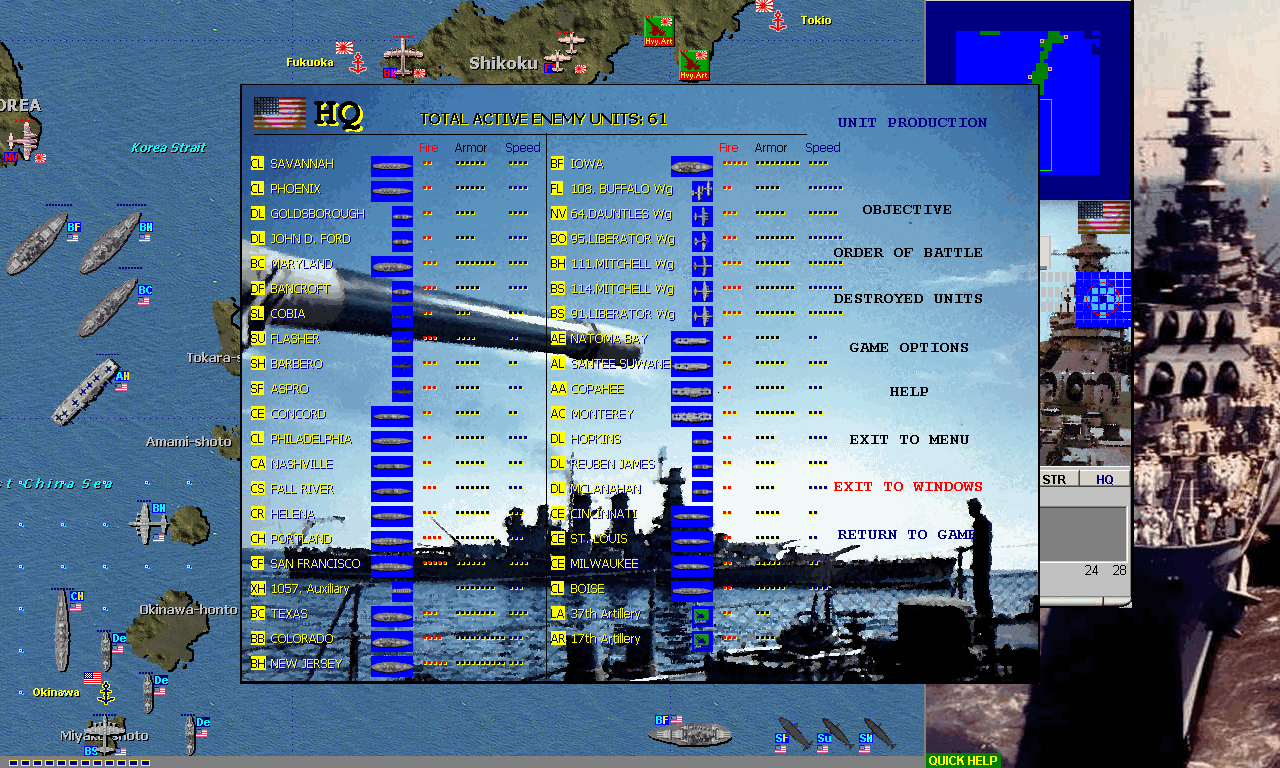
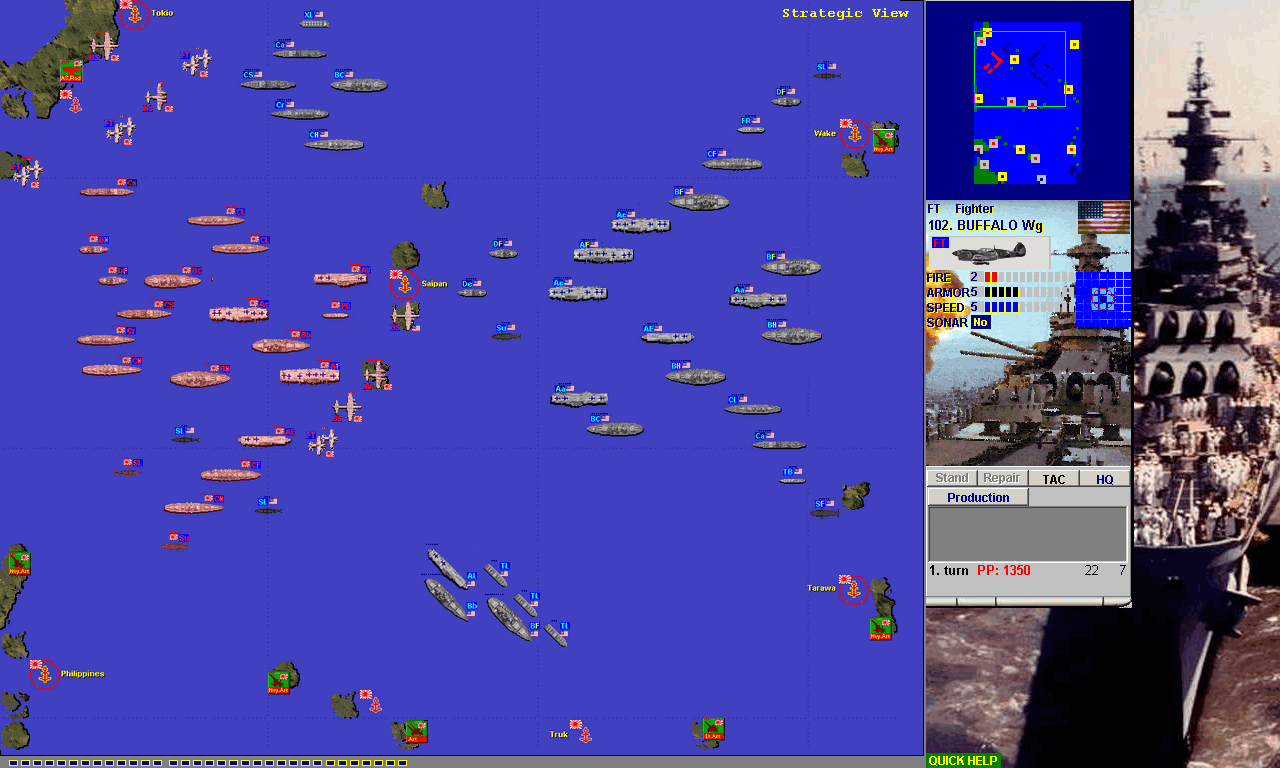
BattleFleet 1939 was a turn-based World War 2 naval strategy game built as an extension of the classic Battleship game: rather than firing at a single fixed grid, players moved fleets of ships, submarines and aircraft across combat maps that could measure up to 96x96 squares. A playable Battleship grid on this page demonstrates the base concept the game extended; BattleFleet 1939 kept the hidden-fleet premise but added movement, unit production and a set of scripted campaigns, missions and death-matches built around World War 2 naval warfare. A later title in the same series, BattleFleet: Pacific War, applied the same engine to the naval war against Japan.


Campaigns
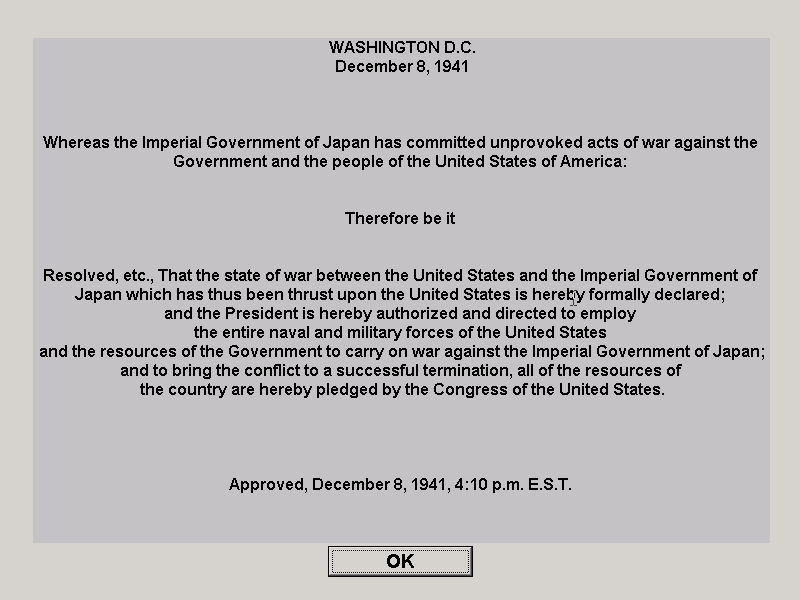
BattleFleet 1939 organized its scripted content into four campaigns, one for each of the war's main combatant navies:
| Campaign | Missions |
|---|---|
| US Navy Operations | 15 |
| Kriegsmarine | 10 |
| British Royal Navy | 10 |
| Imperial Japan Navy | 9 |
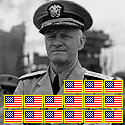
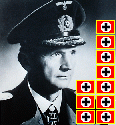
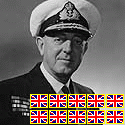
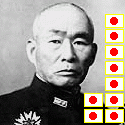
Together the four campaigns totalled 44 scripted missions, on top of a separate pool of standalone missions the game's own feature list put at fifty. Campaign play required at least a minor victory in every mission to progress; a player working through a full campaign would eventually be credited with every rank on that navy's ladder, while a single standalone mission only exposed its lower grades.
Missions, Death-Matches and Free Hunt Scenarios
Beyond the four scripted campaigns, BattleFleet 1939 shipped with a broader mission library. Its feature list advertised 50 Combat Strategy Missions and 23 Death-Match Strategy Scenarios, plus a set of Free Hunt scenarios: a sandbox-style variant of the death-match format built around a single named theatre rather than a scripted objective.


Death-matches carried names tied to specific fleets, among them Kriegsmarine I and II, Royal Navy I, US Navy I, and one named for Admiral Yamamoto, styled "Jamamoto" in the mission list, while Free Hunt scenarios covered Italy, Malaya, Germany, Japan, the United Kingdom and submarine-only engagements. Each of the game's standalone missions was assigned one of four mission types, Conquer, Defend, Escort or Destroy Class, listed here in full:
| Mission | Type |
|---|---|
| Normandy | Destroy Class |
| Iron Sea | Destroy Class |
| Tokio Express | Destroy Class |
| Conquer of Italy | Conquer |
| Lamansh | Conquer |
| Atlantic 1941 | Conquer |
| Atlantic 1943 | Conquer |
| Sink Cruisers | Destroy Class |
| Skagerrak | Conquer |
| Bismarck | Destroy Class |
| Drang Nach Ost | Conquer |
| Mykonos | Conquer |
| Norway Ports | Conquer |
| Alert | Destroy Class |
| Invasion | Destroy Class |
| Ciano's Defense (Italy 1943) | Defend |
| Azores Transport | Escort |
| Convoy PK30 | Destroy Class |
| Grossadmiral | Conquer |
| Long Convoy | Escort |
| Swordfish Hunt | Destroy Class |
| Leutnant zur See | Destroy Class |
| Air Supremacy | Defend |
| Wolf Pack | Destroy Class |
| Frigate Hunt | Destroy Class |
| Norway Convoy | Escort |
| Heavy Cruiser | Destroy Class |
| Corvettes | Destroy Class |
| U-Boats | Destroy Class |
| Battleships | Destroy Class |
| Atlantic Island | Conquer |
| Destroy Royal Air Force | Destroy Class |
| Santa Cruz | Destroy Class |
| Sir John Tovey | Destroy Class |
| Torpedo Boats | Destroy Class |
| Java | Conquer |
| Defense | Defend |
| Devil Island | Conquer |
| Orange Ports | Conquer |
| San Bernardino | Conquer |
| Pacific Race | Conquer |
| Emperor Defense | Defend |
| South Pacific | Defend |
| Dragoon Carriers | Destroy Class |
| Prince of Wales | Destroy Class |
| Heavy Duty | Conquer |
Strategic Objectives and Unit Production
Every BattleFleet 1939 mission was built around one of four strategic objectives:
- Conquer all enemy major ports
- Defend friendly ports
- Destroy enemy ships
- Secure a convoy to a friendly port
Rather than starting each mission with a fixed fleet, a player could produce and deploy new units of any available class during the mission itself, and all units carried historic WW2 names rather than generic labels.
Units
The game's own materials describe its unit roster under two different totals: feature lists advertise fifty unit types available for production, while the enumerated roster, headed "45 Ship / Sub / Plane Types," lists exactly forty-five. That list breaks down into six aircraft carrier variants (fleet, heavy, fast, medium, light and escort) plus an anti-submarine carrier and a battlecruiser, six cruiser variants, three battleship weights, three auxiliary-ship classes, a fleet submarine with an anti-submarine naval unit and a frigate, three bomber types, three naval-aircraft and fighter types, three submarine weights, three destroyer weights, a corvette with a patrol boat and torpedo boat, three transport weights, and three port-artillery weights.
 Fleet Aircraft Carrier, Heavy Aircraft Carrier, Fast Aircraft Carrier
 Medium Aircraft Carrier, Light Aircraft Carrier, Escort Aircraft Carrier
 AntiSub Aircraft Carrier, Battlecruiser, AntiSub Cruiser
 Fleet Cruiser, Heavy Cruiser, Hvy AntiSub Cruiser
 Medium Cruiser, Light Cruiser, Escort Cruiser
 Fleet Battleship, Heavy Battleship, Medium Battleship
 Heavy Auxiliary, Medium Auxiliary, Light Auxiliary
 Fleet Submarine, AntiSub Naval, Frigate
 Strategic Bomber, Heavy Bomber, Bomber
 Long Range Naval, Naval, Fighter
 Heavy Submarine, Medium Submarine, Light Submarine
 Heavy Destroyer, Medium Destroyer, Light Destroyer
 Corvette, Patrol Boat, Torpedo Boat
 Heavy Transport, Medium Transport, Light Transport
 Heavy Port Artillery, Medium Port Artillery, Light Port Artillery
Ranks
BattleFleet 1939 tracked a player's progress through 112 WW2-styled ranks: ten non-commissioned grades and eighteen commissioned grades for each of the four playable navies. Named ranks mixed historical fleet commanders with generic rank titles; a player working through the US Navy path, for instance, could be credited with the names of Chester Nimitz, Ernest King, William Halsey, Raymond Spruance and Thomas Kinkaid at its senior grades, above the standard Fleet Admiral, Admiral, Vice Admiral and Rear Admiral titles down to Recruit. The Kriegsmarine, Royal Navy and Imperial Japan Navy campaigns used the same 28-grade structure with their own historical names and native-language rank titles, from Grossadmiral, Admiral of the Fleet and Joto-Thai down to Matrose, Junior Seaman and Nitto-Suihei respectively. A single standalone mission only exposed the lower ranks, from Lieutenant (Junior) down to Recruit, while a full campaign covered a navy's complete rank ladder.
System Requirements
| Requirement | Detail |
|---|---|
| Operating system | Windows XP, 7, 8 or 10 |
| Hardware | Minimum standard PC configuration of the period |
Play Battleship against the computer
Five ships a side on a 10 × 10 chart: carrier (5 squares), battleship (4), cruiser (3), submarine (3) and destroyer (2). Each salvo is answered by one from the computer, which hunts on a checkerboard pattern and closes in along the line once it has two hits.
Own fleet
Enemy waters
The game loads when this section scrolls into view; it needs JavaScript.