Plate 003 — Submarines
REF: BF-SUB-003List of Torpedoes: Naval Torpedo Types by Nation
From Robert Whitehead's 1866 compressed-air torpedo to today's wire-guided and supercavitating weapons, this is a reference list of torpedo types by nation, with year, diameter, launch platform, propulsion and guidance.
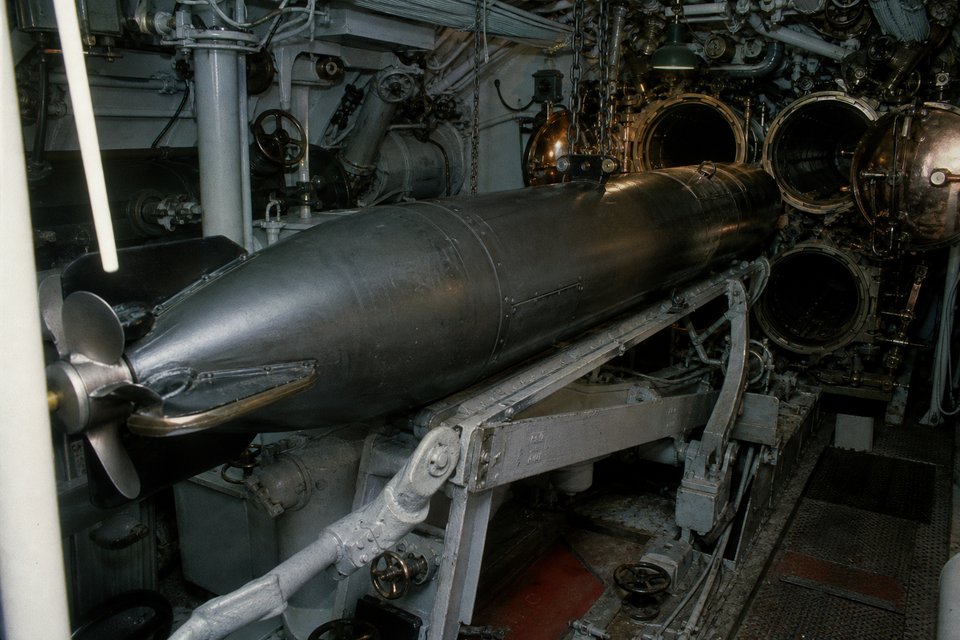
The modern naval torpedo traces back to Robert Whitehead's 1866 design for the Austrian navy, the first self-propelled underwater weapon capable of running a straight course under its own power rather than being towed or fired as a spar charge. Whitehead's original ran on compressed air, a technology that dominated torpedo propulsion for the next four decades and limited both range and speed. The next major leap was the "wet-heater" engine, introduced in the early 1900s, which burned fuel inside the compressed-air flow to heat and expand it before it reached the engine, a straightforward trick that roughly doubled range and speed over cold compressed air alone, and remained the standard propulsion for most navies through the Second World War.
Imperial Japan pushed the wet-heater principle furthest with its oxygen-enriched Type 93 and Type 95 torpedoes of the 1930s, which used pure oxygen instead of compressed air to eliminate the telltale bubble trail and add substantially more range and speed than any Western equivalent, the weapon Allied sailors came to know as the "Long Lance." Electric propulsion, pioneered by Germany's G7e torpedo, offered no wake at all and became the standard choice for submarine-launched weapons after the war, trading some speed for stealth and simplicity. The postwar decades then layered on guidance: acoustic homing heads that steered the torpedo toward a target's propeller noise, wire guidance that let a firing submarine correct a torpedo's course in real time over a thin trailing cable, and, most recently, supercavitating designs like Russia's VA-111 Shkval, which wrap the torpedo in a bubble of gas to cut water drag and reach speeds far beyond anything a conventional torpedo can match.
How Torpedoes Are Classified
Torpedoes are launched from a trainable deck-mounted tube (common on destroyers), from fixed tubes above or below the waterline on cruisers, battleships and submarines, from low-flying aircraft or helicopters, and, in a handful of early cases such as the U.S. Mark 13 fired from World War II PT boats, from gravity-reliant deck-mounted "drop collars." Diameter is the most common way of classifying a torpedo, since it is the single factor that determines which tubes and launchers a given weapon fits, in the same way caliber classifies a gun. Many navies field two weight classes side by side: a lighter torpedo, typically used as a close-attack weapon by aircraft, helicopters and destroyers, and a heavier torpedo used as a standoff weapon, particularly by submerged submarines.
| Diameter | Typical role and users |
|---|---|
| 324 mm (12.75 in) | The most common size for modern lightweight anti-submarine torpedoes (NATO Mark 46/50/54, EuroTorp A244/MU90, UK Sting Ray) |
| 406 mm (16 in) | Used on early specialized Soviet ASW torpedoes and fitted to some Soviet Hotel, Echo and early Delta-class submarines alongside 533 mm tubes |
| 450 mm (17.7 in) | Standard light-torpedo size for the Imperial Japanese Navy and widely used by Italy's Regia Marina in WW2, especially for aerial torpedo bombers |
| 533 mm (21 in) | The most common heavy-torpedo size worldwide: Allied WW2 torpedoes, Kriegsmarine torpedoes, most NATO heavyweight torpedoes, and current Russian ASW models |
| 550 mm (21.7 in) | The standard French Navy size until France adopted NATO's 533 mm standard |
| 610 mm (24 in) | Used for Japan's Type 93 "Long Lance" and derived Kaiten manned torpedoes |
| 650 mm (25.6 in) | The largest torpedo diameter in Russian/Soviet service, including the Type 65; adaptors allow 533 mm torpedoes to be fired from 650 mm tubes |
Larger tube diameters, 660 mm, 762 mm and around 916 mm, have been fitted to some nuclear submarines specifically so the boat can also fire larger munitions such as cruise missiles from the same tubes as its standard heavyweight torpedoes.
Fuzing evolved alongside propulsion and guidance. Early torpedoes relied entirely on a contact exploder triggered by physically striking a hull, a simple mechanism that nonetheless failed at an embarrassingly high rate in some services, most notoriously the US Navy's Mark 14 early in the Pacific War, whose contact and magnetic exploders both malfunctioned for the better part of two years before fixes were forced through. Magnetic influence exploders, designed to detonate under a ship's keel using its magnetic field rather than requiring a direct hit, promised a far more destructive below-the-waterline explosion but proved unreliable across multiple navies in the war's early years, including in Germany's own G7e. Modern homing torpedoes generally combine a proximity fuze with an acoustic or wake-detection guidance package, letting the weapon both find and reliably destroy a target without a precise contact hit.
German Torpedoes
See also the Kriegsmarine's Type VII U-boats, Type I/II U-boats and Type IX U-boats that carried these weapons, commanded through the war by Karl Dönitz.
| Name | Year | Diameter | Platform | Propulsion | Guidance |
|---|---|---|---|---|---|
| G7a | WW2 | 533 mm | Surface ships, U-boats | Wet-heater (compressed air/fuel) | Straight-running / pattern-running |
| G7e | WW2 | 533 mm | U-boats | Electric (battery) | Straight-running; later versions with passive acoustic homing (Zaunkönig) |
| F5b | WW2 | 450 mm | Aircraft | Wet-heater | Straight-running |
| DM1 Seeschlange | Cold War | 533 mm | Surface ships, submarines | Electric | Wire-guided, ASW |
| DM2A1 Seeaal | Cold War | 533 mm | Submarines | Electric | Wire-guided, passive homing |
| DM2A3 Seehecht | Modern | 533 mm | Submarines | Electric | Wire-guided, passive/active homing |
| DM2A4 Seehecht | Modern | 533 mm | Submarines | Electric | Enhanced DM2A3 guidance suite |
| SST4 | Cold War | 533 mm | Submarines (export) | Electric | Wire-guided, passive homing, impact fuse |
| SUT | Modern | 533 mm | Submarines (export) | Electric | Wire-guided, active/passive homing, magnetic or impact fuse |
Japanese Torpedoes
| Name | Year | Diameter | Platform | Propulsion | Guidance |
|---|---|---|---|---|---|
| Type 91 | 1931–1945 | 450 mm | Aircraft | Wet-heater | Straight-running |
| Type 92 | WW2 | 533 mm | Submarines | Electric | Straight-running |
| Type 93 ("Long Lance") | 1932–1945 | 610 mm | Surface ships (destroyers, cruisers) | Oxygen-enriched wet-heater | Straight-running; exceptional range for its era |
| Type 95 | 1935–1945 | 533 mm | Submarines | Oxygen-enriched wet-heater | Straight-running, submarine adaptation of the Type 93 |
| Type 97 | WW2 | 450 mm | Midget submarines | Electric | Straight-running |
| Kaiten | 1944–1945 | Based on 610 mm Type 93 | Manned suicide torpedo, launched from submarines and shore | Oxygen-enriched wet-heater | Manually piloted to target |
Russian and Soviet Torpedoes
| Name | Year | Diameter | Platform | Propulsion | Guidance |
|---|---|---|---|---|---|
| Type 53 family | Introduced 1938; refined through the Cold War | 533 mm | Surface ships, submarines | Wet-heater / later electric variants | Straight-running and acoustic-homing variants |
| Type 65 | Cold War (Type 65-73, 1973) | 650 mm | Submarines | Hydrogen-peroxide (HTP) turbine | Straight-running / wake-homing |
| VA-111 Shkval | Modern | 533 mm | Submarines | Rocket, supercavitating | Straight-running at very high speed (rocket-assisted, not conventionally homing) |
British Torpedoes
| Name | Year | Diameter | Platform | Propulsion | Guidance |
|---|---|---|---|---|---|
| Brennan Torpedo | Victorian era (1880s) | Wire-guided coastal defense weapon | Shore-based coastal batteries | Shore-cranked cable winches | Wire-guided, among the earliest guided weapons of any kind |
| 21 in Mk.II | 1914 | 533 mm | Battleships | Wet-heater | Straight-running |
| 18 in Mk.VII | WW2 | 450 mm | Destroyers, aircraft (including the Fairey Swordfish) | Wet-heater | Straight-running |
| Mark 24 Tigerfish | Cold War | 533 mm | Submarines | Electric (silver-zinc battery) | Wire-guided, active/passive homing |
| Sting Ray | Modern | 324 mm | Aircraft, helicopters, surface ships | Electric | Active/passive acoustic homing, ASW |
| Spearfish | Modern | 533 mm | Submarines | Gas turbine, pump-jet | Wire-guided, active/passive homing |
United States Torpedoes
| Name | Year | Diameter | Platform | Propulsion | Guidance |
|---|---|---|---|---|---|
| Mark 14 | 1938 | 533 mm | Submarines | Wet-heater | Straight-running (notoriously unreliable exploders early in WW2) |
| Mark 18 | 1943–1950 | 533 mm | Submarines | Electric | Straight-running |
| Mark 37 | 1956 | 483 mm (19 in) | Submarines | Electric | Active/passive acoustic homing |
| Mark 44 | Cold War | 324 mm | Aircraft, destroyers | Electric | Active/passive acoustic homing, ASW |
| Mark 46 | 1963 | 324 mm | Aircraft, destroyers, encapsulated in the CAPTOR mine | Solid-propellant / electric variants | Active/passive acoustic homing, ASW |
| Mark 48 | 1972 | 533 mm | Submarines | Piston engine, pump-jet | Wire-guided, active/passive homing |
| Mark 50 | 1991 | 324 mm | Aircraft, surface ships | Lithium battery | Active/passive acoustic homing, ASW |
| Mark 54 (LHT) | Modern | 324 mm | Aircraft, surface ships | Combines Mark 48 and Mark 50 components | Active/passive acoustic homing, ASW |
French, Italian, Swedish and Multinational Torpedoes
| Name | Year | Diameter | Platform | Propulsion | Guidance |
|---|---|---|---|---|---|
| F17 Mod 2 | Modern | 533 mm | Submarines | Electric | Wire-guided, active/passive homing (France) |
| Black Shark | 2004 | 533 mm | Submarines | Electric | Wire-guided, active/passive homing (Italy, WASS) |
| A244/A244-S | Modern | 324 mm | Aircraft, surface ships | Electric | Active/passive acoustic homing, ASW (EuroTorp, France/Italy) |
| MU90 Impact | Modern | 324 mm | Aircraft, surface ships, helicopters | Electric | Active/passive acoustic homing, ASW (EuroTorp, France/Italy/Germany) |
| Torpedo 2000 (Tp 2000) | Modern | 533 mm | Submarines, coastal batteries | Electric | Wire-guided, active/passive homing (Saab, Sweden) |
Torpedo range and effectiveness cannot be judged from diameter alone, length, warhead weight, launch speed, and whether a design is optimized for a submarine tube, a surface-ship mount or an aircraft drop all shape how a given weapon is used. For the surface combatants and submarines that carried these weapons into action, see the USN battleships list and the German battleships Bismarck, Tirpitz and Scharnhorst, the aircraft carrier Graf Zeppelin, and the pocket battleship Admiral Graf Spee, all of which carried torpedo tubes of their own alongside their main guns. The Type XXI and Type XXIII Elektroboote closed out the war carrying improved versions of the electric G7e.
Compare torpedoes: range, speed and warhead
All 34 entries in the data table
Select a column heading to sort.
| Name | Nation | Class | Diameter (mm) | Length (m) | Weight (kg) | Warhead (kg) | Range (m) | Speed (kn) | Compare |
|---|---|---|---|---|---|---|---|---|---|
| Whitehead Mk1 | Austria-Hungary | multi | 450 | 3.6 | 383 | 54 | 730 | 26.5 | |
| Mark VIII (Bliss-Leavitt) | United States | surface | 530 | 6.51 | 1,200 | 211 | 15,000 | 36 | |
| Mark 14 | United States | submarine | 530 | 6.25 | 1,388 | 292 | 4,100 | 46 | |
| Mark 13 | United States | air | 571 | 4.1 | 1,005 | 270 | 5,800 | 33.5 | |
| Mark 15 | United States | surface | 530 | 7.32 | 1,742 | 373 | 13,700 | 26.5 | |
| Mark 18 | United States | submarine | 530 | 6.2 | 1,431 | 261 | 3,700 | 29 | |
| Mark 24 "Fido" | United States | air | 480 | 2.1 | 310 | 42 | 4,000 | 12 | |
| Mark 37 | United States | submarine | 483 | 4.1 | 750 | 150 | 10,000 | 26 | |
| Mark 46 | United States | multi | 324 | 2.59 | 230 | 44 | 11,000 | 40 | |
| Mark 48 | United States | submarine | 530 | 5.8 | 1,558 | 293 | 20,000 | 55 | |
| Mark 48 ADCAP | United States | submarine | 530 | 5.8 | 1,676 | 293 | 27,400 | 55 | |
| Mark 50 | United States | multi | 324 | 2.9 | 363 | 45 | 15,000 | 40 | |
| Mark 54 | United States | multi | 324 | 2.72 | 276 | 44 | 9,100 | 40 | |
| Type 91 | Japan | air | 450 | 5.27 | 848 | 324 | 2,000 | 42 | |
| Type 93 "Long Lance" | Japan | surface | 610 | 9 | 2,700 | 490 | 22,000 | 50 | |
| Type 95 | Japan | submarine | 533 | 7.15 | 1,660 | 405 | 9,000 | 49 | |
| G7a | Germany | multi | 533 | 7.163 | 1,538 | 280 | 12,000 | 30 | |
| G7e (T2/T3) | Germany | submarine | 534.5 | 7.163 | 1,605 | 300 | 5,000 | 30 | |
| G7es "Zaunkoenig" | Germany | submarine | 534.5 | 7.163 | 1,495 | 274 | 5,700 | 24 | |
| 53-38 | Soviet Union | multi | 533 | — | — | 300 | — | — | |
| 53-65 | Soviet Union | submarine | 533 | 7.2 | 2,185 | 308 | 18,000 | 45 | |
| SET-65 | Soviet Union | submarine | 533 | 7.9 | — | 205 | 15,000 | 40 | |
| VA-111 Shkval | Soviet Union | submarine | 533 | 8.2 | 2,700 | 210 | 7,000 | 200 | |
| Type 65 (65-76) | Soviet Union | submarine | 650 | 11 | 4,750 | 557 | 50,000 | 50 | |
| Tigerfish | United Kingdom | submarine | 533 | 6.5 | 1,550 | 340 | 13,000 | 35 | |
| Spearfish | United Kingdom | submarine | 533 | 7 | 1,850 | 300 | 56,000 | 80 | |
| Sting Ray | United Kingdom | multi | 330 | 2.6 | 267 | 45 | 11,000 | 45 | |
| DM2A4 Seehecht | Germany | submarine | 533 | 6.6 | 1,530 | 260 | 50,000 | 50 | |
| F21 Artemis | France | submarine | 533 | 6 | 1,550 | 200 | 50,000 | 50 | |
| MU90 Impact | France/Italy | multi | 323.7 | 2.85 | 304 | 33 | 10,000 | 50 | |
| Black Shark | Italy | submarine | 533 | 6.3 | — | 350 | 50,000 | 50 | |
| A244/S | Italy | multi | 324 | 2.75 | 254 | 45 | 13,500 | 39 | |
| Yu-6 | China | submarine | 533 | — | — | — | 45,000 | 65 | |
| Type 89 | Japan | submarine | 533 | 6.25 | 1,760 | 267 | 50,000 | 55 |
Torpedo drill
An endless run of multiple-choice questions drawn from the 34 entries in the data table. The best streak is kept in this browser only.
Frequently asked questions
Who invented the modern torpedo?
Robert Whitehead designed the first practical self-propelled torpedo in 1866 for the Austrian navy. It ran on compressed air and could hold a straight course under its own power, unlike earlier towed or spar-mounted charges, and the basic layout influenced every torpedo design that followed.
What is the difference between a light and a heavy torpedo?
A light torpedo is typically a close-attack weapon fired from aircraft, helicopters or destroyers, usually 324 mm in diameter today. A heavy torpedo is a standoff weapon, usually 533 mm, fired mainly from submarines against larger surface ships and other submarines.
What made Japan's Type 93 'Long Lance' torpedo so effective?
It used pure oxygen instead of compressed air in its wet-heater engine, which eliminated the visible bubble trail of Western torpedoes and gave it far greater range and speed than any Allied torpedo of the period, letting Japanese destroyers strike from ranges Allied ships thought were safe.
Why did submarines switch to electric torpedoes?
Electric propulsion leaves no exhaust bubbles or wake, unlike compressed-air or oxygen wet-heater engines. That made a submarine's attack far harder for a target to detect and evade, at some cost in top speed compared with oxygen-fueled designs like Japan's Type 95.
What is a wire-guided torpedo?
A wire-guided torpedo trails a thin cable back to the firing submarine or ship, letting an operator correct its course in flight based on updated sonar data, rather than relying only on the torpedo's own homing sensors once it leaves the tube.
What is a supercavitating torpedo?
A supercavitating torpedo, such as Russia's VA-111 Shkval, wraps itself in a bubble of gas as it travels, which sharply cuts water drag and lets it reach speeds far higher than a conventional torpedo, at the cost of guidance precision.
Why did the US Navy's Mark 14 torpedo fail so often early in WW2?
Both its contact and magnetic influence exploders were flawed, and the torpedo also ran deeper than set. The combined faults went uncorrected for roughly two years, causing many submarine commanders to score hits that failed to detonate against Japanese shipping they should have sunk.