Plate 008 — Submarines
REF: BF-SUB-008German U-Boats in World War 2: Types, Tactics and Losses
The Kriegsmarine's U-boat arm sank millions of tons of Allied shipping between 1939 and 1945, at a cost of roughly three boats lost for every four commissioned. This is how the Type VII, IX and XXI classes were built, fought and, mostly, lost.
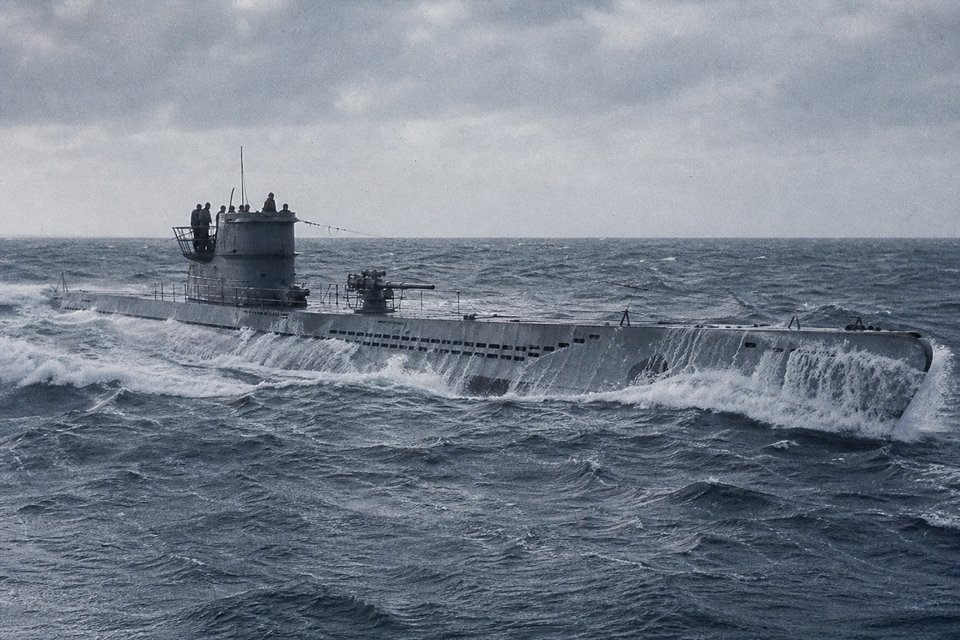
The German U-boat (Unterseeboot) arm was the Kriegsmarine's main offensive weapon against Allied shipping in the Second World War, and for the first three years of the conflict it came close to strangling Britain's supply lines across the Atlantic. Between 1935 and 1945 Germany commissioned somewhere in the range of 1,150 to 1,180 U-boats, sources differ depending on whether they count boats that never completed a war patrol, and lost around 784 of them, roughly two-thirds of all boats built. Of the estimated 40,000 men who served in U-boats, a widely cited figure puts the dead at around 28,000, a casualty rate near 70 percent that makes the U-boat arm one of the costliest branches of service in any twentieth-century military. Set against that cost, U-boats sank on the order of 2,600 to 2,800 Allied merchant ships for roughly 14 million gross register tons, plus close to 175 Allied and Axis warships.
U-boat Types at a Glance
| Type | Role | Commissioned | Notes |
|---|---|---|---|
| Type II (A–D) | Coastal patrol boat | Around 50 | Small "dinghy" boats used mainly for training and Baltic/coastal operations after 1940 |
| Type VII (A–F) | Ocean-going attack boat | Around 700–710 | The most-produced submarine class in history; backbone of the Battle of the Atlantic |
| Type IX (A–D) | Long-range ocean boat | 194 | Greater range than the Type VII; used for distant-water and Monsun operations to the Indian Ocean |
| Type XIV | Supply boat ("Milk Cow") | 10 | Unarmed resupply tanker submarines; refueled and rearmed attack boats far from home ports |
| Type XXI | Elektroboot, ocean-going | 118 (only 1 combat patrol) | Revolutionary high-underwater-speed design; entered service too late to see significant combat |
| Type XXIII | Elektroboot, coastal | 61 (6 operational patrols) | Small electric coastal boat, sister design to the Type XXI; sank the last Allied ship lost in Europe, 7 May 1945 |
Wolfpack Tactics
Karl Dönitz, who commanded the U-boat arm from the start of the war and later succeeded Erich Raeder as commander-in-chief of the Kriegsmarine, built his strategy around the Rudeltaktik, or "wolfpack": rather than hunting alone, several U-boats would shadow a convoy, report its course and speed by radio, then converge for a coordinated surface attack at night, when a U-boat's low silhouette made it nearly invisible to a convoy escort. The tactic multiplied the damage a handful of boats could do to a single convoy and forced the Allies to spread scarce escort vessels thinner across the ocean. It worked best in the mid-Atlantic "air gap," the stretch of ocean beyond the range of shore-based patrol aircraft from both Canada and Britain, where convoys sailed without air cover until escort carriers and longer-ranged aircraft closed the gap in 1943.
Enigma, Ultra, and the Intelligence War
The U-boat campaign was as much an intelligence war as a shooting one. The Kriegsmarine encoded its radio traffic on the Enigma machine, and for long stretches of the war believed that traffic unreadable. British codebreakers at Bletchley Park broke into German naval Enigma traffic in a sustained way from May 1941, producing decrypts known collectively as Ultra intelligence that let the Admiralty reroute convoys around known U-boat concentrations before they ever came into contact. The advantage went back and forth, German cipher changes periodically blacked out Bletchley Park's readability for weeks or months at a time, and Germany's own B-Dienst codebreakers had real success reading Allied convoy codes in 1942, but over the course of the war Ultra intelligence became one of the decisive, if long-secret, factors in winning the Battle of the Atlantic.
The Happy Times
German submariners referred to two distinct stretches of the war as "Die Glückliche Zeit," the Happy Time. The first ran from the fall of France in mid-1940 into early 1941, when U-boats operating from newly captured French Atlantic bases found British convoys thinly escorted and sank shipping at a rate the Royal Navy struggled to answer. The second, shorter Happy Time followed the United States' entry into the war in December 1941: American coastal shipping sailed for months without convoy escort or a blackout of coastal cities, silhouetting merchant ships against the shore lights for prowling U-boats operating just offshore. Both periods ended once convoying, escort numbers, and airborne patrol coverage caught up with the threat.
Black May, 1943
May 1943 broke the U-boat arm's run of success. Long-range aircraft, centimetric radar, improved escort tactics, more escort carriers, and Ultra decrypts all matured at roughly the same time, and German losses spiked accordingly: dozens of U-boats went down in the North Atlantic that month against a shrinking return in sunk tonnage. On 24 May 1943, Dönitz ordered the U-boat force to withdraw from the North Atlantic convoy routes, effectively conceding that the wolfpack tactic could no longer be sustained against the Allies' combined defenses. The U-boat war continued for two more years, but never again at the intensity or effectiveness of 1940–1943.
U-Boat Type VIIA
The Type VIIA boats were designed in 1933 and 1934 as the first of a new generation of German attack U-boats. They were popular with their crews and considerably more capable than the smaller Type II boats they replaced, with four bow torpedo tubes and one stern tube and a typical load of 11 torpedoes. They were agile on the surface and carried an 8.8 cm fast-firing deck gun with roughly 160 rounds. Ten Type VIIA boats were built between 1935 and 1937. All but two, U-29 and U-30, both scuttled in Kupfermühlen Bay on 4 May 1945, were lost during the war.
| Type VIIA | Specification |
|---|---|
| Displacement | 626 t surfaced / 745 t submerged |
| Length | 64.5 m overall; 45.5 m pressure hull |
| Beam | 5.85 m overall; 4.7 m pressure hull |
| Power | 2,310 hp surfaced / 750 hp submerged |
| Speed | 17 knots surfaced / 8 knots submerged |
| Range | 10,000 km (6,200 mi) at 10 knots surfaced |
| Torpedoes | 11 (4 bow, 1 stern) |
| Deck gun | 8.8 cm/45 with approx. 220 rounds |
| Crew | 42–46 |
| Max depth | 220 m (722 ft) |
Type VIIB
The VIIA's main drawback was limited fuel capacity, so 24 Type VIIB boats were built between 1936 and 1940 with an additional 33 tons of fuel carried in external saddle tanks, adding roughly 2,500 miles of surfaced range at 10 knots. They were slightly faster than the VIIA and had two rudders for sharper maneuvering, and could carry three more torpedoes than their predecessor. Type VIIB included some of the best-known U-boats of the war: U-48, the most successful U-boat of the conflict by tonnage sunk, along with Günther Prien's U-47, Otto Kretschmer's U-99, and Joachim Schepke's U-100.
| Type VIIB | Specification |
|---|---|
| Displacement | 753 t surfaced / 857 t submerged |
| Length | 66.5 m overall; 48.8 m pressure hull |
| Beam | 6.2 m overall; 4.7 m pressure hull |
| Power | 3,200 hp surfaced / 750 hp submerged |
| Speed | 17.9 knots surfaced / 8 knots submerged |
| Range | 14,000 km (8,700 mi) at 10 knots surfaced |
| Torpedoes | 14 (4 bow, 1 stern) |
| Deck gun | 8.8 cm/45 with approx. 220 rounds |
| Crew | 44–48 |
| Max depth | 220 m (722 ft) |
Type VIIC
The Type VIIC was the true workhorse of the U-boat force: sources place the number commissioned between about 568 and 580 boats built from 1940 through 1945, depending on which sub-variants and incomplete hulls are counted. The first, U-69, was commissioned in 1940. The VIIC was a modest refinement of the VIIB, similar engines and power, but larger and heavier, which made it slightly slower. Many were fitted with a Schnorchel breathing mast in 1944 and 1945 to let them run submerged on diesel power. Torpedo tube arrangement generally matched earlier types, with a handful of exceptions: U-72, U-78, U-80, U-554 and U-555 had only two bow tubes, while U-203, U-331, U-351, U-401, U-431 and U-651 had no stern tube at all. The best-known Type VIIC boat is almost certainly U-96, the submarine dramatized in the film Das Boot.
U-Flak
The "U-Flak" boats were four Type VIIC hulls, U-441, U-256, U-621 and U-953, converted into heavily armed anti-aircraft escorts for attack U-boats transiting the Bay of Biscay from French Atlantic bases. Conversion began on three further boats, U-211, U-263 and U-271, but none were completed as U-Flaks and all three eventually returned to service as standard VIIC attack boats. The concept began after U-256 was badly damaged by Allied aircraft on 31 August 1942; rather than scrap her, the Kriegsmarine refitted her as a heavily armed anti-aircraft platform meant to blunt the growing air threat over Biscay. The converted boats carried two quadruple 2 cm Flakvierling mounts and an experimental 3.7 cm automatic gun, and an experimental battery of 8.6 cm anti-aircraft rockets was tested but proved unworkable; their fuel load was limited to Biscay-only operations and they carried only five torpedoes, preloaded in the tubes, to free space for extra gun crews. The boats became operational in June 1943 and had early success against surprised RAF aircraft; Dönitz then ordered them to cross the Bay of Biscay in groups at maximum speed, buying roughly two more months of freedom of movement before the RAF adapted by calling in surface hunters to work alongside its aircraft. By November 1943, less than six months after the concept began, all U-Flaks had been converted back to standard attack configuration. German records credit the U-Flaks with only two aircraft shot down across six missions, three credited to U-441 and one each to U-256, U-621 and U-953, a poor return that reflected how quickly the standard U-boat anti-aircraft armament had caught up to make the specialized conversion unnecessary.
| Type VIIC | Specification |
|---|---|
| Displacement | 769 t surfaced / 871 t submerged |
| Length | 67.1 m overall; 50.5 m pressure hull |
| Beam | 6.2 m overall; 4.7 m pressure hull |
| Power | 3,200 hp surfaced / 750 hp submerged |
| Speed | 17.7 knots surfaced / 7.6 knots submerged |
| Range | 13,700 km (8,200 mi) at 10 knots surfaced |
| Torpedoes | 14 (4 bow, 1 stern) |
| Deck gun | 8.8 cm/45 with approx. 220 rounds |
| Crew | 44–52 |
| Max depth | 220 m (722 ft) |
Type VIIC/41
The Type VIIC/41 was a modest refinement of the VIIC with the same armament and engines but a stronger, thicker pressure hull and lighter machinery elsewhere to compensate, making the finished boat slightly lighter than the standard VIIC despite the extra steel. A total of 91 were built; all boats from U-1271 onward lacked mine-handling fittings. One Type VIIC/41, U-995, survives today on display at the Laboe Naval Memorial north of Kiel, the only surviving Type VII U-boat in the world.
| Type VIIC/41 | Specification |
|---|---|
| Displacement | 769 t surfaced / 871 t submerged |
| Length | 67.1 m overall; 50.5 m pressure hull |
| Beam | 6.2 m overall; 4.7 m pressure hull |
| Power | 3,200 hp surfaced / 750 hp submerged |
| Speed | 17.7 knots surfaced / 7.6 knots submerged |
| Range | 14,500 km (8,500 mi) at 10 knots surfaced |
| Torpedoes | 14 (4 bow, 1 stern) |
| Deck gun | 8.8 cm/45 with approx. 220 rounds |
| Crew | 44–52 |
| Max depth | 250 m (820 ft) |
Type VIIC/42
The Type VIIC/42 was designed in 1942 and 1943 to replace the aging VIIC, with a much stronger pressure hull, plating up to 28 mm thick, intended to let it dive roughly twice as deep as earlier VIICs. Externally it would have closely resembled the VIIC/41 but with two periscopes in the conning tower and two additional torpedoes. Contracts were signed for 164 boats and a handful were laid down, but the entire program was cancelled on 30 September 1943 in favor of the new Type XXI Elektroboot, and no VIIC/42 was ever completed enough to launch.
| Type VIIC/42 | Specification |
|---|---|
| Displacement | 999 t surfaced / 1,099 t submerged |
| Length | 68.7 m overall; 50.9 m pressure hull |
| Beam | 6.85 m overall; 5 m pressure hull |
| Power | 4,400 hp surfaced / 750 hp submerged |
| Speed | 18.6 knots surfaced / 7.6 knots submerged |
| Range | 20,150 km (12,600 mi) at 10 knots surfaced |
| Torpedoes | 16 (4 bow, 1 stern) |
| Deck gun | None |
| Crew | 44–52 |
| Max depth | 270 m (890 ft) |
Type VIID
The Type VIID, designed in 1939 and 1940, stretched the VIIC hull to fit three banks of five vertical mine-laying tubes just aft of the conning tower, a layout that, on the outside, looked a little like a modern ballistic-missile submarine, except these tubes ejected mines rather than missiles. Six boats were built, U-213 through U-218; only U-218 survived the war, the other five were lost with most or all of their crews.
| Type VIID | Specification |
|---|---|
| Displacement | 965 t surfaced / 1,080 t submerged |
| Length | 76.9 m overall; 59.8 m pressure hull |
| Beam | 6.4 m overall; 4.7 m pressure hull |
| Power | 3,200 hp surfaced / 750 hp submerged |
| Speed | 16.7 knots surfaced / 7.3 knots submerged |
| Range | 17,900 km (11,200 mi) at 10 knots surfaced |
| Torpedoes | 14 (4 bow, 1 stern); plus 15 SMA mines |
| Deck gun | None |
| Crew | 46–52 |
| Max depth | 200 m (660 ft) |
Type VIIF
The Type VIIF, designed in 1941, was built primarily as a torpedo transport rather than an attack boat, the largest and heaviest of the Type VII family, able to carry up to 39 torpedoes and lacking a deck gun. Only four were built: U-1059 and U-1062 supported the long-range Monsun U-boat operations to the Far East, while U-1060 and U-1061 remained in the Atlantic.
| Type VIIF | Specification |
|---|---|
| Displacement | 1,084 t surfaced / 1,181 t submerged |
| Length | 77.6 m overall; 60.4 m pressure hull |
| Beam | 7.3 m overall; 4.7 m pressure hull |
| Power | 3,200 hp surfaced / 750 hp submerged |
| Speed | 17.6 knots surfaced / 7.9 knots submerged |
| Range | 23,500 km (14,700 mi) at 10 knots surfaced |
| Torpedoes | Up to 39 (14 in tubes, remainder stowed as transport cargo) |
| Deck gun | None |
| Crew | 46–52 |
| Max depth | 200 m (650 ft) |
U-Boat Classes by Hull-Number Range
The Kriegsmarine grouped its submarine force loosely by role: training, coastal, ocean-going, minelaying, supply, and midget/human-torpedo craft. Hull numbers within a type tended to run in blocks rather than a single continuous sequence, since numbers were assigned in the order boats were ordered, not built. The table below summarizes the main blocks; the Type I and Type II boats and the Type IX family each have their own dedicated pages with full specifications.
| Role | Types and hull-number blocks |
|---|---|
| Training | Type I: U-25, U-26 |
| Coastal | Type IIA: U-1–U-6 · Type IIB: U-7–U-24, U-120, U-121 · Type IIC: U-56–U-63 · Type IID: U-137–U-152 · Type XVIIB (experimental): U-1405–U-1407 |
| Ocean-going | Type VIIA: U-27–U-36 · Type VIIB: U-45–U-55, U-73–U-76, U-83–U-87, U-99–U-102 · Type VIIC: U-69–U-72, U-77–U-82, U-88–U-98, U-132–U-136, U-201–U-486 (multiple blocks) |
| Minelaying | Type VIID: U-213–U-218 · Type XB: U-116–U-119 |
| Supply | Type VIIF: U-1059–U-1062 · Type IXD/42: U-883, U-884 · Type XB: U-219, U-220, U-233, U-234 · Type XIV "Milk Cow": U-459–U-464, U-487–U-490 |
| Midget submarines | Seehund (138 built) · Hecht training type (53 built) · Biber (324 built) · Molch (393 built) · Delphin and Seeteufel prototypes |
| Human torpedoes | Neger (200 built) · Marder (500 built) · Hai prototype |
Kriegsmarine Order of Battle: The Rest of the Fleet
U-boats were only part of the Kriegsmarine. The surface fleet they operated alongside (and, after 1943, largely in place of) ranged from the great battleships down to coastal minesweepers; the full breakdown appears on the list of German Navy ships of WW2. In outline, by category:
Capital Ships
- Battleships (Schlachtschiffe): Bismarck class, 42,000 t, 8 x 380 mm guns, Bismarck and Tirpitz, both 1939; Scharnhorst class, 35,000 t, 9 x 280 mm guns, Gneisenau and Scharnhorst, both 1936
- Pre-dreadnoughts (Linienschiffe): Deutschland-class battleships, 15,000 t, 4 x 280 mm guns, Schleswig-Holstein and Schlesien, both 1906
- Heavy cruisers (Schwere Kreuzer): Deutschland class ("pocket battleships"), 12,000 t, 6 x 280 mm guns, Lützow (ex-Deutschland, 1931), Admiral Graf Spee (1933), Admiral Scheer (1934); Admiral Hipper class, 14,000 t, 8 x 203 mm guns, Admiral Hipper and Blücher (both 1937), Prinz Eugen (1938)
- Light cruisers (Leichte Kreuzer): Emden class, 6,000 t, 8 x 150 mm guns, Emden (1925); K class, 7,200 t, 9 x 150 mm guns, Königsberg (1925), Karlsruhe (1927), Köln (1928); Leipzig class, 8,000 t, 9 x 150 mm guns, Leipzig (1929), Nürnberg (1934)
Destroyers and Torpedo Boats
- Zerstörer Typ 1934, 3,155 t, 5 x 127 mm guns: Z1 Leberecht Maas, Z2 Georg Thiele, Z3 Max Schultz, Z4 Richard Beitzen (all 1937)
- Zerstörer Typ 1934A: Z5 Paul Jacobi through Z16 Friedrich Eckoldt
- Zerstörer Typ 1936: Z17 Diether von Roeder through Z22 Anton Schmitt
- Zerstörer Typ 1936A (Narvik): Z23 through Z30
- Zerstörer Typ 1936A (Mob): Z31–Z34 and Z37–Z39
- Zerstörer Typ 1936B: Z35–Z36 and Z43–Z45
- Torpedoboot 1923 ("Raubvogel"), 900 t, 3 x 105 mm guns: Möwe, Falke, Greif, Kondor, Albatros, Seeadler
- Torpedoboot 1924 ("Raubtier"), 950 t, 3 x 105 mm guns: Wolf, Iltis, Jaguar, Leopard, Luchs, Tiger
- Torpedoboot 1935, 1,090 t, 1 x 105 mm gun: T1–T12
- Torpedoboot 1937, 1,150 t, 1 x 105 mm gun: T13–T21
- Flottentorpedoboot 1939 (Elbing class), 1,750 t, 4 x 105 mm guns: T22–T36
Auxiliary Cruisers (Hilfskreuzer)
Converted merchant raiders operating independently against Allied shipping worldwide: Orion, Atlantis, Widder, Thor, Pinguin, Stier, Komet, Kormoran, Michel, Coronel and Hansa.
Mine Warfare Craft
- Minelayers (Minenleger): Tannenberg, 1935, 5,500 t, 3 x 150 mm guns, 460 mines; Brandenburg, 1936, 3,900 t, 3 x 105 mm guns, 250 mines; Lothringen, 1941, 2,000 t, 2 x 88 mm guns, 200 mines; Niedersachsen, 1934, 1,800 t, 2 x 105 mm guns, 260 mines; Drache, 1924, 1,800 t, 2 x 88 mm guns, 120 mines; Brummer, 1940, 3 x 10.5 cm guns and 280 mines; Oldenburg, 1934, 1,200 t, 145 mines; Kamerun and Togo, both 1939, 370 t, 100 mines each; Kiebitz, 1943
- Sperrbrecher pathfinders: Sperrbrecher 1 through Sperrbrecher 100, 5,000 t, 2 x 88 mm guns
- Coastal minesweepers (Küstenminenleger): KM1 through KM36
Small Craft: Schnellboot (E-boats/MTBs)
- S-1 class, 50 t, 1 x 20 mm gun, 2 torpedo tubes: S1–S25
- S-26 class, 75 t: S26–S29
- S-30 class, 80 t: S30–S37
- S-38 class, 80 t: S38–S60
- S-38b class, 90 t, 2 x 20 mm guns: S61–S99
- S-100 class, 100 t, 1 x 37 mm gun: S100–S150
- S-151 class, 100 t, 1 x 37 mm gun: S151–S205
Auxiliary Ships
- Troop ships: Cap Arcona (1927), Deutschland (1923), Goya (1940), Steuben (1923), Wilhelm Gustloff (1937)
- Artillery training ships (Artillerieschulschiffe): Bremse, 1933, 1,800 t, 4 x 127 mm guns; Brummer, 1934, 3,000 t, 8 x 105 mm guns; Admiral Hugo Zeye, 1942
- Radio-controlled targets: Hessen (Braunschweig-class battleship, 1900) and Zähringen (Wittelsbach-class battleship, 1898)
- Gunboats (Leichte Schnellboote): LS1 through LS12
Compare warships side by side
All 15 entries in the data table
Select a column heading to sort.
| Name | Nation | Class | Displacement (t) | Length (m) | Beam (m) | Speed (kn) | Crew | Commissioned | Compare |
|---|---|---|---|---|---|---|---|---|---|
| Type VIIC U-boat | Germany | attack submarine | 857 | 67.2 | 6.2 | 17.7 | 48 | 1,940 | |
| Type IX U-boat | Germany | attack submarine | 1,213 | 76.76 | 6.76 | 18.3 | 48 | 1,937 | |
| Type XXI U-boat | Germany | attack submarine | 1,790 | 76.7 | 8 | 17.2 | 57 | 1,944 | |
| Gato-class submarine | United States | attack submarine | 2,463 | 95 | 8.31 | 21 | 60 | 1,941 | |
| Balao-class submarine | United States | attack submarine | 2,424 | 95 | 8.3 | 20.25 | 81 | 1,943 | |
| USS Nautilus (SSN-571) | United States | attack submarine | 4,158 | 97.5 | 8.5 | 23 | 105 | 1,954 | |
| Los Angeles-class submarine | United States | attack submarine | 6,818 | 110 | 10 | 25 | 129 | 1,976 | |
| Seawolf-class submarine | United States | attack submarine | 9,138 | 108 | 12 | 35 | 140 | 1,997 | |
| Virginia-class submarine | United States | attack submarine | 8,700 | 115 | 10 | 25 | 135 | 2,004 | |
| Ohio-class submarine | United States | ballistic-missile submarine | 18,450 | 170 | 13 | 20 | 155 | 1,981 | |
| Typhoon-class submarine (Project 941 Akula) | Russia | ballistic-missile submarine | 47,240 | 175 | 23 | 27 | 160 | 1,981 | |
| Delta IV-class submarine (Project 667BDRM) | Russia | ballistic-missile submarine | — | — | — | 24 | — | 1,984 | |
| Borei-class submarine (Project 955) | Russia | ballistic-missile submarine | 23,621 | 170 | 13.5 | 29 | 107 | 2,013 | |
| Kursk (K-141, Oscar II class) | Russia | cruise-missile submarine | 16,400 | 154 | 18.2 | 32 | 112 | 1,994 | |
| Vanguard-class submarine | United Kingdom | ballistic-missile submarine | 15,900 | 149.9 | 12.8 | 25 | 135 | 1,993 |
Frequently asked questions
How many U-boats did Germany build in World War 2?
Estimates range from about 1,150 to 1,180 commissioned, depending on whether incomplete or non-operational boats are counted. Around 784 were lost during the war, roughly two-thirds of the total built, split between combat losses, scuttling and surrenders at war's end.
How many German U-boat crewmen died in WW2?
Of the roughly 40,000 men who served in U-boats, a widely cited estimate puts the dead at around 28,000 — a fatality rate near 70 percent, among the highest of any branch of any combatant military in the war, and far higher than surface-fleet losses.
What was the most-produced German U-boat type?
The Type VII, in its VIIA through VIIF variants, with roughly 700 to 710 boats commissioned. It is the most-produced submarine class in naval history and formed the backbone of the Kriegsmarine's Battle of the Atlantic campaign from 1939 to 1943.
What was a U-boat wolfpack?
A Rudeltaktik, or wolfpack, was a group of U-boats coordinated by radio to shadow an Allied convoy and then attack together, usually on the surface at night, overwhelming the convoy's escorts with simultaneous torpedo attacks from multiple boats converging from different directions.
How did Allied codebreaking affect the U-boat campaign?
British codebreakers at Bletchley Park broke German naval Enigma traffic in a sustained way from May 1941, producing Ultra intelligence that let convoys be rerouted around known U-boat positions. German B-Dienst codebreakers had their own successes reading Allied codes, but Ultra became a decisive long-term Allied advantage.
What happened during Black May 1943?
In May 1943, improved radar, long-range aircraft, escort carriers and Ultra decrypts combined to inflict U-boat losses the Kriegsmarine could not sustain. On 24 May 1943, Admiral Karl Dönitz withdrew U-boats from the main North Atlantic convoy routes, ending the wolfpack campaign's most effective phase.
Does any Type VII U-boat still exist today?
Yes. U-995, a Type VIIC/41 commissioned in 1943, is preserved on display at the Laboe Naval Memorial north of Kiel, Germany — the only surviving Type VII U-boat in the world, out of roughly 700 of the type built during the war.