Plate 008 — Battles
REF: BF-BTL-008The Iwo Jima Japanese Defense: Kuribayashi's Tunnels, Bunkers, and Order of Battle
Lieutenant General Tadamichi Kuribayashi rejected beach defense and built Iwo Jima into a fortress of tunnels and bunkers. This is how the Japanese garrison organized its defense in depth, and why the pre-invasion bombardment barely touched it.
The Japanese defenses of Iwo Jima on the chart
19 February – 26 March 1945. Times are local (Iwo Jima, roughly UTC+9). Dates are also given as D-Day-plus-N, the US Marine convention used throughout the official campaign history.
- D-Day · 08:59
Landings on the southeast beaches
After a naval and air bombardment, the 4th and 5th Marine Divisions landed abreast on Green, Red, Yellow and Blue beaches under Mount Suribachi. Soft volcanic ash immobilized vehicles and slowed the infantry; within 90 minutes the 1st Battalion, 28th Marines had crossed the island's 700-yard-wide neck, cutting Suribachi off from the rest of Iwo Jima.
- D-Day · 10:00
Kuribayashi unmasks his artillery
With the beaches jammed with troops and equipment, General Kuribayashi's pre-registered heavy artillery, mortars and dual-purpose guns opened fire from the high ground on both flanks. Casualties mounted rapidly; by nightfall roughly 2,400 Marines were dead or wounded, and the 25th Marines on the right had suffered worst, clawing at the Rock Quarry above Blue Beach.
- D-Day · 11:30
Airfield No. 1 partially seized
The 23d and 27th Marines pushed across the open ground north of the beaches and had partial control of Airfield No. 1 by late morning, repelling a Japanese counter-charge of more than 100 men, though fighting for the airfield's northern edge continued into the next day.
- D+4 · 23 Feb, 08:00
Suribachi isolated and taken
Four days after being cut off, Mount Suribachi fell to the 28th Marines. A 40-man patrol under Lieutenant Harold Schrier climbed the summit and raised a small flag at 10:20, photographed by Leatherneck's Lou Lowery; a larger flag went up three hours later, captured in Joe Rosenthal's photograph. The regiment had taken the mountain in three days for more than 500 additional casualties.
- D+5 · 24 Feb
Drive north into the main belt
Three regimental combat teams attacked abreast into Kuribayashi's main defensive belt north of Airfield No. 2, backed by the largest concentration of Marine tanks of the war. The advance stalled under mines and dug-in antitank guns; by the ninth day the corps had gained about 4,000 yards for 7,000 casualties, fighting through and around Airfield No. 2 and Motoyama village on the plateau above it.
- D+10–D+12 · 1–2 Mar
Hill 382 and the Meatgrinder
The 4th Marine Division finally seized Hill 382, the highest point north of Suribachi, but continued taking heavy losses pushing through the Amphitheater against Turkey Knob – the fortified complex Marines nicknamed the Meatgrinder. On 2 March a Japanese gunner killed Lieutenant Colonel Chandler Johnson, who had ordered the Suribachi flag-raising a week earlier.
- D+11 · 2 Mar
Hill 362-A and 362-B fall
On the western flank the 28th Marines captured Hill 362-A at a cost of about 200 casualties on the same day the 26th Marines took Hill 362-B in the division's bloodiest single attack, losing roughly 500 men and earning five Medals of Honor.
- D+16 · 7 Mar, 05:00
Hill 362-C and the third airfield
In a rare pre-dawn attack without preparatory fire, the 3d Battalion, 9th Marines crossed the line of departure silently at 05:00 and achieved total surprise, though it first seized the wrong hill; by nightfall it held Hill 362-C beyond the uncompleted Airfield No. 3, one of Kuribayashi's main defensive anchors in the center of the island.
- D+17 · 8 Mar, night
Senda's counterattack repulsed
Frustrated by the tightening American pressure, Major General Sadasue Senda led roughly 800 of his surviving troops in one of the few large Japanese counterattacks of the battle against the 4th Marine Division. Given open targets for the first time, the Marines cut the attackers down; about 784 Japanese dead were counted the next day.
- D+25 · 16 Mar
Kitano Point taken, island declared secure
The 21st Marines cleared the extreme northern tip of the island in half a day of sharp fighting; General Erskine signalled “Kitano Point is taken.” The same day, with the last organized pocket at Cushman's Pocket destroyed, General Schmidt declared the island secure, though the 5th Marine Division was still fighting through a cave gorge near Kuribayashi's final command post.
- D+35 · 26 Mar, 03:00
Final attack near Airfield No. 1
Hours after the 5th Marine Division snuffed out the last organized cave resistance in the northern gorge, roughly 300 Japanese survivors infiltrated the length of the island overnight and fell on tents of newly arrived Army fighter pilots beside Airfield No. 1. Pilots, Seabees and pioneers fought them off with small arms; by sunrise about 300 Japanese and over 100 Americans were dead, a grim final action that officially ended the campaign.
Defensive positions shown on the chart
- Mount Suribachi sector.Semi-independent southern stronghold: pillboxes and reinforced steel doors shielding artillery, cut off from the rest of the island on D-Day and reduced in three days.
- Main defense belt.Kuribayashi's principal line across the island north of Airfield No. 2, dug into the Motoyama Plateau; the V Amphibious Corps needed nine days and 7,000 casualties to force it.
- Second defense belt.A further line anchored on Nishi Ridge and Hill 362-A, defended by interlocking bands of fire that a Marine regimental commander called unlike anything he had seen.
- Hill 382.The highest ground north of Suribachi, anchoring the eastern end of the “Meatgrinder” complex with Turkey Knob and the Amphitheater; finally seized by the 4th Marine Division around 1–2 March.
- Turkey Knob.A concrete blockhouse on a rocky knob housing Colonel Chosaku Kaido, Kuribayashi's chief of artillery, who directed fire on the 4th Marine Division from it for weeks.
- The Amphitheater.A natural bowl of caves and gun pits between Hill 382 and Turkey Knob that the 4th Marine Division had to clear cave by cave under constant crossfire.
- Hill 362-A.Western anchor of the second belt beyond Nishi Ridge, captured by the 28th Marines on 2 March for about 200 casualties.
- Hill 362-B.Seized by the 26th Marines in the division's bloodiest single attack of the battle, costing about 500 casualties and five Medals of Honor in one day.
- Hill 362-C.Fortified anchor beyond the third airfield taken by a rare pre-dawn silent attack of the 3d Battalion, 9th Marines on 7 March, after the battalion first seized the wrong hill by mistake.
- Nishi's tank positions.Tanks of Lieutenant Colonel Takeichi Nishi's regiment dug in hull-down and camouflaged as static artillery among Nishi Ridge's defenses west of the second belt.
- Kuribayashi's HQ cave (Kitano gorge).On 4 March Kuribayashi moved his command post to a large cave on the northwest coast near an 800-yard defile Marines called “The Gorge” or “Death Valley,” his final command center.
- Naval guns at the base of Suribachi.Coast-defense and dual-purpose naval guns emplaced in caves at Suribachi's foot, pre-registered on the invasion beaches and unmasked once the beachhead was choked with troops.
- Naval guns at the East Boat Basin quarry.Positions in the Rock Quarry overlooking Blue Beach dominated the 4th Marine Division's right flank, inflicting some of D-Day's heaviest casualties on the 25th Marines.
Outcome. The 36-day battle cost the V Amphibious Corps 24,053 Marine and Navy casualties, of whom 6,140 died – the only Marine Corps battle in which American casualties exceeded the roughly 21,060-man Japanese garrison's own losses of about 22,000 killed (plus 867 captured after organized resistance ended, and a further 1,602 holdouts killed and more captured by the Army garrison in subsequent months). The captured airfields gave crippled B-29 bombers an emergency landing strip: 2,251 made forced landings on Iwo Jima by war's end.
The Iwo Jima Japanese defense was not built to stop the Americans on the beach. By the time Lieutenant General Tadamichi Kuribayashi finished preparing the island, the battle of Iwo Jima Japanese defense plan relied on depth, concealment, and an underground network that would let a garrison of roughly 21,000 men hold off a landing force nearly five times its size for five weeks. Kuribayashi never expected to win. His task, handed to him personally by Prime Minister Hideki Tojo in late May 1944, was to make the island cost more than any Pacific objective the United States had taken so far.
What follows is a look at how that defense was built: Kuribayashi's break with standard doctrine, the tunnels and bunkers his garrison dug into the island's soft volcanic rock, the order of battle he assembled from Army and Navy units, and why 72 days of aerial bombing and three days of naval gunfire barely touched what he had built underground.
Kuribayashi Takes Command of Iwo Jima
Kuribayashi arrived on Iwo Jima on 8 June 1944, about two weeks after Tojo told him the island had to be held "to the last." At the time roughly 80 Japanese fighter aircraft were based there; within a month, American carrier strikes and a two-day naval bombardment had reduced that number to four and destroyed every building on the island. No invasion followed that summer, which gave Kuribayashi almost eight months to prepare. It was time no other Japanese island commander in the Pacific War would get.
Any account of the battle of Iwo Jima Japanese defense starts here, with Kuribayashi using that unplanned pause to override the assumptions of his predecessor. Lieutenant General Hideyoshi Obata, who had been responsible for Iwo Jima earlier in 1944 before returning to the Marianas, had followed the standard doctrine of meeting an invasion at the water's edge: artillery and pillboxes dug in near the beaches. Kuribayashi discarded that plan within weeks of arriving.
Breaking With Beach-Defense Doctrine
The Japanese defenses on Iwo Jima had, until Kuribayashi's arrival, followed the same logic as every other island in the Pacific: stop the enemy while he is still in the water, where naval gunfire cannot easily support him and where the amphibious force is at its most vulnerable. Saipan had shown Kuribayashi exactly what happened to that plan once American naval and air power arrived in strength: beach fortifications were identified and destroyed before the landing craft ever touched sand.
So he inverted it. Rather than contest the beaches, Kuribayashi planned to let the Marines land almost unopposed, then hit them with concentrated automatic-weapons and artillery fire once they had pushed roughly 500 meters inland, far enough that naval gunfire support became harder to coordinate, and directly into the killing ground he had prepared on the high ground north of the landing beaches and on the slopes of Mount Suribachi to the south.
The Iwo Jima Japanese Defense Plan Takes Shape
The finished plan, which took its final form in January 1945, rejected the large-scale counterattacks and banzai charges that had characterized earlier Japanese defenses at Tarawa and Saipan. Kuribayashi forbade them outright. Instead his forces would hold a network of small, mutually supporting positions, each fighting until it was physically destroyed rather than falling back or attempting to retake lost ground. There would be no attempt to save the beach, and no attempt to save the garrison, only to inflict the maximum possible cost on the men who came ashore.
Kuribayashi also stockpiled roughly two and a half months of food and ammunition, aware that once the invasion fleet arrived, the trickle of supplies still reaching the island from Japan would stop for good. Feeding that plan meant getting men, artillery, and construction material to Iwo Jima despite mounting losses to American submarines; substantial quantities still arrived through the autumn of 1944.
Tunnels Beneath the Island
The centerpiece of the Iwo Jima Japanese defense was underground. Naval bombardment in mid-1944 had already proven that anything built on the surface would eventually be found and destroyed, so Kuribayashi brought in mining engineers from Japan to design a tunnel system built at varying depths, with multiple entrances and exits so that no single collapse could trap an entire garrison inside.
The island's soft volcanic stone made this possible at a scale rarely seen elsewhere in the Pacific: it could be cut with hand tools, yet hardened into a durable building material once mixed with cement. The Iwo Jima tunnels were meant to eventually run nearly 27 kilometers (17 miles) end to end, linking the fortified north of the island to Mount Suribachi's defenses in the south. By the time the Marines landed, engineers had completed more than 18 kilometers (11 miles), short of the target but still enough to connect artillery positions, command posts, aid stations, and troop shelters across most of the island. About 25 percent of the entire garrison was assigned to digging, and the finished Iwo Jima tunnels gave defenders multiple entrances and exits at every major position, so a single collapsed passage never cut a garrison off entirely.
Conditions inside were brutal on their own terms. Sulphur fumes vented from the volcanic rock into many of the chambers, and engineers had to design ventilation carefully to keep men from suffocating even before combat began. Kuribayashi's own command post, roughly 500 meters northeast of Kita village, sat 20 meters underground and connected 150 meters of tunnel to his personal war room and two adjoining staff chambers.
Bunkers, Pillboxes, and Blockhouses
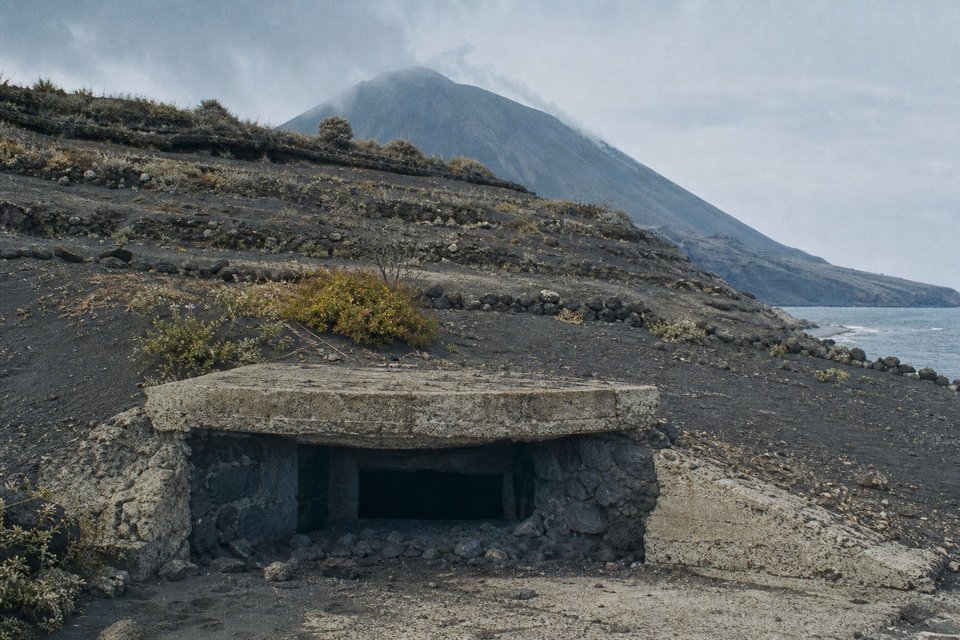
Where the tunnels connected to the surface, the Japanese defenses on Iwo Jima took the form of reinforced-concrete pillboxes and blockhouses, many with walls up to 1.2 meters (four feet) thick, built from the same volcanic-ash concrete used underground. One blockhouse near Hill 382 was large enough to serve as the headquarters of Colonel Chosaku Kaido, who commanded all of Kuribayashi's artillery, and a nearby communications center contained a single chamber roughly 50 meters long and 20 meters wide.
These Iwo Jima fortifications were deliberately hard to spot from the air or from ground level; Nishi's tanks, dug in with turrets removed or buried up to the hull, were nearly invisible until they opened fire. American pre-invasion reconnaissance identified around 750 major defensive installations. Once smaller emplacements the initial surveys never found were added in, the true total by the time the fighting ended was closer to twice that.
Mount Suribachi's Defenses
The southern end of the island, dominated by the extinct volcano of Mount Suribachi, was organized as a semi-independent sector with its own casemated coastal artillery and automatic weapons sited in mutually supporting pillboxes. Kuribayashi assigned it a relatively light infantry garrison, betting that the terrain and the concealed guns on its slopes would do most of the work. The narrow isthmus connecting Suribachi to the rest of the island was covered by artillery and rocket fire from both the mountain and the high ground to the north, so that any American unit trying to isolate the volcano would be caught in a crossfire from two directions at once.
The Main and Second Defense Belts
North of the beaches, Kuribayashi organized his strongest positions into two belts running across the Motoyama plateau. The main defense belt stretched from the cliffs in the northwest, across Motoyama Airfield No. 2, to the smashed village of Minami in the southeast, and combined pillboxes, bunkers, and blockhouses with Nishi's buried tanks in overlapping fields of fire. A second belt ran from Kitano Point across the unfinished Airfield No. 3, leaning more on natural caves and broken terrain than on constructed works, since by early 1945 there was neither time nor material left to build it to the same standard as the first.
Hill 382 and the Meat Grinder
The single toughest sector of the main belt sat around Hill 382 (known to the Japanese as Nidan Iwa), along with the nearby Amphitheater, Turkey Knob, and the ruined village of Minami. American Marines came to know the combined position as the "Meat Grinder," a name that reflected how many separate assaults it took to clear a stretch of ground barely a few hundred meters across. Hill 382 itself, the second-highest point on the island after Suribachi, held a radio and weather station along with Kaido's artillery command blockhouse, and its garrison kept fighting from connected caves for days after the surface positions had apparently been cleared.
Artillery, Mortars, and Rocket Units
By the end of 1944 Kuribayashi had assembled one of the densest concentrations of firepower any Japanese garrison fielded in the Pacific War: 361 artillery pieces of 75 mm caliber or larger, roughly a dozen 320 mm spigot mortars, 65 additional medium and light mortars, 33 naval guns of 80 mm or larger, and 94 anti-aircraft guns of 75 mm or larger. Beyond those, the garrison held more than 200 smaller 20 mm and 25 mm anti-aircraft guns and 69 antitank guns.
The 320 mm spigot mortars, operated by a dedicated mortar battalion, fired a 306-kilogram (675-pound) shell barely 1,300 meters, not far and not especially deadly on impact given the shell's thin casing and minimal fragmentation. What it did instead was terrify: a hit could blow a crater 2.4 meters deep and 4.6 meters across, and Marines who survived a near miss often described the psychological effect as worse than the physical one. Alongside the spigot mortars, Kuribayashi's units also fielded Type 4 20 cm rocket launchers, crude but effective spin-stabilized weapons rushed into production in the last years of the war.
Nishi's roughly 22 to 23 tanks, a mix of Type 95 light tanks and Type 97 medium tanks, were folded into this fire plan rather than held back as a mobile reserve. Dug in near Airfield No. 2 and in scattered positions across the island, they functioned as static gun emplacements, some of them still firing from beneath the rubble after infantry had walked past.
Order of Battle
| Unit | Commander | Approximate strength | Role |
|---|---|---|---|
| 109th Division (overall command) | Lt. Gen. Tadamichi Kuribayashi | ~21,000–23,000 (all units) | Overall Army command of the garrison |
| 2nd Mixed Brigade | Maj. Gen. Sadasue Senda | ~5,200 | Five independent infantry battalions (309th–312th, 314th) |
| 145th Infantry Regiment | Col. Masuo Ikeda | ~2,700 | Three infantry battalions, diverted from a planned Saipan reinforcement |
| 17th Independent Mixed Regiment | Maj. Tamachi Fujiwara | Regiment plus attached 3rd Battalion | Infantry support integrated into the main belt |
| 26th Tank Regiment | Lt. Col. Takeichi Nishi | ~22–23 tanks | Dug in and used as static artillery |
| Divisional Artillery Group | Col. Chosaku Kaido | 361 guns 75 mm+, ~12 320 mm mortars, rocket units | Island-wide fire-support coordination |
| Naval Guard Force | Rear Adm. Toshinosuke Ichimaru | 2,216 personnel from August 1944, growing through early 1945 | Anti-aircraft defense, naval construction, guard duties |
The Courageous Battle Vows
Before the invasion, Kuribayashi circulated a document his men called the Courageous Battle Vows, copies of which turned up afterward in captured pillboxes and on the bodies of the dead. It told every soldier that his fighting position was also his grave, that retreat and surrender were not options, and that killing ten Americans before dying would count as victory enough. However blunt the arithmetic, the vows matched what actually happened: organized Japanese resistance on Iwo Jima ended not with a mass surrender but with individual positions fighting until they had nothing left to fight with.
Why the Bombardment Failed to Break the Defenses
American aircraft had bombed Iwo Jima almost daily since December 1944, adding up to some 72 days of aerial attack by the time the Marines landed, one of the longest preliminary air campaigns of the entire Pacific War. General Holland Smith and Major General Harry Schmidt had asked for ten days of direct naval gunfire support before the landing; a later request scaled that back to nine. Admiral Raymond Spruance approved three.
Against Iwo Jima fortifications built mostly below ground, three days turned out to be nowhere near enough. Of roughly 750 identified Japanese fortifications, fewer than 200 had been silenced by the time the first wave hit the beach, and that count did not include the hundreds of smaller positions naval intelligence never found in the first place. Much of the underground network the bombardment was meant to destroy had never been visible from the air or the sea to begin with; that was the entire point of building it that way.
Casualties and the Last Holdouts
The fighting for Iwo Jima ran from 19 February to 26 March 1945, and the cost on both sides was severe by any measure of the Pacific War. American dead are generally put between 6,821 and roughly 7,000, with close to 19,200 wounded and around 2,650 additional cases of combat fatigue, for total American casualties near 26,000 to 28,000 depending on how they are counted. Japanese losses are harder to pin down precisely: killed and missing during the main battle are usually estimated at 17,845 to 18,375, with 216 taken prisoner during the fighting itself. Mopping-up operations by the Army's 147th Infantry Regiment over the following months killed roughly another 1,600 and captured 867 more, bringing the eventual Japanese death toll close to 20,000 out of a garrison that had numbered barely 21,000 to 23,000.
Not every defender died or surrendered on schedule. When the island was declared secure, American commanders estimated no more than 300 Japanese remained alive in the caves and tunnels; the real number was closer to 3,000. Small groups kept emerging and surrendering for years afterward. The last two, machine gunners Yamakage Kufuku and Matsudo Linsoki, walked out of hiding and surrendered to US Air Force personnel on 6 January 1949, nearly four years after the island was declared secure, reportedly still well fed on stolen American supplies.
See also: Battle of Iwo Jima: preparations, Battle of Iwo Jima: American landing, Iwo Jima battle ships, USS Iwo Jima (LPH-2) operations, USS Iwo Jima (LHD-7), and Imperial Japanese Navy WW2 admirals.
Frequently asked questions
What made the Iwo Jima Japanese defense different from earlier Pacific battles?
Kuribayashi abandoned the standard beach-defense doctrine used at Tarawa and Saipan and built a defense in depth instead: light beach opposition, an underground tunnel network, and mutually supporting positions on the high ground that opened fire once American troops had moved inland. It made the battle of Iwo Jima Japanese defense one of the costliest per square kilometer of the entire war.
How long were the Iwo Jima tunnels?
Engineers planned nearly 27 kilometers (17 miles) of connecting tunnels across the island. By the time of the American landing in February 1945, more than 18 kilometers (11 miles) had been completed, linking artillery positions, command posts, and shelters between the northern strongpoints and Mount Suribachi.
Who commanded the Japanese defense of Iwo Jima?
Lieutenant General Tadamichi Kuribayashi commanded the Army garrison, appointed personally by Prime Minister Hideki Tojo in late May 1944. Rear Admiral Toshinosuke Ichimaru commanded the naval contingent, which handled anti-aircraft defense, naval construction, and guard duties.
Why did Kuribayashi decide against defending the beaches?
He had watched American naval and air power dismantle beach fortifications at Saipan before the landing craft even arrived. Rather than repeat that, he let the Marines come ashore with limited opposition and concentrated his artillery, mortars, and automatic weapons on the ground they would have to cross afterward.
What was the Meat Grinder on Iwo Jima?
It was the nickname Marines gave to the combined defensive complex around Hill 382, the Amphitheater, Turkey Knob, and the village of Minami, part of Kuribayashi's main defense belt across the Motoyama plateau. Clearing it required days of close combat over a few hundred meters of ground.
How many Japanese soldiers defended Iwo Jima?
The garrison numbered roughly 21,000 to 23,000 Army and Navy personnel, organized around the 109th Division, the 2nd Mixed Brigade, the 145th Infantry Regiment, and Rear Admiral Ichimaru's naval guard force.
What weapons made up the Japanese defenses on Iwo Jima?
The garrison held 361 artillery pieces of 75 mm or larger, about a dozen 320 mm spigot mortars, dozens of additional mortars, roughly 200 smaller anti-aircraft guns, Type 4 20 cm rocket launchers, and around 22 to 23 tanks from the 26th Tank Regiment, dug in and used as static artillery.
Why did the pre-invasion bombardment fail to destroy the Iwo Jima fortifications?
Much of the defense was built underground or camouflaged well enough to avoid detection entirely. Of roughly 750 identified fortifications, fewer than 200 had been silenced when the Marines landed, and that count excluded hundreds of smaller positions reconnaissance never found. American commanders had also requested nine to ten days of naval gunfire; Admiral Spruance authorized three.
How many Japanese soldiers survived the battle?
Only 216 were taken prisoner during the main battle. Mop-up operations by the Army's 147th Infantry Regiment over the following months killed roughly 1,600 more holdouts and captured another 867, though isolated survivors kept surfacing for years.
When did the last Japanese holdouts on Iwo Jima surrender?
Two Japanese Navy machine gunners, Yamakage Kufuku and Matsudo Linsoki, surrendered on 6 January 1949, nearly four years after the island was declared secure. American commanders had estimated only around 300 Japanese remained hidden in the caves after the battle; the true figure was closer to 3,000.
What was the Courageous Battle Vows document?
It was Kuribayashi's written order to his garrison, found afterward in pillboxes and on dead soldiers, instructing every man to treat his position as his grave, reject retreat or surrender, and aim to kill ten Americans before dying.