Plate 008 — Aircraft
REF: BF-AIR-008B-24 Liberator
B24 Liberator

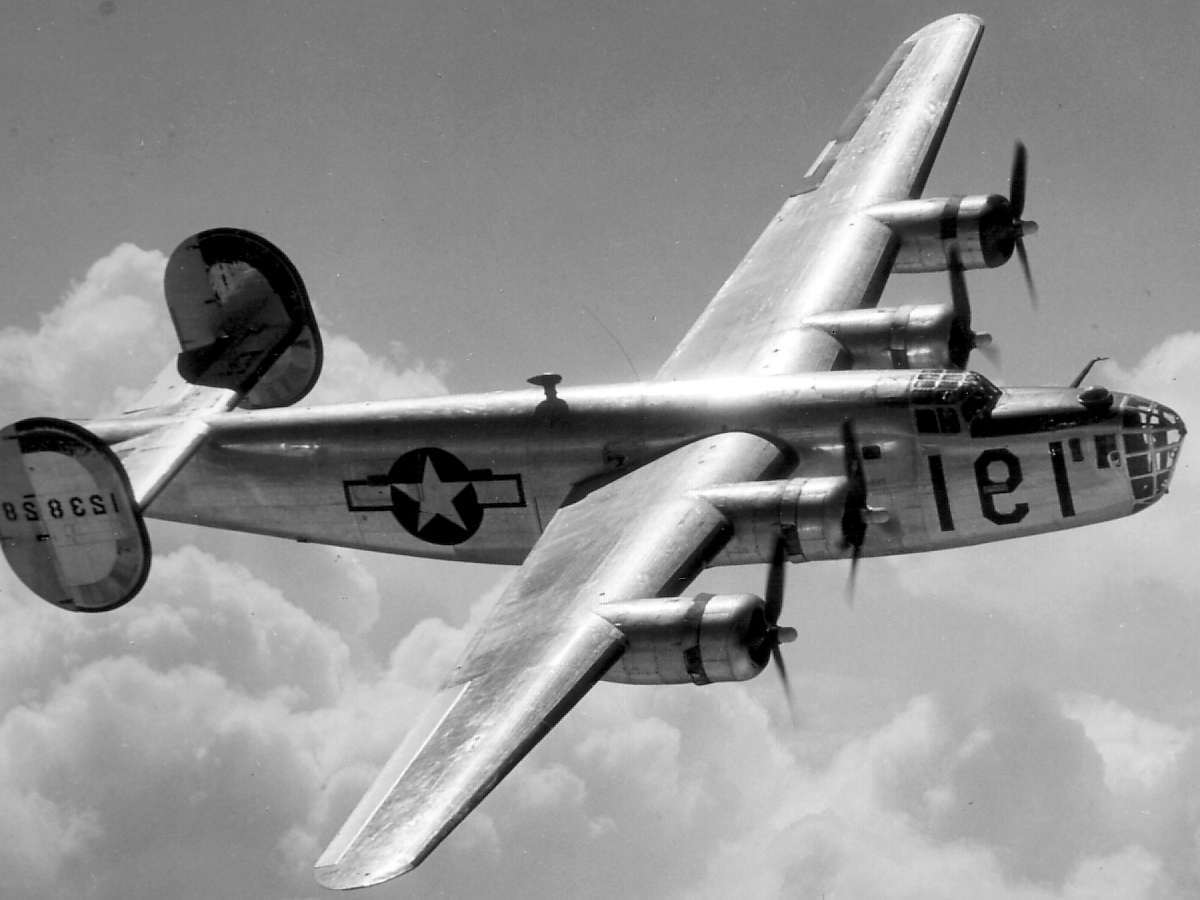
B24
B-24
B-24: often compared to the better known B-17 Flying Fortress, the B-24 was a more modern design with a higher top speed and greater range yet it had a similar bomb load and defensive armament. Nevertheless, popular opinion among aircrews and general staff tended to favor the B-17's rugged qualities above all other considerations. The B-24 was notorious among American air crews for its tendency to catch fire. The placement of the B-24's fuel tanks throughout the upper fuselage and its lightweight construction, designed both to increase range and optimize assembly line production, made the aircraft vulnerable to battle damage
The B24 ( B-24 )was employed in operations in every combat theater during the war. Because of B24 s great range, it was particularly suited for such missions as the famous raid from North Africa against the oil industry at Ploesti, Rumania, Aug. 1, 1943. This feature also made the airplane suitable for long, over-water missions in the Pacific Theater. More than 18,000 Liberators were produced.
B24 Specifications
- Span: 110 feet
- B24 Length: 66 feet, 4 inches
- Height: 17 feet, 11 inches
- B-24 Weight: 56,000 pounds loaded
- Armament: Ten .50-cal. machine guns and 8,000 pounds of bombs
- B24 Engines: Four Pratt &;Whitney R 1830s of 1,200 horsepower each
- Cost: $336,000
B24 Performance
- B-24 Maximum speed: 303 mph.
- B24 Cruising speed: 175 mph.
- B-24 Range: 3,200 mph.
- B24 Service Ceiling: 28,000 feet
B-24 Variants and conversions
X B-24 (Consolidated Model 32)
Designed in 1938 as an improvement on the B-17 Flying Fortress, at the request of the Army Air Corps. It had a wing specially designed for a high aspect ratio, tricycle landing gear, and twin vertical stabilizers. The XB-24 was ordered in 1939 March, and first flew on 29 December 1939. (Total: one)
Y B-24 / LB-30A Preproduction prototypes
Six examples were sent to Great Britain under lend-lease, under the designation LB-30A.
B-24
Service test version of the XB-24, ordered on 27 April 1939, less than 30 days after the XB-24 was ordered, before the XB-24 design was complete. A number of minor modifications were made: elimination of leading edge slots, addition of de-icing boots. (Total: seven; only one used for actual testing)
B-24 ex-"Diamond Lil" from the Commemorative Air Force collection. Airframe returned to B-24 A configuration in 2007 and renamed "Ol 927".
B24 A/LB-30B
Ordered in 1939, the B-24A was the first production model. Due to the need for heavy bombers, the B-24A was ordered before any version of the B-24 flew. The main improvement over the XB-24 was improved aerodynamics, which led to better performance. Some sent to Great Britain under Lend Lease as LB-30B. (Total: 38,20 LB-30Bs, nine B-24Cs)
X B-24 B
When the XB-24 failed to reach its projected top speed, the Pratt & Whitney R-1830-33 radials rated at 1,000 hp (746 kW) it carried were replaced with R-1830-41 turbo-supercharged radials rated at 1,200 hp (895 kW), increasing its top speed by 37 mph (59 km/h). The addition of the turbo-superchargers made the engine cowlings elliptical. The XB-24B version also lacked the engine slots of the original. (Total: one converted XB-24)
B-24C
Conversion of the B-24A using turbo-supercharged R-1830-41 engines. To hold the supercharger and the intercooler intake, the cowlings were made elliptical and the new items added on the sides. The tail gunner position was improved by adding an Emerson A-6 power turret with twin .50-caliber (12.7 mm) machine guns; a Martin power turret was added to the forward fuselage. (Total: nine converted B-24As)
B-24 D
First model produced on a large scale; ordered from 1940 to 1942, as a B-24C with better engines (R-1830-43 supercharged engines). During the production run, the tunnel gun in the belly was replaced by a remote-sited Bendix belly turret; this was later replaced by a Sperry ball turret. In late B-24Ds, 'cheek' guns were added. (Total: 2696, 2381 Consolidated, San Diego; 305 Consolidated, Fort Worth, ten Douglas, Tulsa, Oklahoma)
B-24 E
A slight alteration of the B-24D built by Ford, using R-1830-65 engines. Unlike the B-24D, the B-24E retained the tunnel gun in the belly. The USAAF used the B-24E's primary as training aircraft since this model was not current in armaments and other technology as the aircraft being produced by Consolidated / San Diego (CO). Ford also built sub-assemblies for Douglas; these sub-assemblies were identical to Ford-built B-24Es, except that they used the same engines as the B-24D (R-1830-43 radials). These sub-assemblies were called PK ships and were shipped by truck from Willow Run to the final assembly in Tulsa, Oklahoma. (Total: 801)
X B-24 F
A prototype made to test thermal de-icers, instead of the standard inflatable rubber "boots." (Total: one converted B-24D)
B-24 G
Sperry ball turret, three .50 caliber- (12.7 mm) machine guns in nose. All B-24Gs were built by North American Aviation, which was contracted in 1942. (Total: 25)
B-24G-1
Modified Emerson A-6 tail turret in nose instead of two- three .50 caliber (12.7 mm) machine guns in earlier models. The B-24G-1 was based on the design of the B-24H (Total: 405)
B24 H
Because of obvious vulnerability of the B-24 to head-on attack, the B-24 H design made by Ford used a nose turret, generally a modified Emerson A-6 tail turret. The entire aircraft was redesigned to better fit the turret; 50 airframe changes were made, including a redesigned bombardier compartment. The tail turret was given larger windows for better visibility, the top turret a higher bubble, and the waist gunner positions were offset, to reduce their interference during battle. (Total: 3100)
Consolidated B-24J-55-CO Liberator, Serial number 42-99949 belonged to 93rd BG, 328th BS; lost 21 September 1944 over Belgium. Consolidated B-24J-55-CO Liberator, Serial number 42-99949 belonged to 93rd BG, 328th BS; lost 21 September 1944 over Belgium.
B-24 J
The B-24J was very similar to the B-24H, although the defensive improvements made in the B-24H were not incorporated in the B-24J. The B-24J featured an improved autopilot (type C-1) and a bombsight of the M-1 series. B-24H sub-assemblies made by Ford and constructed by other companies and any model with a C-1 or M-1 retrofit, were all designated B-24Js. (Total: 6678)
X B24 K
An experimental aircraft, made by Ford by splicing a B-23 Dragon tail empennage onto a B-24D airframe. The aircraft was more stable and had better handling than other models, but changing the B-24 design was too expensive to do at the time. However, the XB-24K was the ancestor of the Navy's PB4Y-1. (Total: one converted B-24D)
B-24L
Because of the immense weight of the B-24J, the Army pushed for a lighter version. In the B-24L, the ball turret was replaced by a floor ring mount with two .50 caliber (12.7 mm) machine guns, and the A-6B tail turret by an M-6A. In later aircraft, no tail armament was installed, and when it arrived at its airfield, either an A-6B, an M-6A, or a dual-mount manual .50-caliber (12.7 mm) gun was field-installed. (Total: 1667)
B24 M
An enhancement of the B-24L with further weight-saving devices. The B-24M used a more lightweight version of the A-6B tail turret; the waist gunner positions were left open. For better visibility, the windshield was replaced by a "knife-edge" dual pane versions. The B-24M became the last production model of the B-24; a number of the B-24s built flew only the course between the factory and the scrap heap. (Total: 2593)
X B24 N
A redesign of the B-24J, made to accommodate a single tail. It also featured improved nose and tail turrets. While 5168 B-24Ns were ordered, World War II ended and there was no longer any need for them. (Total: one)
Y B-24 N
Pre-production service test version of the XB-24N. (Total: seven)
X B-24 P
A modified B-24D, made by Sperry Gyroscope Company to test airborne fire control systems. (Total: one converted B-24D)
X B-24 Q
A General Electric conversion of the B-24L, using radar-controlled tail turrets. (Total: one converted B-24L).
XB-41
Because there were no fighters capable of escorting bomber formations on deep strike missions early in World War II, the Army authorized tests for heavily armed bombers to act as escorts for bombing missions. It was completed in 1942. The results of 1943 testing were very negative and the project was quickly cancelled. Performance changed drastically with the addition of more turrets. The escorts were also unable to keep up with bomber formations once the bombs had been dropped.
The XB-41 had 14, .50-caliber (12.7 mm) machine guns, through the addition of a Bendix chin turret and a dorsal Martin power turret on the mid-fuselage. (Total: one converted B-24D)
AT-22 or TB-24
R B-24 L
Developed for training B-29 gunners on an identical remote gun system installed on a B-24L.
T B-24 L
As with the RB-24L, but with additional radar equipment.
C-87 Liberator Express
Passenger transports with accommodation for 20 passengers.
XF-7
Photographic reconnaissance variant developed from the B-24D.
F-7
Photographic reconnaissance variant developed from the B-24H; -FO block.
F-7A
Photographic reconnaissance variant developed from the B-24J; three cameras in the nose and three in the bomb bay.
F-7B
Photographic reconnaissance variant developed from the B-24J; six cameras in the bomb bay.
U.S. Navy Nomenclature and Subvariants
PB4Y-1
B-24 D with different nose turret for U.S. Navy. Designation later applied to all G, J, L and M models received by the U.S. Navy.
PB4Y-1P
Photographic reconnaissance variant developed from the PB4Y-1.
PB4Y-2 Privateer
- RY-1
- U.S. Navy designation for the C-87A.
- RY-2
- U.S. Navy designation for the C-87.
- RY-3
- Transport variant of the PB4Y-2.
British Nomenclature and subvariants
Liberator B Mk I
B-24A (Total: 20), used in British Coastal Patrol and Defense Squadrons.
Liberator B Mk II
The first combat ready B24. The modifications included a three foot nose extension as well as a deeper aft fuselage and wider tailplane – there was no direct B-24 equivalent but similar to the B-24 C - built to meet British specifications with British equipment and armament. A small series of B Mk IIs were reconstructed as unarmed transports, designated the LB-30 with the USAAF. (Total production: 165)
Liberator B Mk III
B-24 D variant with single .303 Browning machine gun in the nose, two in each beam position, and four in a Boulton Paul tail turret similar to that on the Lancaster, as well as, other British equipment. The Martin dorsal turret was retained. (Total: 156)
Liberator B Mk IIIA
Lend-Lease B-24Ds with American equipment and weapons.
Liberator B Mk IV
Reserved for the B-24E, but there is no record of the RAF actually receiving any.
Liberator B Mk V
B-24D modified for extra fuel capacity at the cost or armor, with the same armament fit as the Liberator Mk III.
Liberator B Mk VI
B-24Hs in RAF service fitted with Boulton Paul tail turrets, but retaining the rest of their armament.
Liberator B Mk VIII
RAF designation for B-24Js.
Liberator GR Mk V
B24 D modified by RAF Coastal Command for the anti-submarine role with search radar and Leigh Light. Some were fitted with eight zero-length rocket launchers, four on each wing.
Liberator GR Mk VI
B24 G/H/J type used as a long-range general reconnaissance aircraft by RAF Coastal Command.
Liberator GR Mk VIII
B-24J modified by RAF Coastal Command for the anti-submarine role.
Liberator C Mk VI
Liberator B Mk VIII converted for use as a transport.
Liberator C Mk VII
British designation for C-87.
Liberator C Mk VIII
Liberator G Mk VIII converted for use as a transport.
Liberator C Mk IX
RAF designation for the RY-3/C-87C
B24 PRODUCTION
Continued development work by Consolidated produced a handful of transitional B-24Cs with turbocharged instead of supercharged engines. The turbocharged engines led to the flattened oval nacelles that distinguished all subsequent Liberator models.
The first mass-produced model was the B-24D (Liberator III in British service), entering service in early 1943. It had turbocharged engines and increased fuel capacity. Three more 0.50 caliber (12.7 mm) machine guns brought the defensive armament up to 10 machine guns. At 59,524 lb (27,000 kg) maximum takeoff weight, it was one of the heaviest aircraft in the world; comparable with the British "heavies" the Stirling, Lancaster and Halifax.
B-24s under construction at Ford Motor's Willow Run plant
Production of B-24s increased at an astonishing rate throughout 1942 and 1943. Consolidated Aircraft tripled the size of its plant in San Diego and built a large new plant outside Fort Worth, Texas. More B-24s were built by Douglas Aircraft in Tulsa, Oklahoma. North American Aviation built a plant in Dallas, Texas, which produced B-24Gs and B-24Js.[citation needed] None of these were minor operations, but they were dwarfed by the vast new purpose-built factory constructed by the Ford Motor Company at Willow Run near Detroit, Michigan. Ford broke ground on Willow Run in the spring of 1941, with the first plane coming off the line in October 1942. It had the largest assembly line in the world (3,500,000 ft?/330,000 m?). At its peak, the Willow Run plant produced 650 B-24s per month in 1944. By 1945, Ford made 70% of all B-24s in two nine-hour shifts. Pilots and crews slept on 1,300 cots at Willow Run waiting for their B-24s to roll off the assembly line. At Willow Run, Ford produced half of 18,000 total B-24s.
Each of the B-24 factories was identified with a production code: Consolidated/San Diego, CO; Consolidated/Fort Worth, CF; Ford/Willow Run, FO; North American, NT; and Douglas/Tulsa, DT.
In 1943, the model of Liberator considered by many the "definitive" version was introduced. The B24 H was 10 in (25 cm) longer, had a powered gun turret in the upper nose to reduce vulnerability to head-on attack and was fitted with an improved bomb sight, autopilot, and fuel transfer system. Consolidated, Douglas and Ford all manufactured the B-24H, while North American made the slightly different B-24G. All five plants switched over to the almost identical B-24J in August 1943. The later B24 L and B24 M were lighter-weight versions and differed mainly in defensive armament.[citation needed] WASP pilots (left to right) Eloise Huffines Bailey, Millie Davidson Dalrymple, Elizabeth McKethan Magid and Clara Jo Marsh Stember, with a B-24 in the background
As the war progressed, the complexity of servicing the Liberator continued to increase. The B24 variants made by each company differed slightly, so repair depots had to stock many different parts to support various models. Fortunately, this problem was eased in the summer of 1944, when North American, Douglas, and Consolidated Aircraft at Fort Worth stopped making B-24s, leaving only the Consolidated plant in San Diego and the Ford plant in Willow Run.[citation needed]
In all, 18,482 B-24s were built by September 1945. Twelve thousand saw service with the USAAF. The U.S. Navy operated about 1,000 PB4Y-1s, and almost 800 PB4Y-2 Privateers which were derived from the B-24. The Royal Air Force flew about 2,100 B-24s in 46 bomber groups and 41 squadrons; the Royal Canadian Air Force 1,200 B-24Js; and the Royal Australian Air Force (RAAF) 287 B-24Js, B-24Ls, and B-24Ms. Liberators were the only heavy bomber flown by the RAAF in the Pacific. Two squadrons of the South African Air Force based in Italy flew B24s.
The B-24 was more difficult to fly as well, with heavy control forces and poor formation flying characteristics. The B-24 nevertheless provided excellent service in a variety of roles thanks to its large payload and long range.