Plate 001 — Intelligence
REF: BF-INT-001WW2 Third Reich Organization
WW2 3rd REICH
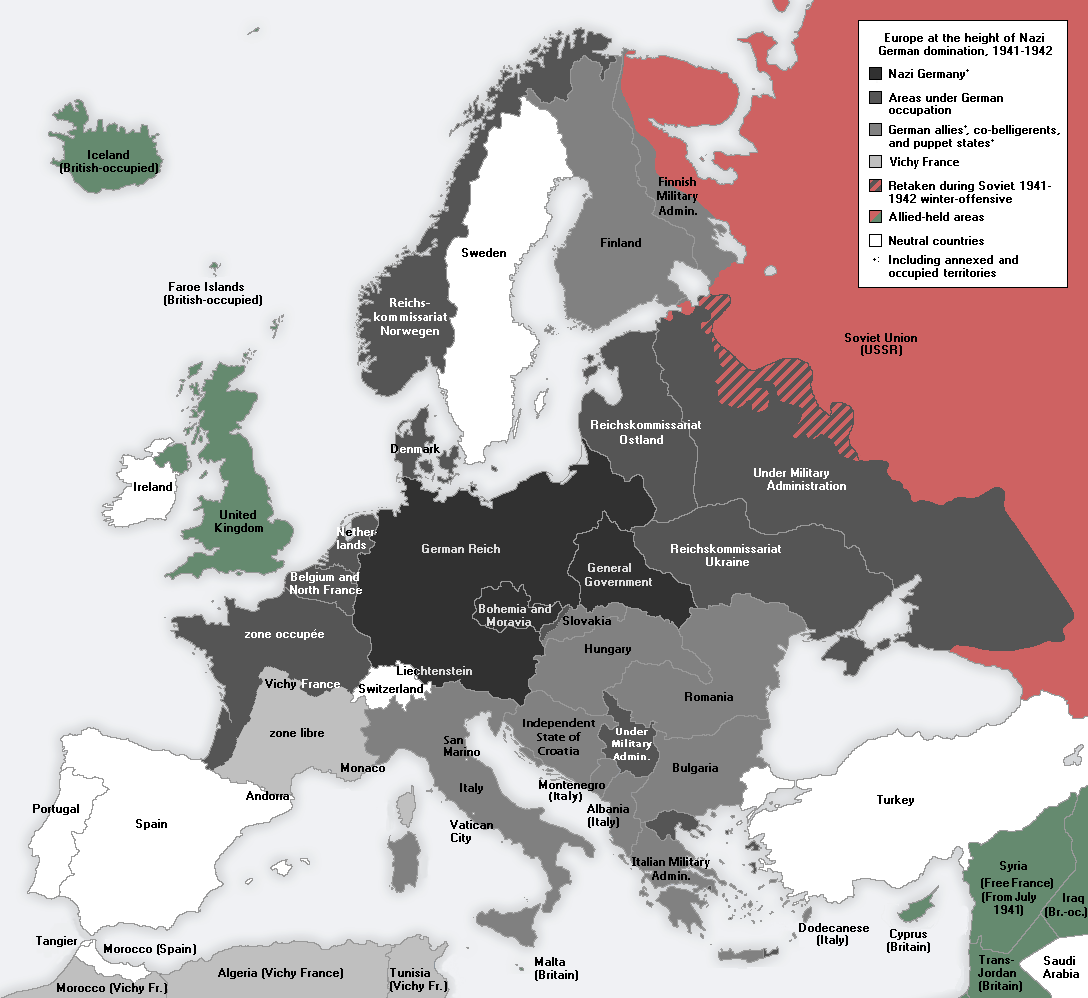 Third Reich Map
Organizations in The Third Reich
The leaders of Nazi Germany created a large number of different organisations for the purpose of helping them in staying in power. The character of the most of them is typical for totalitarian regimes, although most countries do have armed forces of some sort.
Military
- Oberkommando der Wehrmacht (OKW) -- Armed Forces High Command
- Oberkommando des Heeres (OKH) -- Army High Command
- Oberkommando der Marine (OKM) -- Navy High Command
- Oberkommando der Luftwaffe (OKL) -- Airforce High Command
- Wehrmacht -- Armed Forces
- Heer -- Army
- Luftwaffe -- Airforce
- Kriegsmarine -- Navy
- Oberbefehlshaber West
- Abwehr -- Military Intelligence
Paramilitary organisations
SA -- Sturmabteilung SS -- Schutzstaffel Waffen-SS Deutscher Volkssturm
- State police
- - Reich Central Security Office (RSHA - Reichssicherheitshauptamt)
- - Regular Police (Ordnungspolizei (ORPO))
- - Schutzpolizei (Safety Police)
- - Gendarmerie (Rural Police)
- - Gemeindepolizei (Local Police)
- - Security Police (Sicherheitspolizei (SIPO))
- - Geheime Staatspolizei (Gestapo)
- - Reich Kriminalpolizei (Kripo)
- - Sicherheitsdienst (SD)
Political organizations
- Nazi Party -- National Socialist German Workers Party (abbreviated NSDAP)
- Youth organisations
- Hitler-Jugend -- Hitler-youth (for boys and young men)
- Bund Deutscher Mädel (for girls and young women)
- Labour organisations
- Deutsche Arbeitsfront
- Kraft durch Freude
Wehrmacht
The unified armed forces of Germany from 1935 to 1945 were called the Wehrmacht. This included the Heer (army), Kriegsmarine (navy), and the Luftwaffe (air force). From 2 August 1934, members of the armed forces were required to pledge an oath of unconditional obedience to Hitler personally. In contrast to the previous oath, which required allegiance to the constitution of the country and its lawful establishments, this new oath required members of the military to obey Hitler even if they were being ordered to do something illegal. Hitler decreed that the army would have to tolerate and even offer logistical support to the Einsatzgruppen—the mobile death squads responsible for millions of deaths in Eastern Europe—when it was tactically possible to do so.Members of the Wehrmacht also participated directly in the Holocaust by shooting civilians or undertaking genocide under the guise of anti-partisan operations.
In spite of efforts to prepare the country militarily, the economy could not sustain a lengthy war of attrition such as had occurred in World War I. A strategy was developed based on the tactic of Blitzkrieg (lightning war), which involved using quick coordinated assaults that avoided enemy strong points. Attacks began with artillery bombardment, followed by bombing and strafing runs. Next the tanks would attack and finally the infantry would move in to secure any ground that had been taken.Victories continued through mid-1940, but the failure to defeat Britain was the first major turning point in the war. The decision to attack the Soviet Union and the decisive defeat at Stalingrad led to the retreat of the German armies and the eventual loss of the war. The total number of soldiers who served in the Wehrmacht from 1935 to 1945 was around 18.2 million, of whom 5.3 million died.
SA and SS
Sturmabteilung (SA; Storm Detachment; Brownshirts), founded in 1921, was the first paramilitary wing of the Nazi Party. Their initial assignment was to protect Nazi leaders at rallies and assemblies.[197] They also took part in street battles against the forces of rival political parties and violent actions against Jews and others.By 1934, under Ernst Röhm's leadership, the SA had grown to over half a million members—4.5 million including reserves—at a time when the regular army was still limited to 100,000 men by the Versailles Treaty.
Rohm hoped to assume command of the army and absorb it into the ranks of the SA.[200] Hindenburg and Defence Minister Werner von Blomberg threatened to impose martial law if the alarming activities of the SA were not curtailed.[201] Hitler also suspected that Röhm was plotting to depose him, so he ordered the deaths of Röhm and other political enemies. Up to 200 people were killed from 30 June to 2 July 1934 in an event that became known as the Night of the Long Knives.[202] After this purge the SA was no longer a major force.
Initially a force of a dozen men under the auspices of the SA, the Schutzstaffel (SS) grew to become one of the largest and most powerful groups in Nazi Germany.Led by Reichsführer-SS Heinrich Himmler from 1929, the SS had over a quarter million members by 1938 and continued to grow.Himmler envisioned the SS as being an elite group of guards, Hitler's last line of defence.The Waffen-SS, the military branch of the SS, became a de facto fourth branch of the Wehrmacht.
In 1931 Himmler organised an SS intelligence service which became known as the Sicherheitsdienst (SD; Security Service) under his deputy, SS-Obergruppenführer Reinhard Heydrich.This organisation was tasked with locating and arresting communists and other political opponents. Himmler hoped it would eventually totally replace the existing police system.Himmler also established the beginnings of a parallel economy under the auspices of the SS Economy and Administration Head Office. This holding company owned housing corporations, factories, and publishing houses.
From 1935 forward the SS was heavily involved in the persecution of Jews, who were rounded up into ghettos and concentration camps.With the outbreak of World War II, SS units called Einsatzgruppen followed the army into Poland and the Soviet Union, where from 1941 and 1945 they killed more than two million people, including 1.3 million Jews. SS-Totenkopfverbände (death's head units) were in charge of the concentration camps and extermination camps, where millions more were killed.
NSDAPNazi Party leaders and officials
- Gunter d'Alquen
- Ludolf von Alvensleben
- Max Amann
- Benno von Arent
- Heinz Auerswald
- Hans Aumeier
- Arthur Axmann
- Erich von dem Bach
- Herbert Backe
- Richard Baer
- Alfred Baeumler
- Gottlob Berger
- Werner Best
- Hans Biebow
- Gottfried Graf von Bismarck-Schönhausen
- Paul Blobel
- Werner von Blomberg
- Hans-Friedrich Blunck
- Josef Blösche
- Horst Böhme
- Ernst Boepple
- Ernst Wilhelm Bohle
- Martin Bormann
- Philipp Bouhler
- Viktor Brack
- Karl Brandt
- Alois Brunner
- Walter Buch
- Karl Buck
- Josef Bürckel
- Anton Burger
- Werner Catel
- Heinrich Cla?
- Carl Clauberg
- Leonardo Conti
- Kurt Daluege
- Richard Walther Darr?
- Joseph "Sepp" Dietrich
- Otto Dietrich
- Oskar Dirlewanger
- Horst Dressler-Andress
- Irmfried Eberl
- Adolf Eichmann
- Theodor Eicke
- August Eigruber
- Hermann Esser
- Richard Euringer
- Karl Fiehler
- Ludwig Fischer
- Albert Forster
- Hans Frank
- Karl Hermann Frank
- Roland Freisler
- Wilhelm Frick
- Hans Fritzsche
- Walther Funk
- Karl Gebhardt
- Achim Gercke
- Kurt Gerstein
- Odilo Globocnik
- Richard Glücks
- Joseph Goebbels
- Wilhelm Gocke
- Hermann Goring
- Amon Göth
- Ulrich Greifelt
- Robert Ritter von Greim
- Arthur Greiser
- Wilhelm Grimm
- Walter Gro?
- Kurt Gruber
- Hans Günther
- Franz Gärtner
- Eugen Hadamovsky
- Ernst Hanfstaengel
- Karl Hanke
- Fritz Hartjenstein
- Paul Hausser
- Franz Hayler
- Heinrich Heim
- August Heißmeyer
- Otto Herzog
- Rudolf He?
- Walther Hewel
- Werner Heyde
- Reinhard Heydrich
- Konstantin Hierl
- Erich Hilgenfeldt
- Heinrich Himmler
- Hans Hinkel
- August Hirt
- Adolf Hitler
- Hermann Höfle
- Rudolf H??
- Franz Hofer
- Karl Holz
- Karl Jäger
- Ernst Jarosch
- Friedrich Jeckeln
- Alfred Jodl
- Hanns Johst
- Hans Jüttner
- Rudolf Jung
- Ernst Kaltenbrunner
- Karoly Kampmann
- Karl Kaufmann
- Wilhelm Keitel
- Wilhelm Keppler
- Hanns Kerrl
- Dietrich Klagges
- Wilhelm Kleinmann
- Helmut Knochen
- Erich Koch
- Ilse Koch
- Karl Otto Koch
- Max Kögel
- Franz Konrad
- Wilhelm Koppe
- Josef Kramer
- Fritz Krebs
- Bernhard Krüger
- Friedrich Wilhelm Krüger
- Gustav Krupp
- Hans Lammers
- Herbert Lange
- Adolf Lenk
- Robert Ley
- Arthur Liebehenschel
- Julius Lippert
- Michael Lippert
- Dietrich Loder
- Wilhelm Loeper
- Georg Lörner
- Hinrich Lohse
- Werner von Lorenz
- Hanns Ludin
- Martin Luther
- Viktor Lutze
- Emile Maurice
- Kurt Mayer
- Herbert Mehlborn
- Josef Mengele
- Alfred Meyer
- Konrad Meyer
- Kurt Meyer
- Heinrich Müller
- Eugen M?ndler
- Alfred Helmut Naujoks
- Arthur Nebe
- Hermann Neef
- Karl Neuhaus
- Konstantin Freiherr von Neurath
- Herta Oberheuser
- Otto Ohlendorf
- Helmuth von Pannwitz
- Otto Paul
- Joachim Peiper
- Salomon Franz von Pfeffer
- Henry Picker
- Paul Pleiger
- Oswald Pohl
- Franz von Pfeffer
- Erich Priebke
- Hans-Adolf Prützmann
- Karl Rahm
- Rudolf Rahn
- Friedrich Rainer
- Erich Rajakowitsch
- Sigmund Rascher
- Walther Rauff
- Hermann Rauschning
- Hanns Rauter
- Walter Reder
- Wilhelm Reinhard
- Fritz Reinhardt
- Adrian von Renteln
- Joachim von Ribbentrop
- Rolf Rienhardt
- Ernst Röhm
- Erwin Rösener
- Alfred Rosenberg
- Wilhelm Ruder
- Ernst Rudin
- Bernhard Rust
- Fritz Sauckel
- Hjalmar Schacht
- Emanuel Schaefer
- Gustav Adolf Scheel
- Walter Schellenberg
- Hans Schemm
- Wilhelm Schepmann
- Baldur von Schirach
- Franz Schlegelberger
- Albrecht Schmelt
- Carl Schmitt
- Kurt Schmitt
- Paul Schmitthenner
- Gertrud Scholtz-Klink
- Kurt Freiherr von Schröder
- Walther Schultze
- Arthur Sch?rmann
- Franz Xaver Schwarz
- Heinrich Schwarz
- Siegfried Seidl
- Franz Seldte
- Arthur Sey?-Inquart
- Gustav Simon
- Albert Speer
- Walter Stang
- Franz Stangl
- Johannes Stark
- Otto Steinbrink
- Gregor Straßer
- Otto Straßer
- Julius Streicher
- Jürgen Stroop
- Otto von Stülpnagel
- Friedrich Syrup
- Josef Terboven
- Otto Thierack
- Fritz Todt
- Hans Trummler
- Hans von Tschammer und Osten
- Xavier Vallat
- Albert Vögler
- Hermann Vo?
- Hilmar Wäckerle
- Otto Wagener
- Adolf Wagner
- Gerhard Wagner
- Josef Wagner
- Robert Wagner
- Christian Weber
- Wilhelm Wei?
- Horst Wessel
- Robert Wetzel
- Max Winkler
- Giselher Wirsing
- Christian Wirth
- Hermann Wirth
- Karl Wolff
- Adolf Ziegler
- Matthes Ziegler
- Wilhelm Ziegler
- Hans Zöberlein
- Franz Ziereis
The Reichskommissariat (Reich Commissariat) is the German designation for a type of administrative office headed by a government official known as a Reichskommissar (English: Reich Commissioner). Although many different such offices existed primarily throughout the Imperial German and Nazi periods in a number of different fields (such as public infrastructure, spatial planning, ethnic cleansing, etc.) it is most commonly used to refer to the quasi-colonial territorial units established by Nazi Germany in several occupied countries during World War II. While officially located outside of the German Reich in a legal sense, these entities were directly controlled by their supreme civil authorities (the Reichskommissars), who ruled their assigned territories as German governors on behalf of and as direct representatives of Adolf Hitler.
The introduction of these territorial administrations served a number of purposes. Those established or planned to be established in Western and Northern Europe were in general envisioned as the transitional phases for the future incorporation of various Germanic countries outside of pre-war Germany into an expanded Nazi state. Their eastern counterparts served primarily colonialist and imperialist purposes, as sources of future Lebensraum for German settlement and the exploitation of natural resources.
Another contrast was the level of administrative overhaul implemented in these two types. As in most other territories conquered by the Germans, local administrators and bureaucrats were pressured to continue their regular day-to-day operations (especially at the middle and lower levels) albeit under German oversight. Throughout the war the Reichskommissariats in Western and Northern Europe simply retained the previously existing administrative structure however, while in the eastern ones completely new such structures were introduced.
All of these entities were nonetheless intended for eventual integration into a Greater Germanic Reich (Grossgermanisches Reich) encompassing the general area of Europe stretching from the North Sea to the Ural mountains, for which Germany was to form the basis