Plate 021 — Aircraft
REF: BF-AIR-021F-117 Nighthawk Bomber: Specifications, Combat History and the Vega 31 Loss
A guide to the Lockheed F-117 Nighthawk, the first operational stealth aircraft, covering its Have Blue and Skunk Works origins, its combat record from Panama to Iraq, the 1999 loss of Vega 31 over Serbia, and its 2008 retirement.
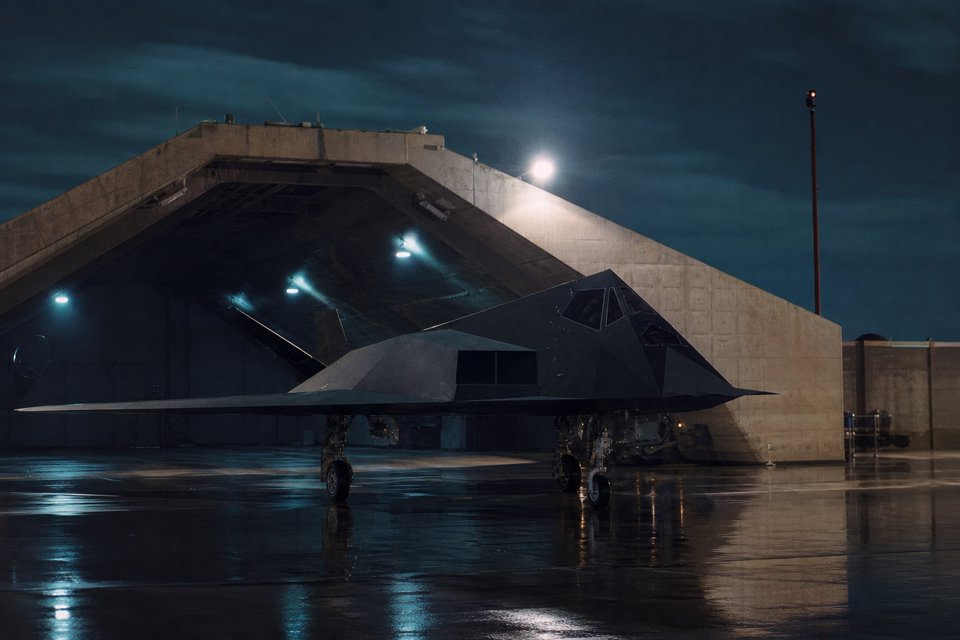
The Lockheed F-117 Nighthawk, developed by the Skunk Works under the Have Blue and Senior Trend programmes, was the world's first operational aircraft designed from the outset to exploit low-observable stealth technology. Before it was given an official name, the engineers and test pilots who developed it referred to the ungainly, angular airframe — which was flown mostly at night to avoid detection by Soviet reconnaissance satellites — as "the Cockroach," a nickname that has stuck in Skunk Works lore ever since, alongside the later, more pointed "Wobblin' Goblin" the operational squadrons never fully embraced. Lockheed built 64 examples between 1981 and 1990: 5 Have Blue and YF-117A prototypes plus 59 production F-117As. The US Air Force retired the type in 2008, though a portion of the fleet has continued flying test and training missions for years afterward.
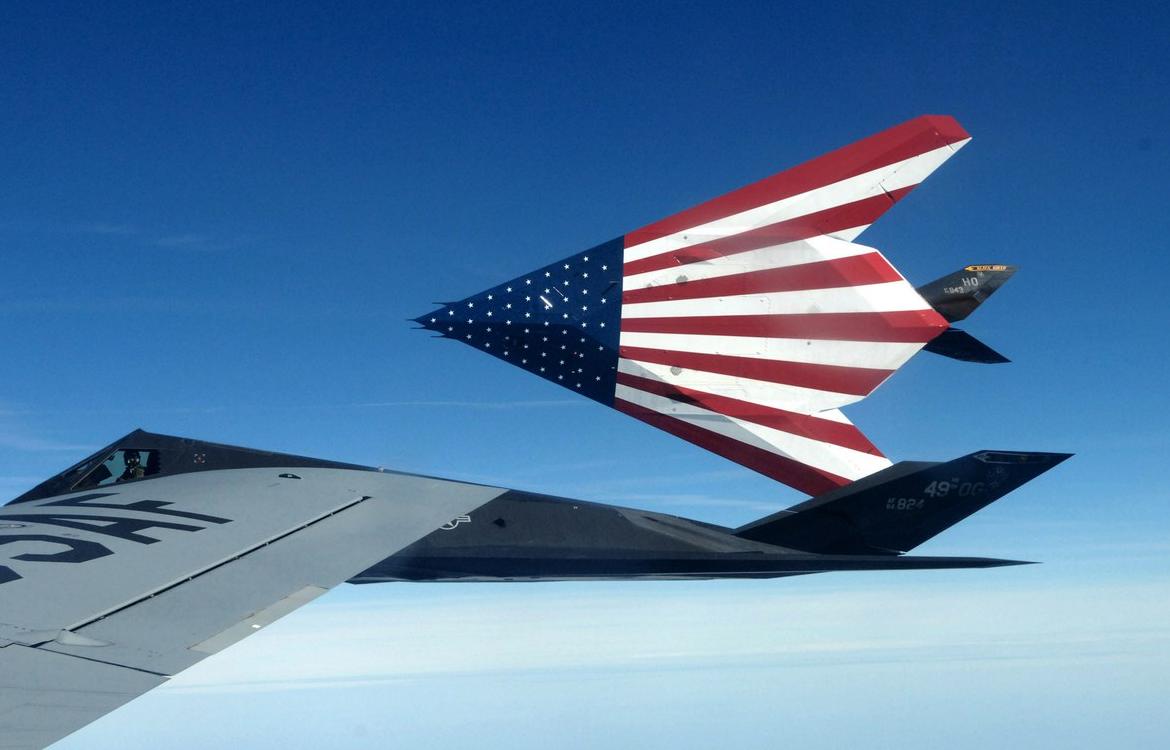
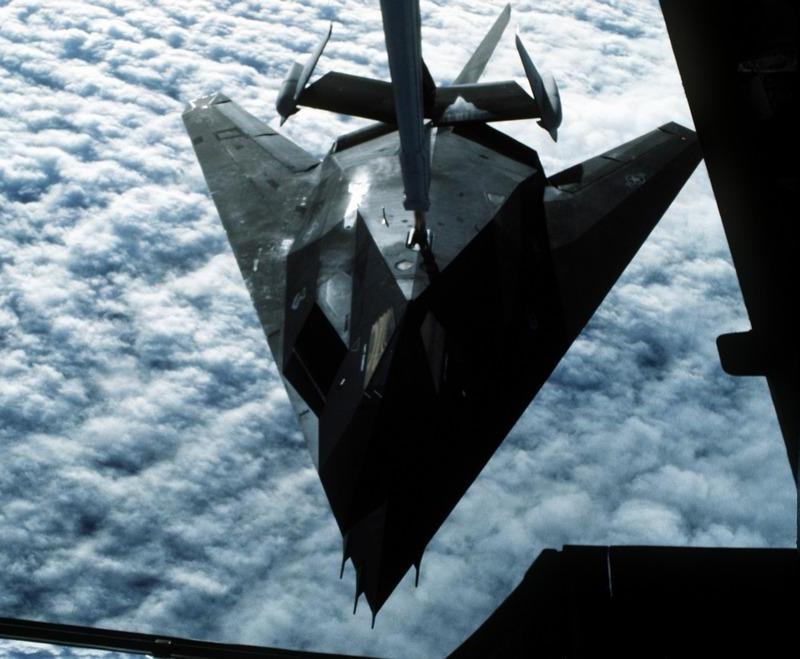
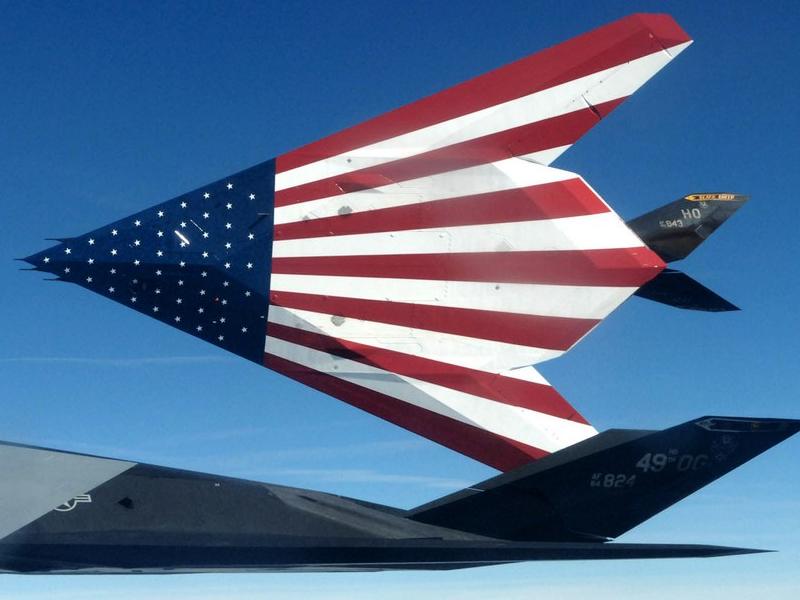
F-117 Nighthawk Specifications
| Specification | Detail |
|---|---|
| Manufacturer | Lockheed Advanced Development Projects ("Skunk Works") |
| Programme origin | Have Blue technology demonstrator, first flown 1 December 1977 |
| First flight (YF-117A) | 18 June 1981 |
| Total built | 64 (5 Have Blue/YF-117A prototypes, 59 production F-117A) |
| Retired (official) | 2008; a number retained for test and training use since |
| Crew | 1 |
| Length | 20.08 m (65 ft 11 in) |
| Wingspan | 13.20 m (43 ft 4 in) |
| Empty weight | 13,381 kg (29,500 lb) |
| Maximum take-off weight | 23,814 kg (52,500 lb) |
| Engines | 2x General Electric F404-F1D2 non-afterburning turbofans |
| Maximum speed | 1,040 km/h (646 mph), high subsonic |
| Armament | Up to two GBU-10 Paveway II or GBU-27 laser-guided bombs; no gun, no air-to-air missiles |
Design
The F-117 is classified as a fighter under the "F-" designation, but it was designed and used purely as a stealthy ground-attack aircraft, with no gun and no confirmed air-to-air capability despite occasional claims that it could carry Sidewinder missiles. The "F-" prefix has never been officially explained; the most commonly repeated account is that the US Air Force, which has traditionally been proudest of its fighters and least enthusiastic about ground-attack aircraft, judged that a "sexy" fighter designation would win the radical new stealth programme more political and budgetary support than an honest "A-" attack-aircraft or "B-" bomber label — and that the misleading name also served a security purpose, discouraging foreign intelligence services from correctly assessing the aircraft's actual role.
The design traces back to a 1975 Skunk Works model nicknamed "the Hopeless Diamond," a play on the Hope Diamond referencing its ungainly, multi-faceted shape. Working from Soviet physicist Pyotr Ufimtsev's published theoretical work on radar-wave diffraction, Skunk Works mathematician Bill Schroeder and computer scientist Denys Overholser wrote a program called Echo that let engineers, for the first time, design an airframe out of flat radar-scattering panels called facets, arranged so that the airframe reflected over 99 percent of a radar's signal energy away from its source rather than back toward it. Two 60-percent-scale technology-demonstrator aircraft were built under the Have Blue programme, which ran from 1976 to 1979; the first flew on 1 December 1977, and both prototypes — designated HB1001 and HB1002 — were eventually lost during the test campaign: HB1001 crashed on 4 May 1978 after its landing gear jammed on its 36th flight, and HB1002 was lost on 11 July 1979 on its 52nd flight after a loose exhaust clamp started an engine fire that damaged its hydraulics; both pilots, Bill Park and Ken Dyson, ejected safely. Despite the losses, the flight-test data the programme generated convinced the Air Force the faceted shape genuinely worked, paving the way for the follow-on Senior Trend programme that produced the F-117 itself. Have Blue's aerodynamics were notoriously poor by conventional fighter standards: because minimising radar reflections took priority over everything else, the airframe was deliberately unstable and could not have been flown at all without a quadruple-redundant fly-by-wire flight control system borrowed directly from the F-16 programme to constantly correct its attitude. The single-seat, twin-engine aircraft uses quadruple-redundant fly-by-wire flight controls to remain controllable at all, is air-refuellable to support long-range missions, and carries sophisticated navigation and attack avionics built around an automated mission-planning system developed specifically to exploit the aircraft's unique low-observable characteristics.
Weapons Bay
Every weapon the F-117 carries rides internally in a single centreline bomb bay, since hanging bombs or fuel tanks externally on pylons would have wrecked the airframe's carefully shaped radar signature the moment they were loaded. That internal bay limits the aircraft to two large weapons at most — typically a pair of 907 kg (2,000 lb) class laser-guided bombs such as the GBU-10 Paveway II or the penetrating GBU-27 — which is a modest load next to a conventional strike fighter's external stores, but the doctrine behind the F-117 never called for volume; a single well-placed 2,000 lb bomb delivered by an aircraft the enemy's radar could not reliably see was judged to be worth far more than a heavier but detectable strike package that might be intercepted before reaching its target.
Training a Single-Seat Stealth Pilot
Because the F-117 has only one seat, the Air Force could not train new pilots the conventional way, with an instructor riding along in a two-seat trainer version of the operational jet — no such F-117 trainer variant was ever built. New Nighthawk pilots were instead drawn from experienced fighter pilots, typically with prior time in aircraft like the F-111 or F-4, and worked up on the type using simulators and closely supervised solo sorties at Tonopah under instructors from the unit itself, with the aircraft's computerised mission-planning system doing much of the work of reducing pilot workload once airborne. That pipeline, unusual for a modern combat aircraft, is part of why F-117 squadrons stayed relatively small even at the programme's peak, and why pilots who did qualify on the type tended to treat their sequential "Bandit" number as a mark of a fairly exclusive club.
Sensors and Radar Signature
The F-117 carries no radar of its own, on the reasoning that an active radar transmits a signal an enemy can detect, and even a switched-off antenna still reflects energy back toward whoever is illuminating it — so the aircraft instead finds and tracks targets with a pair of passive forward-looking and downward-looking infrared sensors paired with a laser rangefinder and designator, and navigates primarily by GPS and a high-accuracy inertial navigation system rather than radar-aided positioning. Its automated mission-planning and attack computer can carry out most of a strike, including releasing weapons, with minimal pilot intervention once the mission profile is loaded. The airframe's radar cross-section — the effective size it presents to an enemy radar, as distinct from its physical size — has been publicly cited at around 0.001 square metres, several orders of magnitude smaller than that of a conventional fighter, achieved through the combination of faceted shaping, radar-absorbent skin materials, and careful attention to edge alignment so that reflections are steered away from likely threat directions rather than back at the source.
Life at Tonopah
Secrecy shaped daily life for F-117 crews as much as it shaped the aircraft. Pilots and maintainers based at Tonopah Test Range lived with their families in Las Vegas and commuted to the remote desert airfield by chartered aircraft and ground transport each working week, returning home only on days off, and pilots adopted the callsign "Bandit" followed by a number recording the sequence of their first F-117 flight — a numbering system Nighthawk pilots still use informally today as a mark of who flew the type and when. For years, airmen assigned to the programme were told to tell friends and family they flew the Northrop F-5 in an aggressor training role rather than reveal what they actually flew, a cover story that held until the Air Force's 1988 public acknowledgement of the aircraft finally let them describe their work honestly.
Development and Entry into Service
The decision to produce the F-117A was made on 1 November 1978, with a contract awarded to the Skunk Works in Burbank, California, under programme director Ben Rich. The YF-117A first flew on 18 June 1981, only 31 months after the full-scale development decision — a remarkably fast timeline the Skunk Works was already known for. The first production aircraft was delivered in 1982, and the type reached initial operational capability in October 1983 with the 4450th Tactical Group, whose Nighthawks were based at Tonopah Test Range Airport, Nevada, and flown almost exclusively at night to preserve secrecy. Because the programme was classified, the 4450th was nominally listed as flying A-7 Corsair II aircraft out of Nellis Air Force Base, and ground crews commuted to Tonopah on dedicated "Key Air" passenger flights rather than being based there openly. The Air Force publicly acknowledged the aircraft's existence only in 1988, when it released a grainy official photograph, and the type's first public flight before a crowd came in April 1990, when two F-117s landed at Nellis Air Force Base in daylight. The last of the 59 production airframes was delivered in the summer of 1990, and in 1992 the entire fleet relocated from Tonopah to Holloman Air Force Base, New Mexico, placing it under the 49th Fighter Wing. Programme oversight ran through the Aeronautical Systems Center at Wright-Patterson Air Force Base, Ohio, which combined the still-classified stealth technology with concurrent development and production to get the aircraft into service unusually quickly, while day-to-day logistics support was handled by the Sacramento Air Logistics Center at McClellan Air Force Base, California, and ongoing weapon-system improvements were managed through USAF Plant 42 at Palmdale, California — the same Southern California industrial complex where Lockheed's Skunk Works had built the airframes in the first place.
Ben Rich, who took over the Skunk Works from its founder Kelly Johnson and led the F-117 programme through development, later wrote about the effort in his 1994 memoir Skunk Works, co-authored with journalist Leo Janos, which remains one of the most widely read first-hand accounts of how a classified American stealth programme was actually designed, tested and fielded under wartime-style secrecy during peacetime.
The name Nighthawk itself was not officially assigned until relatively late in the programme; for years the aircraft flew under its internal Senior Trend designation with no public name at all, since the Air Force had not planned to acknowledge its existence, let alone christen it.
Holloman remained the F-117's only US home for the rest of its operational life, and the 49th Fighter Wing's badge and lineage still carry the distinction of having flown the world's first stealth fighter through its entire front-line career, from the type's public unveiling in 1988 to its retirement two decades later.
Squadrons
Across its 27 years of service, the F-117 fleet was organised under three successive commands as the programme moved out of the shadows and, eventually, toward retirement.
| Unit | Base | Active |
|---|---|---|
| 4450th Tactical Group | Tonopah Test Range, Nevada | 1979-1989 |
| 4450th / 4451st F-117 Tactical Squadrons | Tonopah Test Range | 1981-1989 |
| 4453rd Test and Evaluation Squadron | Tonopah Test Range | 1985-1989 |
| 37th Tactical Fighter Wing | Tonopah Test Range | 1989-1992 |
| 415th / 416th / 417th F-117 Squadrons | Tonopah Test Range | 1989-1992 |
| 49th Fighter Wing | Holloman AFB, New Mexico | 1992-2008 |
| 7th / 8th / 9th F-117 Fighter Squadrons | Holloman AFB | 1992-2006/2008 |
| 410th Flight Test Squadron | Edwards AFB, California | 1993-2008 |
Combat History
The F-117's first combat use came during the US invasion of Panama in December 1989, when two Nighthawks dropped bombs on Rio Hato airfield. Its largest and most publicised combat role came during the 1991 Gulf War, when F-117s flew roughly 1,300 sorties over 6,905 combat flying hours and struck more than 1,600 high-value targets in Iraq. Although the 37th Tactical Fighter Wing's 42 F-117s made up only about 2.5 percent of allied strike aircraft in theatre, they were tasked against more than 40 percent of the strategic target set attacked in the war's opening days, including some of the only strikes flown directly against targets in downtown Baghdad — a distinction the Nighthawk shared with the F-16s that flew the large daylight "Package Q" raid on the Iraqi capital on 19 January 1991. Precision performance during the war was disputed after the fact: figures cited immediately afterward put the F-117's laser-guided bomb hit rate at better than 80 percent, but later independent assessments scaled that figure back to somewhere in the range of 41 to 60 percent once analysts accounted for weapons that missed, malfunctioned, or hit the wrong aim point within a target complex. From Holloman, the 49th Fighter Wing's F-117s went on to fly non-stop deployments to Southwest Asia — including an approximately 18.5-hour non-stop flight from New Mexico to Kuwait that stood for years as a record for single-seat fighter aircraft — and the type saw further combat over Serbia during Operation Allied Force in 1999, over Afghanistan during Operation Enduring Freedom in 2001, and over Iraq again during Operation Iraqi Freedom in 2003 — where two Nighthawks dropped the opening bombs of the war on the Dora Farms complex outside Baghdad in an unsuccessful attempt to kill Saddam Hussein before the wider air campaign began.
Despite the airframe's odd, angular looks, F-117 pilots have long pushed back on one of the aircraft's most persistent nicknames, "Wobblin' Goblin," which originated during the early flight-test years when the deliberately unstable airframe genuinely was difficult to handle at low speed; those who flew the operational F-117A maintained that the production aircraft's fly-by-wire system handled entirely normally and that the name reflected Have Blue-era teething problems rather than anything true of the fielded fighter.
Loss over Serbia, 1999
The F-117's only combat loss came during the Kosovo War, on 27 March 1999. Colonel Zoltán Dani's 3rd Battalion, 250th Missile Brigade of the Serbian air defence force, equipped with the 1960s-vintage Isayev S-125 "Neva" system (NATO reporting name SA-3 "Goa"), tracked and destroyed an F-117A carrying the callsign "Vega 31," serial number 82-0806, with an upgraded Neva-M missile. According to NATO's then-commander General Wesley Clark and other Allied officers, Serbian operators had found that keeping their radars on unusually long wavelengths and using them only in short bursts let them briefly detect the F-117 despite its stealth shaping, and Dani's unit had also positioned visual spotters to track NATO strike patterns and anticipate the Nighthawk's approach routes. The pilot, Lieutenant Colonel Dale Zelko — misidentified for years afterward, since a different name had been painted on the aircraft's canopy — ejected safely and was rescued by a US Air Force combat search-and-rescue team several hours later. Because destroying the wreckage risked bad publicity from footage of Serbian civilians examining it, the remains were never bombed, and are reported to have been shown to Russian personnel afterward, a development Western analysts believed compromised elements of the then quarter-century-old stealth technology. Sections of the wrecked aircraft are still displayed today at the Museum of Aviation in Belgrade, near Belgrade Nikola Tesla Airport. A second F-117 was reportedly damaged during the same campaign and, although it returned to base, is said never to have flown again.
The Post-Desert Storm Production Debate
Desert Storm's publicity briefly revived interest in Washington in buying more F-117s rather than retiring the line after only 59 production aircraft. According to contemporary defence-press accounts, Georgia Senator Sam Nunn, then a senior voice on the Senate Armed Services Committee, argued that the Air Force's plan to buy 72 more F-16s for roughly the same money as 24 additional F-117As made poor sense given the stealth aircraft's showing in the war, and the Senate at one point voted to redirect funding from the F-16 order toward more Nighthawks. The Air Force itself opposed the idea: Lockheed, whose F-22 design had just won the Advanced Tactical Fighter competition, was reportedly told not to campaign publicly for a new F-117 production run for fear that Congress would see it as competing with F-22 funding, and the additional-aircraft proposal was ultimately overtaken by later budget votes and never funded. The Skunk Works kept its F-117 production tooling and jigs in storage regardless, and continued refining a family of internally funded upgrade proposals — the F-117A+, F-117B, its British-market F-117C variant, the F-117N and the A/F-117X — on the chance a customer eventually emerged; none did.
Variant Proposals in Detail
Beyond the basic naval-versus-land-based split described above, Lockheed's paper studies moved through several distinct configurations as requirements shifted. The RF-117A reconnaissance conversion was offered in two forms: a removable bomb-bay pallet carrying a sideways-looking electro-optical sensor, priced at around $213 million for 24 conversion kits and swappable back to a strike configuration in about four hours, and a more capable integral suite combining an infrared line scanner, an electro-optical camera and a datalink, estimated at $520 million for 24 aircraft in a 1992 proposal; neither was funded. The F-117A+ upgrade, projected at roughly $79 million for a prototype conversion, would have added an F-15-type undercarriage and an afterburning F414 engine alongside 18 additional low-observable technologies Lockheed did not publicly detail. The naval F-117N and its more ambitious derivative, the A/F-117X, doubled internal payload from 2,270 kg to 4,536 kg (5,000 to 10,000 lb), added folding wings, an arrester hook and an F-14-derived main undercarriage for carrier compatibility, and were pitched to the Navy at a projected unit cost near $70 million based on a 250-aircraft production run — well above what the Navy judged the single-mission aircraft was worth once the Joint Advanced Strike Technology programme promised a genuinely multirole stealth fighter instead.
Retirement and Later Flying
The Air Force officially retired the F-117 fleet in 2008, replacing its ground-attack stealth role with the multirole F-22 Raptor and the newer F-35 Lightning II, both of which combine stealth with air-to-air capability the Nighthawk never had. Retirement did not mean the type disappeared: the Air Force kept roughly 45 airframes in flyable storage rather than scrapping them outright, and F-117s have continued to appear periodically over the Nevada desert test ranges through the 2010s and into the 2020s, flying in what are generally understood to be adversary-training, sensor-testing and research roles that benefit from a real, if dated, low-observable airframe rather than a simulated one. The Air Force has never given a public retirement date for this residual fleet, and sightings of F-117s flying alongside F-22s and F-35s have continued to be reported in recent years.
Proposed Variants
None of the F-117's proposed derivatives entered production, but Lockheed pursued several through the 1990s, driven partly by a desire to keep the Skunk Works production line and design team active after the Air Force declined to buy additional F-117As despite a push in Washington to do so following Desert Storm.
| Proposal | Summary |
|---|---|
| RF-117A | Reconnaissance conversion with a sideways-looking sensor pallet or an integral IRLS/EO/datalink suite; never built |
| F-117A+ | Enhanced low-observable upgrade with an F-15-type undercarriage and an afterburning F414 engine |
| F-117B | Enlarged-weapons-bay, longer-span version with GPS and HARM compatibility, offered to the USAF and RAF |
| F-117N "Seahawk" | Carrier-capable proposal for the US Navy with folding wings and an arrester hook |
| A/F-117X | Multirole derivative of the F-117N pitched as an alternative to the Joint Advanced Strike Technology aircraft that became the F-35 |
The Navy tested the basic F-117 concept in 1984 but judged it unsuitable for carrier operations. Lockheed nonetheless kept pitching navalised variants through the early 1990s: the original F-117N proposal offered the Navy an aircraft largely unchanged beyond an automatic carrier landing system, while the more ambitious A/F-117X added an afterburning General Electric F414 engine (shared with the F/A-18E/F), a multimode air-to-air and air-to-ground radar, AIM-120 AMRAAM compatibility and a doubled internal payload of 4,536 kg (10,000 lb). None of the naval proposals were funded, and the Joint Advanced Strike Technology programme they were meant to influence instead produced the F-35. A parallel British proposal, sometimes referred to as the F-117C, offered the Royal Air Force a stealthy replacement for the retiring Panavia Tornado in the deep-strike role; two RAF exchange pilots had evaluated the F-117 in 1986 in recognition of British support for the 1986 US bombing of Libya, but this proposal also went unfunded. No F-117 of any configuration was ever exported or sold to a foreign air force; even the closest US allies who evaluated it, such as the RAF pilots who flew it in 1986, did so as guests within the American programme rather than as prospective purchasers, and the aircraft's stealth technology remained tightly restricted to US service throughout its operational life — a sharp contrast with later Lockheed Martin stealth programmes like the F-35, which was designed from the outset to be sold to a wide roster of allied air forces.
Maintenance and Why the Air Force Retired It
Part of the F-117's operating cost, and ultimately part of the case for retiring it, lay in how its stealth was applied rather than built in. Each airframe was covered in nearly a tonne of radar-absorbent material, manufactured as flat sheets and glued onto the metal skin, with the joints and gaps between panels hand-filled with a putty ground crews called "butter"; keeping that coating intact and correctly bonded after every flight and weapons load was a labour-intensive job that later, more integrated stealth designs were built to avoid. The F-22 and F-35 that succeeded the F-117 in the Air Force's stealth inventory instead used computer-aided design to bake low-observable shaping and coatings into the airframe from the start, needing far less of the manual rework the Nighthawk demanded after every sortie — one of several reasons the Air Force judged a 1980s-technology single-role attack aircraft no longer worth the upkeep once multirole stealth fighters covering the same ground-attack mission, and more besides, were available in numbers.
Preserved Aircraft
A number of retired F-117s are on public display, alongside the classified population still held by the Air Force for test purposes. The National Museum of the United States Air Force at Wright-Patterson AFB, Ohio holds an F-117A in its Cold War gallery, one serves as a static gate-guard display at Nellis Air Force Base in Nevada, and further examples are held by the Pima Air & Space Museum in Tucson, Arizona and the Palm Springs Air Museum in California. Most of the residual flyable fleet remains based around Tonopah and the Air Force's test ranges in Nevada rather than in museums, which is why sightings of active F-117s photographed from public land have continued to surface periodically since the type's official 2008 retirement.
Legacy
As the first operational stealth aircraft, the F-117 proved that a low-observable airframe could be built reliably enough for routine squadron service rather than remaining a laboratory curiosity, and its maintenance statistics ended up comparable to other tactical aircraft of similar complexity despite the exotic radar-absorbent coatings its ground crews had to maintain. It set the template that the flying-wing B-2 Spirit and, later, the F-22 and F-35 built on with genuinely aerodynamic stealth shaping rather than the F-117's angular facets, and its single Serbian combat loss is still cited around the world as proof that even a stealth aircraft can be found by a patient, well-positioned defender using older equipment cleverly. Alongside the Skunk Works' earlier U-2 and SR-71 Blackbird, the Nighthawk anchors Lockheed's reputation as the dominant builder of secretive, high-technology aircraft for the US military, a reputation the company has carried forward into the F-22 and F-35 programmes, and it remains a fixture of comparisons with contemporaries such as the F-14 Tomcat and the B-52 Stratofortress that filled very different niches in the same US Cold War and post-Cold War air arsenal.
| Aircraft | First flight | Stealth approach | Status (2026) |
|---|---|---|---|
| F-117 Nighthawk | 1981 | Faceted panels, applied RAM coating | Retired 2008; residual test/training use |
| B-2 Spirit | 1989 | Flying-wing shaping, integrated coatings | In service |
| F-22 Raptor | 1997 | Curved low-RCS shaping, integrated coatings | In service |
| F-35 Lightning II | 2006 | Curved low-RCS shaping, integrated coatings | In service, multiple export operators |
Laid out this way, the F-117's place in the lineage is clear: it proved stealth could fly and fight, but every aircraft that came after it moved away from flat, radar-deflecting facets and glued-on absorbent sheets toward smoothly curved shapes and coatings baked into the manufacturing process from the start — a shift that cut both radar cross-section and the maintenance hours needed to keep it that way. Even so, none of those later aircraft has replicated the F-117's specific ground-attack niche exactly: the B-2 is a much larger, longer-range flying-wing bomber built for intercontinental missions, while the F-22 and F-35 are true multirole fighters that add air-to-air combat capability the Nighthawk never had, meaning the F-117's narrow job — a single pilot, in a single-purpose stealth attack jet, penetrating defended airspace alone at night to hit one or two precision targets — has effectively been folded into broader multirole aircraft rather than handed to any direct one-for-one successor.
Compare aircraft side by side
All 58 entries in the data table
Select a column heading to sort.
| Name | Nation | Class | Length (m) | Wingspan (m) | Max take-off (kg) | Max speed (km/h) | Range (km) | Ceiling (m) | Crew | Built | Compare |
|---|---|---|---|---|---|---|---|---|---|---|---|
| Grumman F-14A Tomcat | United States | fighter | 19.1 | 19.51 | — | 2,485 | 2,960 | 15,200 | 2 | — | |
| McDonnell Douglas F-15 Eagle | United States | fighter | 19.43 | 13.05 | — | 2,655 | — | 18,290 | — | — | |
| General Dynamics F-16A Fighting Falcon | United States | multirole | 15.06 | 9.96 | 13,558 | 2,121 | — | 16,764 | 1 | — | |
| McDonnell Douglas F/A-18C Hornet | United States | multirole | 17.1 | 12.3 | 23,537 | — | 2,844 | 15,240 | 1 | — | |
| Lockheed Martin F-22A Raptor | United States | stealth fighter | 18.92 | 13.56 | — | 2,410 | 3,220 | 20,000 | 1 | 195 | |
| Lockheed Martin F-35A Lightning II | United States | stealth multirole | 15.7 | 10.7 | — | — | 2,172 | 15,000 | 1 | — | |
| Lockheed F-117A Nighthawk | United States | stealth attack | — | — | — | 1,101 | — | 13,716 | 1 | 64 | |
| McDonnell Douglas F-4C Phantom II | United States | fighter | 17.73 | 11.76 | 26,308 | 2,253 | — | 18,166 | 2 | — | |
| Northrop F-20 Tigershark | United States | fighter | 14.17 | 8.13 | — | 2,232 | — | 16,764 | 1 | — | |
| Douglas A-4 Skyhawk | United States | attack | 12.22 | 8.38 | 11,113 | 1,078 | — | — | 1 | — | |
| Grumman A-6E Intruder | United States | attack | 16.69 | 16.15 | 27,397 | 1,030 | — | — | 2 | — | |
| Fairchild Republic A-10A Thunderbolt II | United States | attack | 16.26 | 17.53 | — | 724 | — | — | 1 | — | |
| Lockheed Martin AC-130J Ghostrider | United States | gunship | 29.79 | 40.41 | 74,389 | 669 | 4,828 | 8,534 | — | — | |
| Lockheed C-130H Hercules | United States | transport | 29.82 | 40.41 | 70,307 | 589 | 2,407 | — | — | — | |
| Boeing B-17G Flying Fortress | United States | bomber | 22.8 | 31.6 | 29,700 | 462 | 3,220 | 10,900 | 10 | — | |
| Consolidated B-24J Liberator | United States | bomber | 20.47 | 33.53 | 29,484 | 478 | 2,478 | 8,534 | 11 | 18,000 | |
| North American B-25J Mitchell | United States | bomber | 16.13 | 20.6 | — | 438 | 2,173 | — | 6 | 9,800 | |
| Martin B-26G Marauder | United States | bomber | — | — | — | 459 | 1,770 | 6,035 | — | 5,288 | |
| Boeing B-29 Superfortress | United States | bomber | 30.18 | 43.36 | — | — | — | — | 10 | 3,970 | |
| Boeing B-52H Stratofortress | United States | bomber | 48.5 | 56.4 | 221,353 | 1,046 | 14,162 | 15,240 | 5 | — | |
| Rockwell B-1B Lancer | United States | bomber | 44.5 | 41.8 | — | 1,368 | — | 15,000 | 4 | — | |
| Northrop Grumman B-2 Spirit | United States | stealth bomber | 21 | 52.4 | 152,634 | 1,010 | 11,100 | 15,240 | 2 | — | |
| Lockheed P-38L Lightning | United States | fighter | 11.53 | 15.85 | 7,938 | 666 | 1,770 | 12,192 | 1 | — | |
| Republic P-47D Thunderbolt | United States | fighter | 11.02 | 12.43 | 7,938 | 715 | 1,657 | 12,802 | 1 | — | |
| North American P-51D Mustang | United States | fighter | 9.83 | 11.28 | 5,489 | 703 | 1,609 | 12,771 | 1 | 15,686 | |
| Grumman F4F-3 Wildcat | United States | fighter | 8.76 | 11.58 | — | 515 | — | — | 1 | — | |
| Grumman F6F-5 Hellcat | United States | fighter | 10.24 | 13.06 | 6,991 | 604 | — | — | 1 | — | |
| Vought F4U Corsair | United States | fighter | 10.36 | 12.5 | — | 729 | 1,448 | — | 1 | — | |
| Douglas SBD Dauntless | United States | dive bomber | 10.08 | 12.65 | — | 410 | 1,245 | 7,782 | 2 | — | |
| Grumman TBF Avenger | United States | torpedo bomber | 12.5 | 16.5 | — | 443 | 1,609 | — | 3 | — | |
| Supermarine Spitfire Mk IX | United Kingdom | fighter | 9.46 | 11.23 | 3,402 | 657 | — | 13,106 | 1 | — | |
| Hawker Hurricane Mk IIC | United Kingdom | fighter | 9.83 | 12.19 | 3,950 | 547 | 966 | 11,000 | 1 | 8,000 | |
| de Havilland Mosquito | United Kingdom | fighter-bomber | 13.57 | 16.51 | 8,210 | 668 | — | — | 2 | — | |
| Avro Lancaster | United Kingdom | bomber | 21 | 31 | — | 450 | 2,670 | 7,500 | 7 | — | |
| Gloster Meteor F.8 | United Kingdom | fighter | 13.59 | 11.32 | — | 965 | — | 13,100 | 1 | — | |
| McDonnell Douglas/BAe AV-8B Harrier II | United States | attack | 14.12 | 9.25 | — | — | 3,300 | — | 1 | 340 | |
| Panavia Tornado IDS/GR1 | United Kingdom/West Germany/Italy | strike aircraft | 16.72 | 13.9 | 27,200 | 2,336 | 3,890 | — | 2 | 990 | |
| Messerschmitt Bf 109G-6 | Germany | fighter | 8.95 | 9.925 | 3,400 | 642 | 1,012 | — | 1 | 34,248 | |
| Focke-Wulf Fw 190A-8 | Germany | fighter | 8.95 | 10.51 | 4,900 | 652 | 950 | 10,350 | 1 | 20,000 | |
| Junkers Ju 87 Stuka | Germany | dive bomber | — | — | — | 340 | 715 | — | 2 | 6,000 | |
| Junkers Ju 88A-4 | Germany | bomber | 14.4 | 20 | 14,000 | 470 | 1,790 | 8,199 | 4 | 15,183 | |
| Heinkel He 111H-16 | Germany | bomber | 17.4 | 22.6 | 14,000 | 434 | 2,100 | 8,500 | 5 | 6,508 | |
| Messerschmitt Me 262A-1a | Germany | fighter | 10.6 | 12.6 | 7,130 | 900 | 1,050 | 11,450 | 1 | 1,430 | |
| Mitsubishi A6M2 Zero (Model 21) | Japan | fighter | 9.06 | 12 | 2,796 | 533 | 1,870 | — | 1 | 10,939 | |
| Ilyushin Il-2M3 Sturmovik | Soviet Union | attack | 11.65 | 14.6 | 6,360 | 410 | 765 | 4,525 | 2 | 36,183 | |
| Mikoyan-Gurevich MiG-15bis | Soviet Union | fighter | 10.86 | 10.08 | 6,045 | 1,074 | 1,859 | 15,500 | 1 | 17,310 | |
| Mikoyan-Gurevich MiG-21F-13 | Soviet Union | interceptor | 13.46 | 7.15 | 8,386 | 2,125 | — | 19,000 | 1 | 11,496 | |
| Mikoyan MiG-29 'Fulcrum-A' | Soviet Union | fighter | 17.32 | 11.36 | 18,500 | 2,445 | 2,100 | 17,000 | 1 | 1,600 | |
| Sukhoi Su-24MK Fencer | Soviet Union | attack | 22.53 | 17.64 | 43,755 | 1,654 | 2,775 | 11,000 | 2 | 1,400 | |
| Sukhoi Su-27S Flanker | Soviet Union | fighter | 21.94 | 14.7 | 28,000 | 2,500 | 3,900 | 18,500 | 1 | 680 | |
| Sukhoi Su-35S Flanker-E | Russia | fighter | 21.9 | 15.3 | 34,500 | 2,400 | 3,600 | 18,000 | 1 | 155 | |
| Sukhoi Su-57 | Russia | stealth fighter | 22 | 14.1 | 37,000 | 2,500 | 4,000 | 20,000 | 1 | 44 | |
| Eurofighter Typhoon | United Kingdom/Germany/Italy/Spain | multirole | 15.96 | 10.95 | 21,000 | 2,125 | — | — | 1 | 611 | |
| Kamov Ka-25 | Soviet Union | helicopter | 9.75 | 15.74 | 7,500 | 209 | 400 | 3,350 | 4 | 460 | |
| Boeing AH-64D Apache | United States | helicopter | 14.97 | 5.23 | 10,107 | 261 | 1,900 | 2,889 | 2 | 2,700 | |
| Bell AH-1G HueyCobra | United States | helicopter | 16.2 | 4.08 | 4,309 | 276 | 574 | 3,475 | 2 | 1,116 | |
| Boeing Vertol CH-46E Sea Knight | United States | helicopter | 13.66 | 15.24 | 11,022 | 267 | 1,019 | 5,182 | 5 | 524 | |
| Sikorsky CH-53D Sea Stallion | United States | helicopter | 20.58 | 22 | 19,051 | 315 | 1,000 | 5,105 | — | 267 |
Frequently asked questions
When did the F-117 Nighthawk first fly?
The YF-117A first flew on 18 June 1981, following the Have Blue technology demonstrator, which first flew on 1 December 1977. The type reached initial operational capability in October 1983.
How many F-117s were built?
Lockheed built 64 F-117s in total: 2 Have Blue demonstrators, 3 further YF-117A prototypes, and 59 production F-117A aircraft delivered between 1982 and 1990.
Was the F-117 ever shot down?
Yes, once. On 27 March 1999, during the Kosovo War, a Serbian S-125 (SA-3) missile battery under Colonel Zoltan Dani shot down an F-117A, callsign Vega 31, over Serbia. The pilot, Lt Col Dale Zelko, ejected safely and was rescued.
Why does the F-117 have an 'F' designation if it carries no air-to-air weapons?
The Air Force has never officially explained the fighter designation. The most common explanation is that a 'fighter' label won the stealth programme more institutional support than an honest attack- or bomber-aircraft designation, and also helped obscure the aircraft's real role from foreign intelligence.
Is the F-117 still flying?
The Air Force officially retired the F-117 in 2008, but kept roughly 45 airframes in flyable storage rather than scrapping the fleet. F-117s have continued to be seen flying test, training and adversary-support missions over Nevada test ranges through the 2010s and into the 2020s.
What replaced the F-117 Nighthawk?
The Air Force's ground-attack stealth mission passed to the multirole F-22 Raptor and F-35 Lightning II, both of which combine stealth with air-to-air capability the single-role F-117 never had, using curved, integrated low-observable shaping rather than the F-117's flat radar-deflecting facets.
Did the F-117 see combat outside the Gulf War?
Yes. It flew its first combat mission during the 1989 invasion of Panama, was used extensively in the 1991 Gulf War, flew in Operation Allied Force over Serbia in 1999, in Operation Enduring Freedom over Afghanistan in 2001, and opened Operation Iraqi Freedom in 2003 with a strike on the Dora Farms complex outside Baghdad.