Plate 013 — Aircraft
REF: BF-AIR-013The AC-130 Gunship vs C-130: Weapons, Spectre Variants and Fire Control
The AC-130 gunship is the armed variant of the C-130 Hercules, built around side-firing cannon, a howitzer and a fire-control system that keeps them locked on target through a continuous banked turn. This guide covers every variant, its weapons, and its combat record from Vietnam to Iraq.
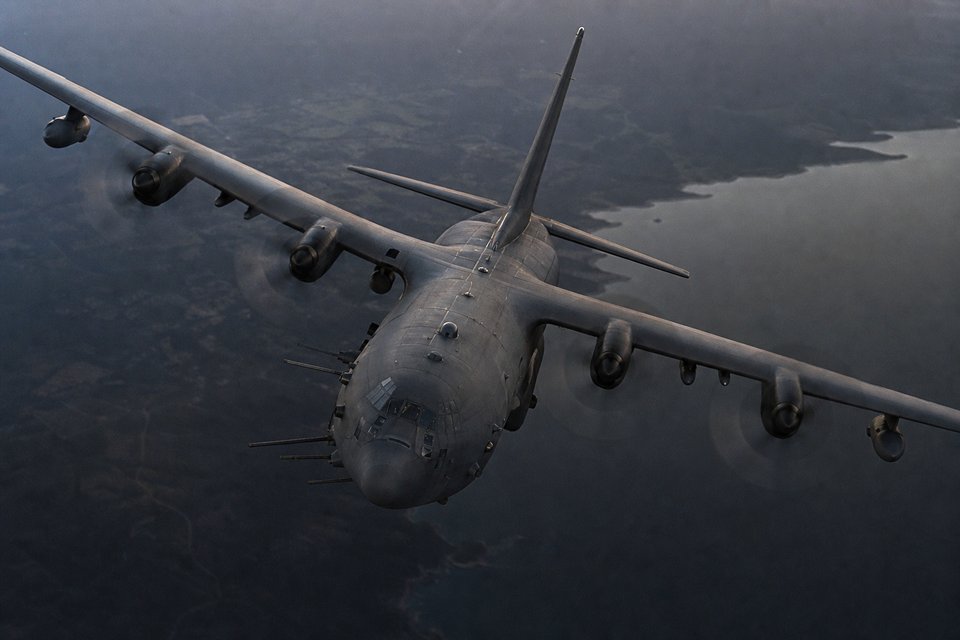
The AC-130 gunship is the armed, side-firing variant of the Lockheed C-130 Hercules transport, built to circle a target and put sustained, precise fire onto it from altitude rather than diving on it like a fighter-bomber. The name appears in several spellings: AC-130 gunship, AC130 gunship, C130 gunship, or just AC 130, and all of them mean the same aircraft family covered here. The most common comparison search, C130 vs AC130, is really asking one question: what turns an unarmed cargo Hercules into a gunship. The short answer is the AC 130 weapons fit, the sensors that aim it, and the flight profile built around both, all covered below alongside every production variant and the aircraft's combat record from Vietnam to Iraq.
From C-130 Hercules to AC-130 Gunship: A Short History
The C-130 itself predates the gunship idea by more than a decade. The Korean War exposed a gap in US airlift: the Air Force had nothing built to carry troops and cargo into short, rough airstrips near the front. Tactical Air Command issued a requirement for a new transport in February 1951, Lockheed won the contract that July, and the YC-130 prototype first flew from Burbank, California, on 23 August 1954. The production C-130A entered service in December 1956 and started the longest continuous military aircraft production run on record, one still running today in the C-130J.
From Puff the Magic Dragon to AC-130A: The Gunship Concept
The side-firing gunship concept did not start with the C-130. It started with the Douglas AC-47, a converted C-47 transport fitted with three side-firing miniguns, which flew its first combat mission over Vietnam in December 1964. Its pilots picked up the call sign "Puff the Magic Dragon," borrowed from the Peter, Paul and Mary song, and the aircraft flew roughly 4,000 missions defending outposts and villages before being credited with several thousand enemy casualties. Ground troops under siege at a remote outpost could call in "Spooky" and expect an aircraft that could keep a single point on a perimeter lit and under fire continuously for hours, something no fighter-bomber making single passes could offer. The bigger, slower AC-119 followed as an interim type, and by 1967 the Air Force had converted the first C-130A into a gunship, mounting side-firing 7.62 mm miniguns and 20 mm cannons on a much larger, faster airframe with far greater range and payload than either predecessor. The AC-130 gunship inherited Puff's basic idea, and improved on it in almost every dimension.
AC-130 Gunship Variants: Spectre, Spooky, Stinger II and Ghostrider
Seven distinct AC-130 gunship variants have flown since 1968, though only one remains in service today. Early aircraft carried the Spectre name; the AC-130U introduced Spooky II, and later conversions took Stinger II and Ghostrider.
| Variant | Years active | Nickname | Notes |
|---|---|---|---|
| AC-130A | 1968-1995 | Spectre / Pave Pronto | First C-130 gunship conversion, flown in Vietnam |
| AC-130E | 1971-1988 (later upgraded to H) | Spectre | Added 40 mm and 105 mm guns to the basic layout |
| AC-130H | 1972-2015 | Spectre | Upgraded AC-130E; retired after 43 years of service |
| AC-130U | 1995-2020 | Spooky II | All-new build with synthetic-aperture radar and twice the AC-130H's ammunition capacity |
| AC-130W | 2012-2022 | Stinger II | Converted MC-130W with a Precision Strike Package of guided munitions |
| AC-130J | 2015-present | Ghostrider | Current production model, built on the C-130J airframe; sole variant in service |

AC-130 Gunship Weapons: Guns, Howitzers and Precision Munitions
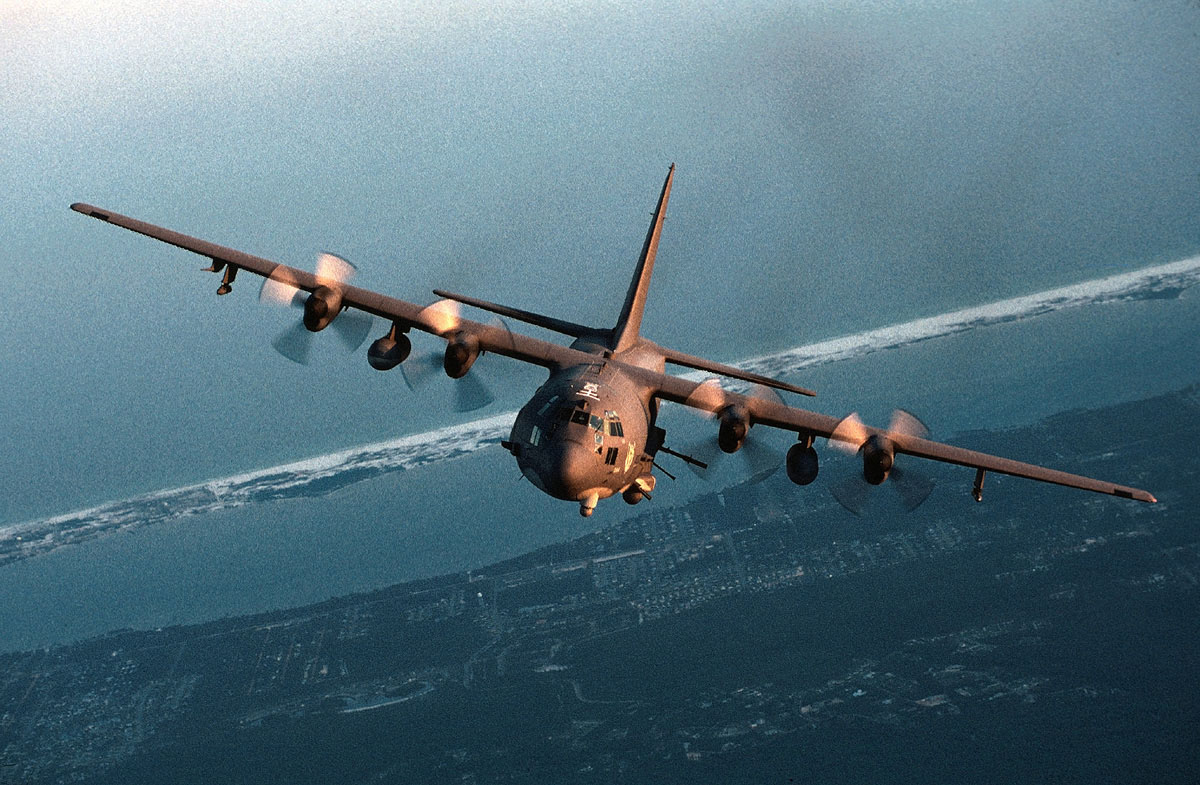
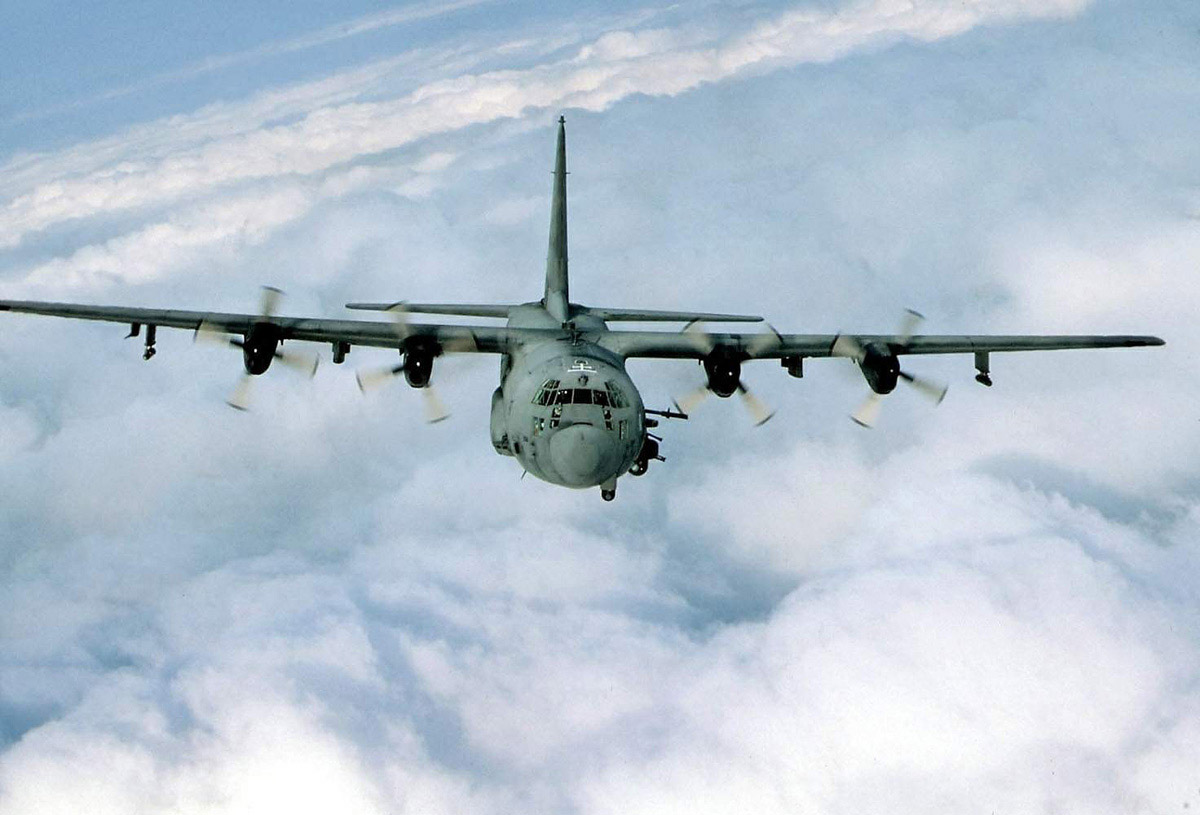
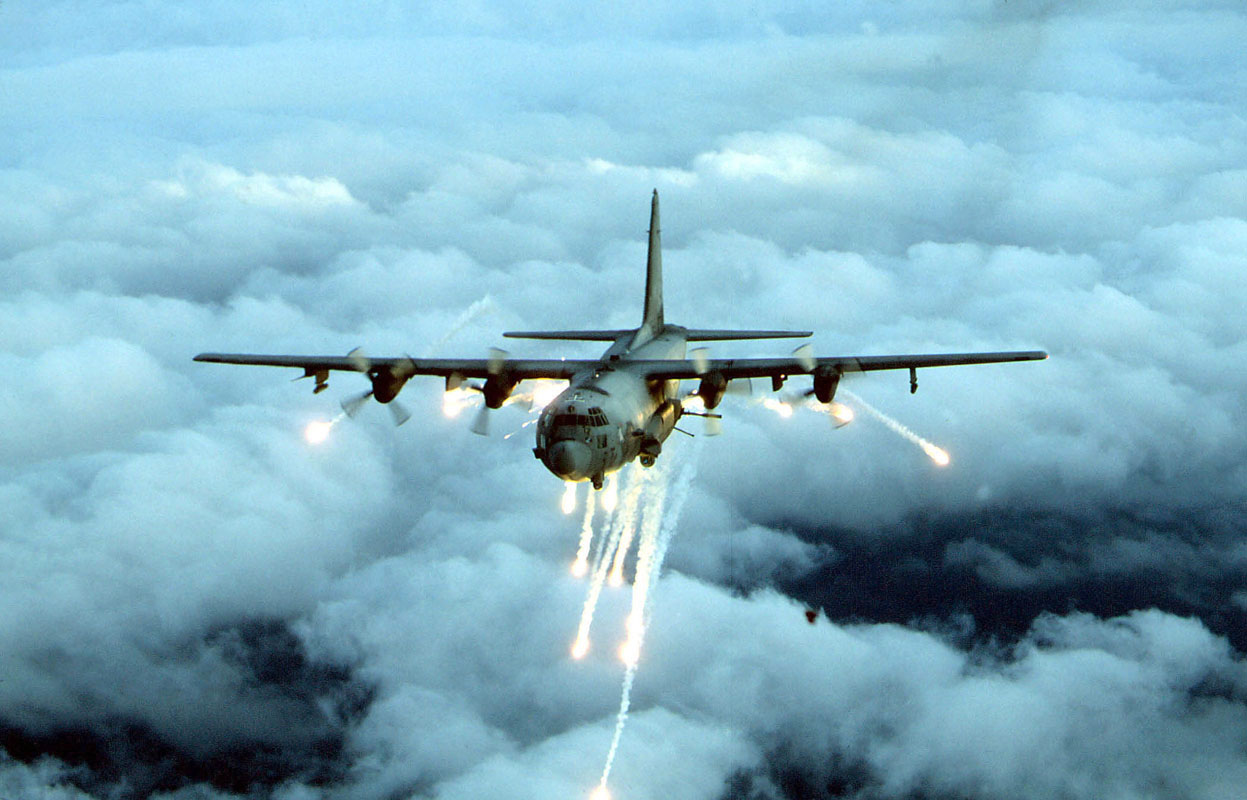
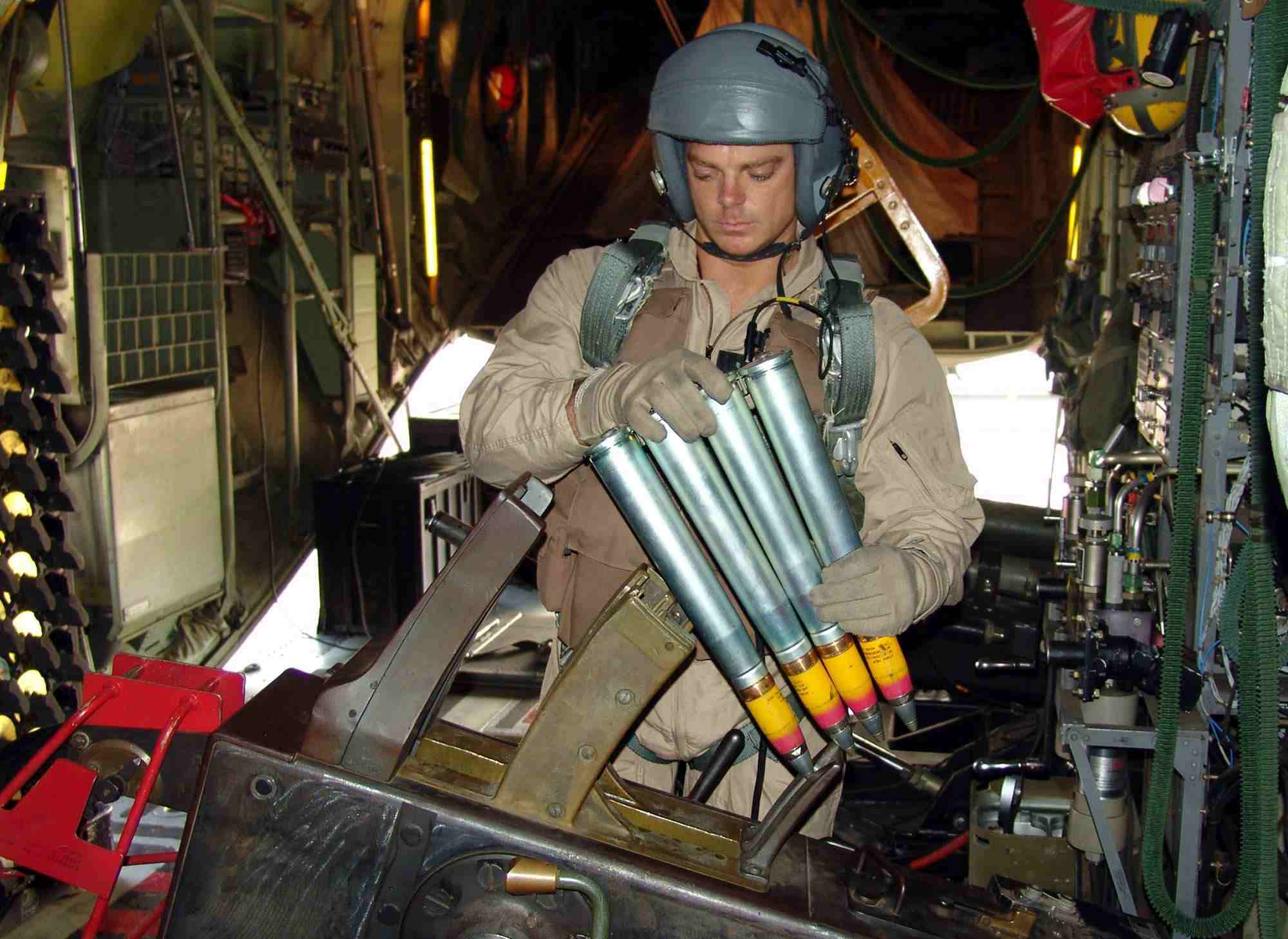
Every generation of AC 130 weapons has followed the same logic: side-firing guns aimed by orbiting the target, growing steadily more precise and more automated with each variant. The AC-130A carried 7.62 mm miniguns and 20 mm Vulcan cannons for area suppression. The AC-130E and H added a 40 mm Bofors autocannon and, later, a 105 mm howitzer for point targets such as bunkers and vehicles; the 20 mm cannons were removed from the H model around 2002. The AC-130U Spooky II replaced the 20 mm guns entirely with a single 25 mm GAU-12/U Gatling gun alongside its 40 mm and 105 mm guns, and could track and engage two targets at once using its onboard strike radar.
The current AC-130J Ghostrider drops the 40 mm gun altogether, pairing a 30 mm GAU-23/A cannon with the same 105 mm M102 howitzer and adding a "Gunslinger" launcher for up to ten AGM-176 Griffin missiles or GBU-44/B Viper Strike munitions, plus wing-mounted AGM-114 Hellfire missiles and GBU-39 Small Diameter Bombs. That mix of guns and guided weapons lets a single AC130 gunship engage a bunker, a vehicle and a dismounted fighting position in the same orbit without repositioning.
How the Pylon Turn Works: Sensors and Fire Control
An AC-130 gunship does not point its nose at a target the way a fighter does; every gun is mounted along the left side of the fuselage, so the pilot banks into a steady left-hand turn and holds it, flying a continuous circle, a manoeuvre called a pylon turn, around a fixed point on the ground. That orbit keeps the guns, sensors and fire-control radar locked on the same spot for as long as the aircraft has fuel and ammunition, typically thousands of feet above small-arms range. A fire-control computer calculates ballistics, wind drift and slant range in real time and corrects aim between individual rounds, a level of precision no human gunner could match by eye. From roughly 12,000 feet in a 35-degree bank, an AC-130J can put 105 mm howitzer rounds inside a 10-metre circle. Target identification runs through electro-optical and infrared sensors plus, on the AC-130U and later variants, synthetic-aperture strike radar, letting the crew find and confirm a target at night or through cloud that would hide it from a pilot looking out a canopy.
AC-130 Gunship vs C-130: What Changes on a Gunship
The AC-130 gunship vs C-130 transport question has a short answer: same airframe, different job. In an AC-130 vs C-130 comparison the wings, engines and cockpit are shared, and nearly everything behind the flight deck is not. The airframe underneath is the same Hercules either way; the differences are entirely in what gets bolted on.
| C-130 Hercules (transport) | AC-130 gunship | |
|---|---|---|
| Primary role | Tactical airlift, cargo and troops | Close air support, air interdiction, force protection |
| Armament | None | Side-firing cannon, howitzer and guided munitions |
| Sensors | Navigation radar only | EO/IR turrets, fire-control computer, strike radar (U and later) |
| Crew | 3-5 (pilots, loadmaster) | 7 on the AC-130J: 2 pilots, 2 combat systems officers, 3 special mission aviators |
| Typical operator | Air Mobility Command, allied air forces | Air Force Special Operations Command |
| Unit cost | Roughly $30-70 million depending on model | About $165 million for the AC-130J |
Put simply, the c130 vs ac130 question is a question about mission, not airframe: strip the guns, sensors and armor plating off any AC-130 gunship and the aircraft underneath flies like any other military transport of its generation.
Combat History: Vietnam to Iraq
The AC-130 gunship has flown in every major US conflict since Vietnam, where it destroyed more than 10,000 trucks along the Ho Chi Minh Trail and flew thousands of close air support and interdiction sorties. During Operation Urgent Fury in Grenada in 1983, AC-130s suppressed Grenadian and Cuban air defenses and supported the airborne and air-landed assault on Point Salines airfield, work that earned the crews the Lieutenant General William H. Tunner Award. In Panama during Operation Just Cause in 1989, AC-130s destroyed Panamanian Defense Force headquarters and several command posts, again earning the Tunner Award along with the Mackay Trophy for the year's most meritorious flight. In both operations, the gunship's ability to loiter over a fixed objective for an extended period, rather than making a single high-speed pass, let ground commanders call in corrections on the same target repeatedly as the tactical picture changed, a capability that fast jets flying that era's strike packages simply could not offer over the same window of time.
The Gulf War produced both the type's greatest workload and its worst loss. AC-130s flew close air support and base-defense missions through Operation Desert Storm, but on 31 January 1991, during the Battle of Khafji, the AC-130H "Spirit 03" stayed on station past sunrise to destroy an Iraqi missile battery threatening Marines on the ground and was shot down by a surface-to-air missile, killing all 14 crew members, still the largest single combat loss the US Air Force suffered in that war. In Somalia, AC-130s struck targets tied to militia leader Mohamed Farrah Aidid during Operation Continue Hope in mid-1993, but US officials withdrew the gunships from theater before the October 1993 Battle of Mogadishu; they returned in 1994-95 to help cover the UN withdrawal during Operation United Shield. AC-130s later supported NATO operations over Bosnia, the 2001 invasion of Afghanistan, and the 2003 Iraq War, and remained in near-continuous use over both countries for the following two decades.
How Many AC-130 Gunships Are in Service Today?
None of the Cold War-era variants still fly operationally. The AC-130H retired in May 2015, the AC-130U in June 2020, and the AC-130W Stinger II in 2022, each replaced by the AC-130J Ghostrider. Air Force Special Operations Command originally planned to buy 37 Ghostriders; the program was cut back, and by late 2022 all deliveries were complete at around 30 aircraft, based mainly at Cannon Air Force Base, New Mexico, and Hurlburt Field, Florida. By fiscal year 2025, the entire fleet had been brought up to the Block 30 configuration standard, aligning sensors, radios and weapons integration across every airframe. In November 2025, the Air Force Reserve's 919th Special Operations Wing flew its first AC-130J mission, extending the gunship role to a reserve unit for the first time in the type's history. Every AC-130J now on the ramp is the only c130 gunship variant the Air Force operates, and none of the older Spectre or Spooky II airframes remain flyable in any role.
AC-130 Gunship Compared to Other Close Air Support Aircraft
The AC-130 gunship is not the only aircraft the US military uses for close air support, and it fills a distinct niche among them. The A-10 Thunderbolt II covers similar ground at much lower altitude and higher speed, trading the gunship's standoff range and loiter time for heavy armor plating that lets it absorb direct hits and fly straight at a target rather than orbiting it. Rotary-wing platforms such as the AH-64 Apache operate closer still to the ground and can hover, but carry a fraction of the AC-130's fuel and ammunition, and cannot match its four-hour-plus time on station. Since the mid-2000s, remotely piloted aircraft such as the MQ-9 Reaper have taken over much of the long-endurance overwatch role once flown by manned gunships, loitering for a full day at a time, though with far less firepower and no ability to walk cannon fire onto a moving target the way an AC-130's fire-control system does. In practice the three types are complementary rather than interchangeable, and US planners routinely stack an AC-130, an Apache and a Reaper over the same objective at different altitudes.
Limits and Vulnerabilities of the AC-130 Gunship
The pylon turn that makes an AC-130 gunship so accurate is also what makes it vulnerable: circling a fixed point at a few thousand feet, slower than 200 knots, only works where the enemy has no meaningful air defense left. Spirit 03's loss over Khafji is the clearest proof of that limit: daylight, a single shoulder-fired missile, and a gunship that had chosen to stay one pass too many. That constraint has shaped every deployment since: gunships fly almost exclusively at night, need friendly air superiority overhead, and are held back once man-portable air-defense systems or radar-guided anti-aircraft weapons are confirmed in an area. Identifying targets correctly from altitude has also drawn sustained criticism; sensors that reliably distinguish a weapon from a farm tool are far from perfect, and incidents in Vietnam, Afghanistan and Iraq involving celebratory gunfire mistaken for hostile fire, or fighters mixed among civilians, have made accuracy claims for the type a genuinely contested subject rather than a settled one.
AC-130 vs C-130 and other aircraft, figure by figure
All 58 entries in the data table
Select a column heading to sort.
| Name | Nation | Class | Length (m) | Wingspan (m) | Max take-off (kg) | Max speed (km/h) | Range (km) | Ceiling (m) | Crew | Built | Compare |
|---|---|---|---|---|---|---|---|---|---|---|---|
| Grumman F-14A Tomcat | United States | fighter | 19.1 | 19.51 | — | 2,485 | 2,960 | 15,200 | 2 | — | |
| McDonnell Douglas F-15 Eagle | United States | fighter | 19.43 | 13.05 | — | 2,655 | — | 18,290 | — | — | |
| General Dynamics F-16A Fighting Falcon | United States | multirole | 15.06 | 9.96 | 13,558 | 2,121 | — | 16,764 | 1 | — | |
| McDonnell Douglas F/A-18C Hornet | United States | multirole | 17.1 | 12.3 | 23,537 | — | 2,844 | 15,240 | 1 | — | |
| Lockheed Martin F-22A Raptor | United States | stealth fighter | 18.92 | 13.56 | — | 2,410 | 3,220 | 20,000 | 1 | 195 | |
| Lockheed Martin F-35A Lightning II | United States | stealth multirole | 15.7 | 10.7 | — | — | 2,172 | 15,000 | 1 | — | |
| Lockheed F-117A Nighthawk | United States | stealth attack | — | — | — | 1,101 | — | 13,716 | 1 | 64 | |
| McDonnell Douglas F-4C Phantom II | United States | fighter | 17.73 | 11.76 | 26,308 | 2,253 | — | 18,166 | 2 | — | |
| Northrop F-20 Tigershark | United States | fighter | 14.17 | 8.13 | — | 2,232 | — | 16,764 | 1 | — | |
| Douglas A-4 Skyhawk | United States | attack | 12.22 | 8.38 | 11,113 | 1,078 | — | — | 1 | — | |
| Grumman A-6E Intruder | United States | attack | 16.69 | 16.15 | 27,397 | 1,030 | — | — | 2 | — | |
| Fairchild Republic A-10A Thunderbolt II | United States | attack | 16.26 | 17.53 | — | 724 | — | — | 1 | — | |
| Lockheed Martin AC-130J Ghostrider | United States | gunship | 29.79 | 40.41 | 74,389 | 669 | 4,828 | 8,534 | — | — | |
| Lockheed C-130H Hercules | United States | transport | 29.82 | 40.41 | 70,307 | 589 | 2,407 | — | — | — | |
| Boeing B-17G Flying Fortress | United States | bomber | 22.8 | 31.6 | 29,700 | 462 | 3,220 | 10,900 | 10 | — | |
| Consolidated B-24J Liberator | United States | bomber | 20.47 | 33.53 | 29,484 | 478 | 2,478 | 8,534 | 11 | 18,000 | |
| North American B-25J Mitchell | United States | bomber | 16.13 | 20.6 | — | 438 | 2,173 | — | 6 | 9,800 | |
| Martin B-26G Marauder | United States | bomber | — | — | — | 459 | 1,770 | 6,035 | — | 5,288 | |
| Boeing B-29 Superfortress | United States | bomber | 30.18 | 43.36 | — | — | — | — | 10 | 3,970 | |
| Boeing B-52H Stratofortress | United States | bomber | 48.5 | 56.4 | 221,353 | 1,046 | 14,162 | 15,240 | 5 | — | |
| Rockwell B-1B Lancer | United States | bomber | 44.5 | 41.8 | — | 1,368 | — | 15,000 | 4 | — | |
| Northrop Grumman B-2 Spirit | United States | stealth bomber | 21 | 52.4 | 152,634 | 1,010 | 11,100 | 15,240 | 2 | — | |
| Lockheed P-38L Lightning | United States | fighter | 11.53 | 15.85 | 7,938 | 666 | 1,770 | 12,192 | 1 | — | |
| Republic P-47D Thunderbolt | United States | fighter | 11.02 | 12.43 | 7,938 | 715 | 1,657 | 12,802 | 1 | — | |
| North American P-51D Mustang | United States | fighter | 9.83 | 11.28 | 5,489 | 703 | 1,609 | 12,771 | 1 | 15,686 | |
| Grumman F4F-3 Wildcat | United States | fighter | 8.76 | 11.58 | — | 515 | — | — | 1 | — | |
| Grumman F6F-5 Hellcat | United States | fighter | 10.24 | 13.06 | 6,991 | 604 | — | — | 1 | — | |
| Vought F4U Corsair | United States | fighter | 10.36 | 12.5 | — | 729 | 1,448 | — | 1 | — | |
| Douglas SBD Dauntless | United States | dive bomber | 10.08 | 12.65 | — | 410 | 1,245 | 7,782 | 2 | — | |
| Grumman TBF Avenger | United States | torpedo bomber | 12.5 | 16.5 | — | 443 | 1,609 | — | 3 | — | |
| Supermarine Spitfire Mk IX | United Kingdom | fighter | 9.46 | 11.23 | 3,402 | 657 | — | 13,106 | 1 | — | |
| Hawker Hurricane Mk IIC | United Kingdom | fighter | 9.83 | 12.19 | 3,950 | 547 | 966 | 11,000 | 1 | 8,000 | |
| de Havilland Mosquito | United Kingdom | fighter-bomber | 13.57 | 16.51 | 8,210 | 668 | — | — | 2 | — | |
| Avro Lancaster | United Kingdom | bomber | 21 | 31 | — | 450 | 2,670 | 7,500 | 7 | — | |
| Gloster Meteor F.8 | United Kingdom | fighter | 13.59 | 11.32 | — | 965 | — | 13,100 | 1 | — | |
| McDonnell Douglas/BAe AV-8B Harrier II | United States | attack | 14.12 | 9.25 | — | — | 3,300 | — | 1 | 340 | |
| Panavia Tornado IDS/GR1 | United Kingdom/West Germany/Italy | strike aircraft | 16.72 | 13.9 | 27,200 | 2,336 | 3,890 | — | 2 | 990 | |
| Messerschmitt Bf 109G-6 | Germany | fighter | 8.95 | 9.925 | 3,400 | 642 | 1,012 | — | 1 | 34,248 | |
| Focke-Wulf Fw 190A-8 | Germany | fighter | 8.95 | 10.51 | 4,900 | 652 | 950 | 10,350 | 1 | 20,000 | |
| Junkers Ju 87 Stuka | Germany | dive bomber | — | — | — | 340 | 715 | — | 2 | 6,000 | |
| Junkers Ju 88A-4 | Germany | bomber | 14.4 | 20 | 14,000 | 470 | 1,790 | 8,199 | 4 | 15,183 | |
| Heinkel He 111H-16 | Germany | bomber | 17.4 | 22.6 | 14,000 | 434 | 2,100 | 8,500 | 5 | 6,508 | |
| Messerschmitt Me 262A-1a | Germany | fighter | 10.6 | 12.6 | 7,130 | 900 | 1,050 | 11,450 | 1 | 1,430 | |
| Mitsubishi A6M2 Zero (Model 21) | Japan | fighter | 9.06 | 12 | 2,796 | 533 | 1,870 | — | 1 | 10,939 | |
| Ilyushin Il-2M3 Sturmovik | Soviet Union | attack | 11.65 | 14.6 | 6,360 | 410 | 765 | 4,525 | 2 | 36,183 | |
| Mikoyan-Gurevich MiG-15bis | Soviet Union | fighter | 10.86 | 10.08 | 6,045 | 1,074 | 1,859 | 15,500 | 1 | 17,310 | |
| Mikoyan-Gurevich MiG-21F-13 | Soviet Union | interceptor | 13.46 | 7.15 | 8,386 | 2,125 | — | 19,000 | 1 | 11,496 | |
| Mikoyan MiG-29 'Fulcrum-A' | Soviet Union | fighter | 17.32 | 11.36 | 18,500 | 2,445 | 2,100 | 17,000 | 1 | 1,600 | |
| Sukhoi Su-24MK Fencer | Soviet Union | attack | 22.53 | 17.64 | 43,755 | 1,654 | 2,775 | 11,000 | 2 | 1,400 | |
| Sukhoi Su-27S Flanker | Soviet Union | fighter | 21.94 | 14.7 | 28,000 | 2,500 | 3,900 | 18,500 | 1 | 680 | |
| Sukhoi Su-35S Flanker-E | Russia | fighter | 21.9 | 15.3 | 34,500 | 2,400 | 3,600 | 18,000 | 1 | 155 | |
| Sukhoi Su-57 | Russia | stealth fighter | 22 | 14.1 | 37,000 | 2,500 | 4,000 | 20,000 | 1 | 44 | |
| Eurofighter Typhoon | United Kingdom/Germany/Italy/Spain | multirole | 15.96 | 10.95 | 21,000 | 2,125 | — | — | 1 | 611 | |
| Kamov Ka-25 | Soviet Union | helicopter | 9.75 | 15.74 | 7,500 | 209 | 400 | 3,350 | 4 | 460 | |
| Boeing AH-64D Apache | United States | helicopter | 14.97 | 5.23 | 10,107 | 261 | 1,900 | 2,889 | 2 | 2,700 | |
| Bell AH-1G HueyCobra | United States | helicopter | 16.2 | 4.08 | 4,309 | 276 | 574 | 3,475 | 2 | 1,116 | |
| Boeing Vertol CH-46E Sea Knight | United States | helicopter | 13.66 | 15.24 | 11,022 | 267 | 1,019 | 5,182 | 5 | 524 | |
| Sikorsky CH-53D Sea Stallion | United States | helicopter | 20.58 | 22 | 19,051 | 315 | 1,000 | 5,105 | — | 267 |
Frequently asked questions
What is an AC-130 gunship?
An AC-130 gunship is an armed variant of the Lockheed C-130 Hercules transport, fitted with side-firing cannon, a howitzer and, on the newest model, guided missiles and bombs. It flies a banked orbit called a pylon turn to keep its weapons trained on a single ground target for extended periods.
What's the difference between a C130 vs AC130?
A C-130 is an unarmed tactical transport carrying troops or cargo. An AC-130 is the same airframe converted into a gunship, with side-mounted guns, sensors and a fire-control system added and cargo capacity removed. Only Air Force Special Operations Command flies the armed version.
What are the AC 130 weapons on the current model?
The AC-130J Ghostrider carries a 30 mm GAU-23/A cannon and a 105 mm M102 howitzer, plus a 10-round Gunslinger launcher for AGM-176 Griffin missiles or Viper Strike munitions, and wing-mounted Hellfire missiles and Small Diameter Bombs. Earlier variants carried different combinations of 20 mm, 25 mm and 40 mm cannons.
How fast is the AC-130 gunship?
The AC-130J has a maximum speed around 362 knots (about 416 mph), though it operates far slower than that during an actual gun run, typically under 200 knots while holding a steady pylon turn around a target. Its range is roughly 3,000 miles without air refueling.
Why is it called Spectre?
Spectre was the Air Force's radio call sign and nickname for the AC-130A, AC-130E and AC-130H gunships from Vietnam through the type's retirement in 2015. Later variants took their own names, Spooky II for the AC-130U, Stinger II for the AC-130W, and Ghostrider for the current AC-130J.
How many AC-130 gunships are in service?
Around 30 AC-130J Ghostriders are in Air Force Special Operations Command service as of the mid-2020s, based mainly at Cannon Air Force Base, New Mexico, and Hurlburt Field, Florida. Every earlier c130 gunship variant, the H, U and W models, has been retired.
Has an AC-130 ever been shot down?
Yes. The AC-130H "Spirit 03" was shot down by an Iraqi surface-to-air missile on 31 January 1991 during the Battle of Khafji, killing all 14 crew members. It remains the only AC-130 lost to enemy fire and the largest single combat loss the US Air Force suffered during the Gulf War.
What replaced the AC-130H and AC-130U?
The AC-130J Ghostrider replaced all three older variants, the AC-130H (retired 2015), AC-130U (retired 2020) and AC-130W Stinger II (retired 2022). It is built new on the C-130J airframe rather than converted from an older Hercules, and it is the only AC-130 gunship model the Air Force still flies.
How much does an AC-130J cost?
Each AC-130J Ghostrider costs roughly $165 million, according to Air Force figures, considerably more than the $132.4 million and $190 million quoted in the early 2000s for the AC-130H and AC-130U (fiscal 2001 dollars), reflecting the newer airframe, engines and precision-strike package.
Can civilians see an AC-130 gunship?
AC-130Js occasionally appear at US air shows and static displays, and Air Force Special Operations Command has released cockpit and gun-camera footage from training and past operations. Because the type is a special-operations asset flown mainly out of Cannon Air Force Base and Hurlburt Field, close public access is rarer than for a mainline transport or fighter aircraft.