Plate 022 — Aircraft
REF: BF-AIR-022F-14 Tomcat: Specifications, Variants and Combat History
A guide to the Grumman F-14 Tomcat, the US Navy's variable-sweep interceptor built around the AIM-54 Phoenix missile, covering its design, combat record from the Gulf of Sidra to Iraq, 2006 retirement, and Iran's continued use of the type.
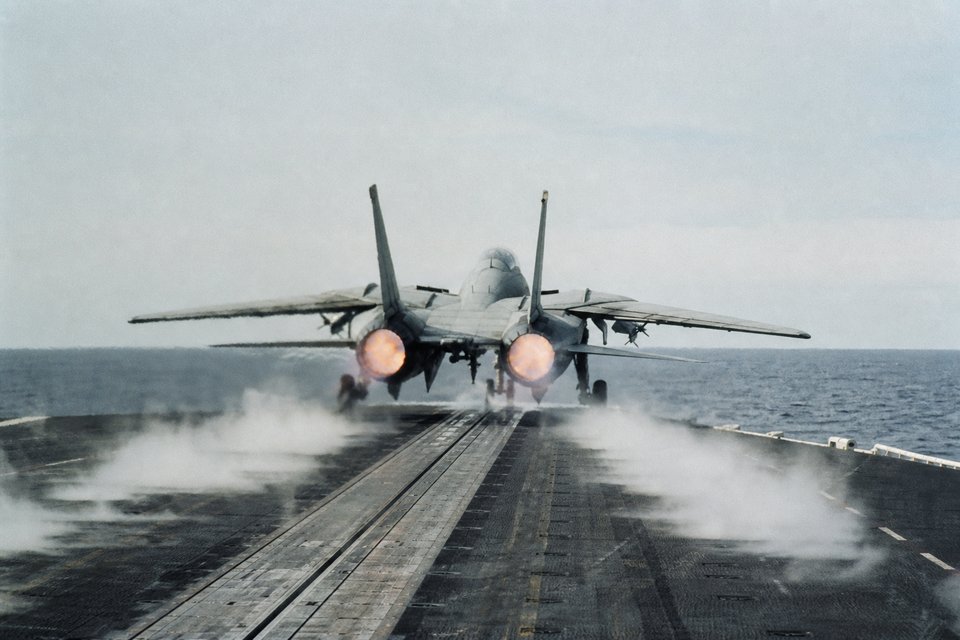
The Grumman F-14 Tomcat is a supersonic, twin-engine, variable-sweep-wing fighter built for the United States Navy as a carrier-based interceptor and air-superiority aircraft. Two crew members — a pilot and a radar intercept officer (RIO) — share navigation, target acquisition, electronic countermeasures and weapons employment across a cockpit built around the Hughes AWG-9 radar and the long-range AIM-54 Phoenix missile. Grumman built 712 Tomcats between 1969 and 1991 at its Calverton, New York plant, and the type served the US Navy from 1974 until its retirement in 2006. Iran remains the only export customer and the last air force still flying the F-14 today, more than half a century after the type's first flight.
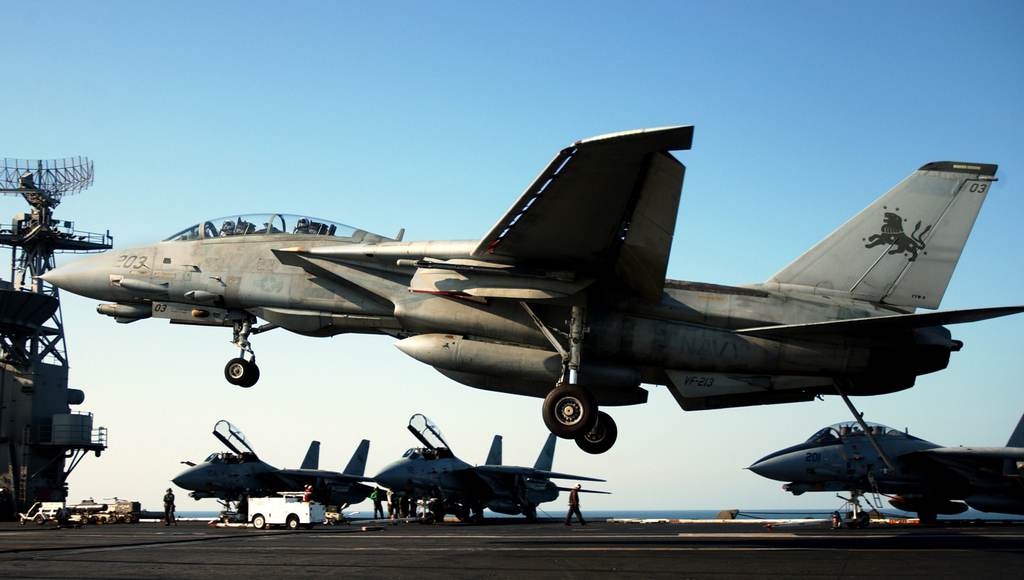
F-14 Tomcat Specifications
| Specification | Detail |
|---|---|
| Manufacturer | Grumman Aerospace Corporation (later Northrop Grumman) |
| First flight | 21 December 1970 |
| Entered US Navy service | September 1974 |
| Retired (US Navy) | 22 September 2006 |
| Total built | 712 (1969–1991), including 12 YF-14A prototypes |
| Crew | 2 (pilot, radar intercept officer) |
| Length | 19.1 m (62 ft 9 in) |
| Wingspan | 19.5 m unswept / 11.4 m swept (64 ft / 38 ft) |
| Maximum speed | Mach 2.34 (approx. 2,485 km/h / 1,544 mph) |
| Combat range | Approx. 1,600 nm (2,965 km) ferry range |
| Engines | 2× Pratt & Whitney TF30-P-414A (F-14A) or 2× General Electric F110-GE-400 (F-14B/D) |
| Radar | Hughes AN/AWG-9 (F-14A/B); Raytheon AN/APG-71 (F-14D) |
| Primary armament | AIM-54 Phoenix, AIM-7 Sparrow, AIM-9 Sidewinder, M61 Vulcan 20 mm cannon |
Origins of the Programme
The F-14 exists because an earlier attempt to give the Navy a fleet-defence fighter failed. In the early 1960s, the Pentagon tried to build a single airframe — the General Dynamics F-111 — for both the Air Force and the Navy under the Tactical Fighter Experimental (TFX) programme. The naval version, designated F-111B, grew too heavy for carrier operations and lacked the agility the fleet wanted, and Congress cancelled it in 1968 after Grumman, the Navy subcontractor on the F-111B, had already begun lobbying for a clean-sheet alternative built specifically around carrier requirements and the existing AWG-9 radar and AIM-54 Phoenix missile developed for the cancelled programme. Grumman won the resulting VFX competition, and the aircraft that emerged reused the F-111B's most successful subsystems — the radar, the missile and, on early aircraft, some structural design choices — while starting fresh on the airframe itself.
Design
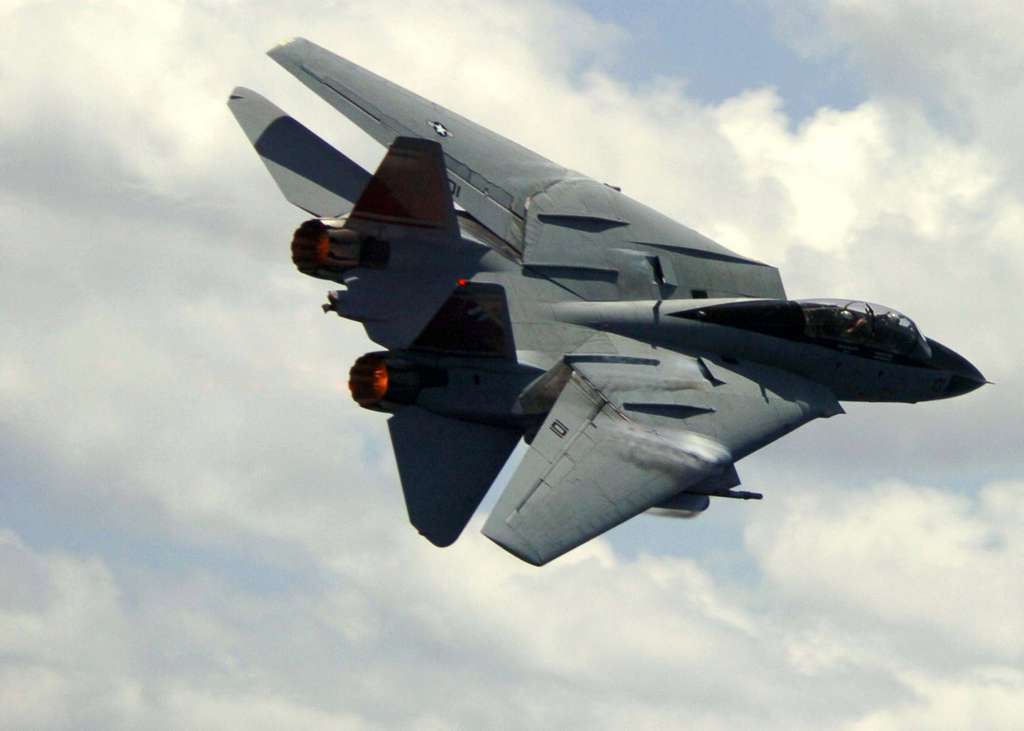
The Tomcat's variable-sweep wing lets it fly efficiently at low speed for carrier landings while sweeping back to 68 degrees for supersonic dashes, and Grumman used the same pivoting-wing layout it had tested on the earlier F-111B naval fighter programme that the F-14 replaced. The wing sweep itself is normally automatic rather than pilot-selected: the Central Air Data Computer moves the wings anywhere between 20 and 68 degrees based on current speed and altitude, with a separate "oversweep" position beyond 68 degrees used only on deck to pack the folded wings into a smaller carrier-parking footprint, and pilots retained a manual override for combat manoeuvring. Small "glove vanes" ahead of the wing root, fitted to early A-models, extended automatically at high speed to help trim the aircraft, though they were later deactivated as unnecessary weight. The airframe is built around a twin-tail, twin-engine layout with the two crew seated in tandem under a single long canopy; the pilot flies from the front seat while the RIO manages the AWG-9 radar, the Tactical Information Display and, on later jets, the datalink and defensive systems from the rear. Both crew sit on Martin-Baker GRU-7A zero-zero ejection seats, and defensive equipment includes the ALE-39 chaff and flare dispenser and the ALQ-126 or, on upgraded jets, ALQ-165 radar-jamming systems.
Becoming a Tomcat RIO required a separate training track from the pilot seat: naval flight officers went through their own primary and intermediate flight training before specialising on the F-14 at the fleet replacement squadron, learning to operate the AWG-9 and, later, the APG-71 radar, manage the Phoenix and Sparrow engagement envelopes, and run the TARPS camera and datalink systems on reconnaissance sorties — a division of labour that let the pilot concentrate entirely on flying the aircraft in a high-g dogfight or a low-level strike run while the RIO fought the sensors and weapons. The arrangement carried over directly from the earlier F-4 Phantom, whose two-seat crew concept the Navy had already found effective enough to specify again for the F-14.
Weapons and Sensors
As a fleet-defence interceptor, the Tomcat's signature weapon is the AIM-54 Phoenix, a radar-guided missile that — cued by the AWG-9's ability to track up to 24 targets and engage six at once in track-while-scan mode — could threaten bombers and cruise-missile carriers at ranges beyond 100 km (54 nm), a capability no other fighter of its generation matched. The AIM-7 Sparrow and AIM-9 Sidewinder covered medium- and short-range engagements, and an M61A1/A2 Vulcan 20 mm cannon was fitted for close combat. Later in its life the airframe picked up a genuine strike role: the LANTIRN targeting pod let F-14s designate their own laser-guided bombs and assess battle damage, and from 2001 the type could also carry the GPS-guided Joint Direct Attack Munition, dropping its first JDAM in combat on 11 March 2002 and eventually carrying up to four at once on the F-14D. A separate reconnaissance role came earlier: the Tactical Air Reconnaissance Pod System (TARPS), fielded from 1981, turned a share of the fleet into the Navy's primary tactical-reconnaissance platform after the retirement of the dedicated RA-5C Vigilante and RF-8G Crusader, with each carrier air wing typically assigning one Tomcat squadron three TARPS-capable jets and four trained aircrews; a later Fast Tactical Imagery upgrade let those aircraft transmit reconnaissance photography back to the carrier while still airborne instead of waiting to land and process film.
Long before any of that hardware saw combat, the AWG-9's range made the Tomcat the aircraft of choice for a much quieter Cold War mission: identifying and shadowing Soviet naval aviation as it probed US carrier battle groups. Tu-95 Bear-D maritime patrol aircraft, tasked with locating carriers for the Soviet Navy's anti-ship missile forces, were a routine target for Tomcat intercepts through the 1970s and 1980s, with F-14s from squadrons such as VF-114 flying wingtip-to-wingtip alongside the much larger Soviet bombers long enough for photographs to be taken and the Bear's course logged. These intercepts rarely made headlines at the time, but they were the F-14's most frequently flown real-world mission for most of its career, far outnumbering the handful of shooting engagements the type is remembered for today.
Variants
| Variant | Engines | Notes |
|---|---|---|
| YF-14A | TF30 | 12 prototype and pre-production aircraft |
| F-14A | 2× TF30-P-414A | 545 built for the US Navy, 79 for Iran; original two-seat interceptor |
| F-14A Plus / F-14B | 2× F110-GE-400 | 38 new-build plus 48 F-14As upgraded; re-engined, most avionics and the AWG-9 retained |
| F-14D Super Tomcat | 2× F110-GE-400 | 37 new-build plus 18 upgraded from F-14A; glass cockpit, APG-71 radar |
The original F-14A was the interceptor Grumman built to a 1968 Navy requirement after the collapse of the F-111B programme; its Pratt & Whitney TF30 engines, inherited from that earlier project, proved chronically unreliable — prone to compressor stalls that could lead to a flameout or an uncontrollable flat spin — and are estimated to have contributed to roughly 28 percent of all F-14 accidents, a failure rate the Navy spent years trying to manage through pilot training before the re-engined B and D models finally solved it. The F-14B (originally F-14A Plus) swapped in the General Electric F110-GE-400, correcting the engine problem and improving thrust-to-weight while keeping the AWG-9 radar and most existing avionics; roughly 70 more airframes were brought up to a further F-14B Upgrade standard in the late 1990s with better offensive and defensive systems. The F-14D Super Tomcat was the final and most capable version, pairing the F110 engines with a digital glass cockpit and the Raytheon AN/APG-71 radar in place of the AWG-9; only 37 were built new and 18 converted, making it the rarest Tomcat variant despite being the most advanced.
Aboard the Carrier
A typical carrier air wing in the Tomcat's heyday embarked two F-14 squadrons of around ten aircraft each alongside two squadrons of F/A-18 Hornets, an EA-6B Prowler electronic-warfare detachment, E-2 Hawkeye airborne early-warning aircraft, S-3 Viking anti-submarine jets and a mix of helicopters, with the Tomcats generally standing the outer combat air patrol stations furthest from the ship where the AWG-9's long detection range and the Phoenix's reach were most useful. As the air wing's biggest and heaviest fighter, the F-14 also carried the most demanding maintenance and deck-handling requirements of any aircraft aboard, a factor that weighed directly on the later decision to consolidate the air wing around the single-type Super Hornet.
Operational History
The F-14 began replacing the F-4 Phantom II in US Navy service in September 1974, when VF-1 Wolfpack and VF-2 Bounty Hunters embarked aboard USS Enterprise and covered the American withdrawal from Saigon the following spring. Its first air-to-air kills came on 19 August 1981 over the Gulf of Sidra, when two VF-41 Black Aces Tomcats shot down two Libyan Su-22 Fitters that had fired first; a second Gulf of Sidra incident followed on 4 January 1989, when VF-32 F-14s downed two Libyan MiG-23 Floggers. Away from headline dogfights, the Tomcat's most sustained combat role in the 1980s was reconnaissance: TARPS-equipped aircraft flew regular missions over Lebanon's Bekaa Valley, developing high-speed, medium-altitude tactics to survive the SA-6 and AAA threat there after a Tomcat was fired on by an SA-2 near Berbera, Somalia, in April 1983. The unexpected demand for combat imagery pushed the Navy to fast-track sensors such as the 91 cm KA-93 long-range optics camera and an expanded chaff adapter for the Phoenix launch rail, along with commercial radar detectors taped into the front cockpit as a stopgap against SA-6 batteries until a proper radar-warning upgrade arrived later in the decade.
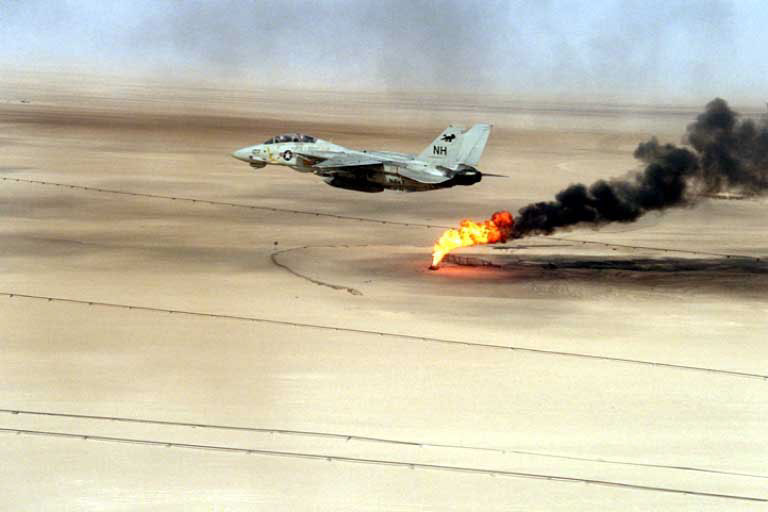
During the 1991 Gulf War, F-14s flew combat air patrol over the Persian Gulf and Red Sea plus strike-escort and reconnaissance sorties, though strict identification-friend-or-foe rules limited use of the AIM-54 and left most in-country air-superiority work to USAF F-15 Eagles. The US Navy's only combat loss of a Tomcat came on 21 January 1991, when an F-14A Plus from VF-103 was downed by an Iraqi SA-2 near Al Asad airbase; both crew ejected safely, the pilot was rescued by US Special Operations Forces, and the RIO was held as a prisoner of war until the ceasefire. The F-14's only confirmed kill of the war was an Iraqi Mi-8 helicopter, downed with an AIM-9 Sidewinder. Tomcats went on to fly over Bosnia during Operation Deliberate Force in 1995 and over Kosovo during Operation Allied Force in 1999, and led some of the opening strikes of Operation Enduring Freedom on 7 October 2001 after JDAM integration gave the airframe a genuine precision-strike role alongside its fighter mission. F-14s from VF-2, VF-31, VF-32, VF-154 and VF-213 flew in Operation Iraqi Freedom from 2003, with the D-model squadrons gaining JDAM capability by March of that year and a ROVER III downlink in December 2005 to send targeting video directly to ground forward air controllers.
Retirement
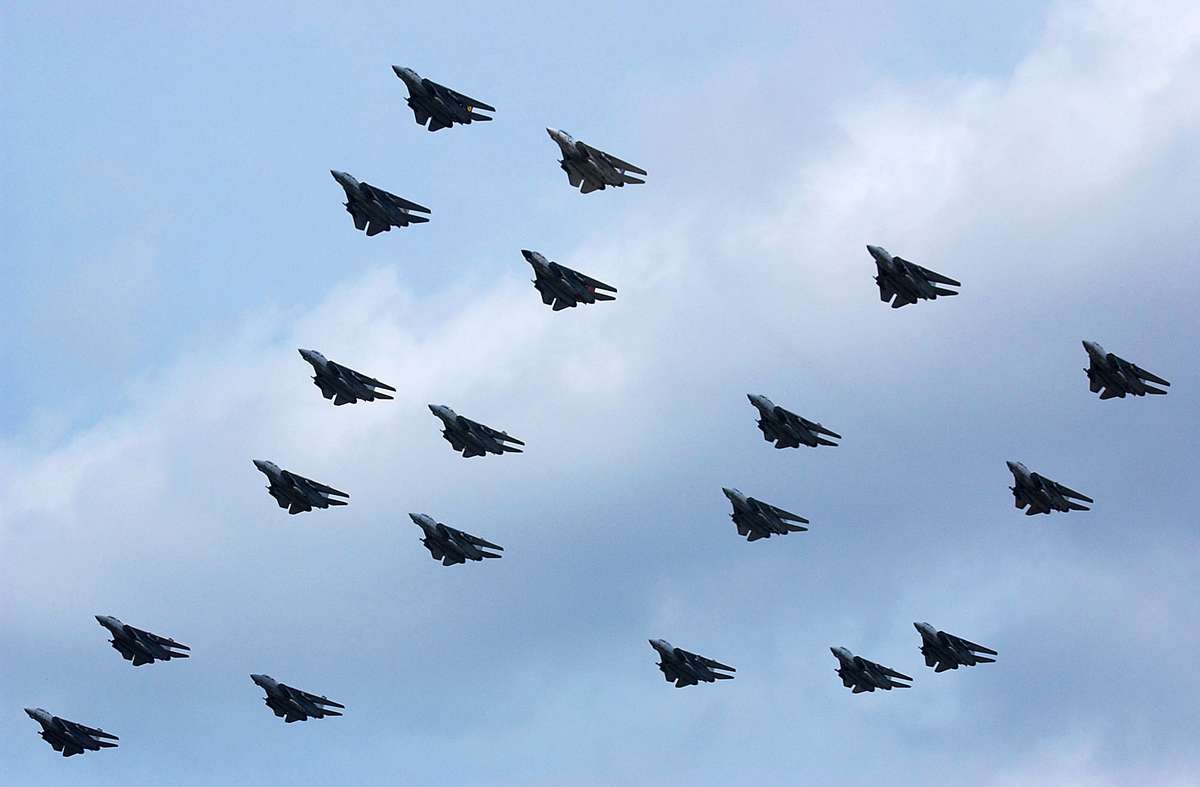
The US Navy retired the F-14 in stages through 2006 as squadrons converted to the F/A-18E/F Super Hornet. The type's last combat mission was flown on 8 February 2006, when two VF-31 and VF-213 Tomcats recovered aboard USS Theodore Roosevelt after dropping the final bomb of a Navy Tomcat's combat career; over that deployment the two squadrons together logged 1,163 combat sorties, 6,876 flight hours and roughly 4,300 kg of ordnance dropped in support of Operation Iraqi Freedom. VF-31 Tomcatters and VF-213 Black Lions then flew 22 aircraft in formation into Naval Air Station Oceana on 10 March 2006 for their last fly-in, while VF-31 kept a handful of jets combat-ready into the summer to preserve carrier qualification up to the end. The final catapult launch of a US Navy F-14 came from USS Theodore Roosevelt on 28 July 2006, and the official retirement ceremony was held at Oceana on 22 September 2006, with a backup jet flying the ceremonial last flight after the primary aircraft suffered a mechanical fault. The very last Tomcat flight in US service, a ferry flight from Oceana to Republic Airport on Long Island, took place on 4 October 2006.
Surviving US airframes were flown to the 309th Aerospace Maintenance and Regeneration Group "boneyard" at Davis-Monthan Air Force Base, Arizona, where the Air Force had most of them shredded rather than sold as surplus, specifically to keep spare parts out of Iranian hands; by mid-2007 several dozen had already been destroyed at a cost of roughly $900,000, with the landing gear cut away by torch first because of its strength. A number escaped the scrapper and are preserved at museums and as static displays, including several of the original Have Blue-era test airframes.
| Aircraft | Location | Notes |
|---|---|---|
| YF-14A (Prototype #3) | Cradle of Aviation Museum, Garden City, NY | Nonstructural demonstration testbed |
| YF-14A (Prototype #5) | National Naval Aviation Museum, Pensacola | Systems compatibility demonstrator |
| YF-14A/B (Prototype #7) | Intrepid Sea-Air-Space Museum, New York City | Engine and F-14B testbed |
| F-14A | USS Midway Museum, San Diego | Carrier museum ship display |
| F-14D | National Air and Space Museum, Udvar-Hazy Center | Flew in the second Gulf of Sidra incident |
| F-14A | Wings Over the Rockies Air Museum, Denver | Static display |
| F-14A | Museum of Flight, Seattle | Static display |
| F-14A | Pima Air & Space Museum, Tucson | Static display |
| F-14D | Carolinas Aviation Museum, Charlotte, NC | VF-213, last F-14 to launch on a combat mission (Iraq, Feb 2006) |
| F-14A | Tulsa Air and Space Museum, Tulsa, OK | Carries VF-41 Black Aces markings |
| F-14A | USS Hornet Museum, Alameda | Flown by VF-101 Grim Reapers, retired 2000 |
| F-14B | Grissom Air Museum, Peru, IN | First aircraft retired from VF-11 Red Rippers |
| F-14D | Castle Air Museum, Atwater, CA | Static display |
| F-14D | American Air Power Museum, Farmingdale, NY | Last (American) Tomcat to take flight |
| F-14D | Naval Air Station Oceana, Virginia Beach | Last F-14 built by Grumman |
| F-14A | Kalamazoo Aviation History Museum, MI | Static display |
| F-14A | Western Aerospace Museum, Oakland, CA | Static display |
| F-14A | Pacific Coast Air Museum, Santa Rosa, CA | Static display |
| F-14A | Grumman Memorial Park, Calverton, NY | On the site of the former production plant |
| F-14D | Hickory Regional Airport, Hickory, NC | VF-31, flown at the squadron's sunset ceremony |
US Navy Squadrons
At its peak the Tomcat equipped more than two dozen Pacific and Atlantic Fleet fighter squadrons, most of which converted to the F/A-18 Hornet or Super Hornet as the F-14 wound down through the 1990s and 2000s, with only VF-31 and VF-213 flying the type through to its retirement in 2006.
| Squadron | Fleet | Fate |
|---|---|---|
| VF-1 Wolfpack | Pacific | Disestablished 1993 |
| VF-2 Bounty Hunters | Pacific | Redesignated VFA-2 (F/A-18F), 2003 |
| VF-21 Freelancers | Pacific | Disestablished 1996 |
| VF-24 Fighting Renegades | Pacific | Disestablished 1996 |
| VF-51 Screaming Eagles | Pacific | Disestablished 1995 |
| VF-111 Sundowners | Pacific | Disestablished 1995 |
| VF-114 Aardvarks | Pacific | Disestablished 1993 |
| VF-124 Gunfighters | Pacific | Fleet replacement squadron, disestablished 1994 |
| VF-154 Black Knights | Pacific | Redesignated VFA-154 (F/A-18F), 2003 |
| VF-191 Satan's Kittens | Pacific | Disestablished 1988 |
| VF-194 Red Lightnings | Pacific | Disestablished 1988 |
| VF-201 Hunters | Pacific (Reserve) | Redesignated VFA-201 (F/A-18A), 1999 |
| VF-202 Superheats | Pacific (Reserve) | Disestablished 1999 |
| VF-301 Devil's Disciples | Pacific (Reserve) | Disestablished 1994 |
| VF-302 Stallions | Pacific (Reserve) | Disestablished 1994 |
| VF-11 Red Rippers | Atlantic | Redesignated VFA-11 (F/A-18F), 2005 |
| VF-14 Tophatters | Atlantic | Redesignated VFA-14 (F/A-18E), 2001 |
| VF-32 Swordsmen | Atlantic | Redesignated VFA-32 (F/A-18F), 2005 |
| VF-33 Starfighters | Atlantic | Disestablished 1993 |
| VF-41 Black Aces | Atlantic | Redesignated VFA-41 (F/A-18F), 2001 |
| VF-74 Bedevilers | Atlantic | Disestablished 1994 |
| VF-84 Jolly Rogers | Atlantic | Disestablished 1995 |
| VF-101 Grim Reapers | Atlantic | Fleet replacement squadron, disestablished 2005 |
| VF-102 Diamondbacks | Atlantic | Redesignated VFA-102 (F/A-18F), 2002 |
| VF-103 Sluggers/Jolly Rogers | Atlantic | Redesignated VFA-103 (F/A-18F), 2005 |
| VF-142 Ghostriders | Atlantic | Disestablished 1995 |
| VF-143 Pukin' Dogs | Atlantic | Redesignated VFA-143 (F/A-18E), 2005 |
| VF-211 Fighting Checkmates | Atlantic | Redesignated VFA-211 (F/A-18F), 2004 |
| VF-31 Tomcatters | Atlantic | Last F-14 squadron; redesignated VFA-31 (F/A-18E), 2006 |
| VF-213 Black Lions | Atlantic | Last F-14 squadron; redesignated VFA-213 (F/A-18F), 2006 |
| VX-4 Evaluators | Test and Evaluation | Disestablished 1994 |
| VX-9 Vampires | Test and Evaluation | Transitioned to F/A-18 and other types |
| VX-23 Salty Dogs | Test and Evaluation | Transitioned to F/A-18 and other types |
Iran and the F-14
Iran bought 79 F-14As under the Shah in the mid-1970s, making it the type's only export customer, and took delivery before the 1979 revolution cut off US support and spare parts. The Islamic Republic of Iran Air Force nonetheless kept a portion of the fleet flying through the 1980–1988 war with Iraq, where Iranian Tomcats used the AWG-9's long detection range to act as a kind of mini-airborne-early-warning platform for other IRIAF fighters as much as an interceptor in its own right, since Iranian pilots husbanded their dwindling stock of AIM-54 Phoenix missiles carefully once resupply stopped and often fell back on the AIM-7 and AIM-9 instead. Sources differ widely on how many Iraqi aircraft Iranian F-14s destroyed during the war, with published claims ranging from several dozen to well over a hundred; the spread reflects how difficult it is to verify combat claims made by either side independently, and no figure should be treated as settled. What is clear is that Iranian ground crews became skilled at cannibalising grounded airframes and machining substitute parts, keeping a portion of the fleet flying for decades after the type was retired everywhere else.
Iran remains the sole air force still operating the F-14 as of 2026, flying a shrinking number of A-model airframes from squadrons including the 81st and 82nd Tactical Fighter Squadrons, though exact operational numbers are not published and independent verification of the fleet's current size and readiness is limited. During the June 2025 Twelve-Day War with Israel, multiple sources reported the destruction of Iranian F-14As, with figures cited around five airframes lost to Israeli strikes on air bases and parked aircraft; the precise count varies between accounts and has not been independently confirmed. Iran has also worked for years on a locally built replacement for the Phoenix, the Fakour-90, first shown publicly around 2013 and intended as a reverse-engineered, longer-lived successor to the small stock of original AIM-54s the air force could no longer resupply from the United States; how widely it has actually been fielded on the operational fleet is not independently verifiable. See the overview of Iran's armed forces for the wider context of the country's air power, or compare the Tomcat with the stealth aircraft that eventually superseded its mission profile, the F-22 Raptor and the F-35 Joint Strike Fighter.
Why the Navy Replaced It
The decision to retire a jet still capable of the missions above came down to economics as much as capability. The F-14's variable-sweep wing, its two distinct engine types across the fleet and its analogue-heavy F-14A/B cockpits meant a maintenance burden that a late-1990s Navy budget under pressure to fund the F/A-18E/F and the coming Joint Strike Fighter programme could no longer justify alongside a single-role interceptor whose signature weapon, the Phoenix missile, was fired in actual combat only a handful of times across the type's entire career and never produced a confirmed kill. The Super Hornet, despite carrying a shorter-ranged weapons load and no equivalent to the Phoenix until later AMRAAM upgrades, offered a common airframe across strike and fighter squadrons, a lower cost per flight hour, and a production line still open when the Tomcat's was not — Grumman had stopped building F-14s in 1991, so every additional year of service meant drawing down an already-fixed pool of spare parts. That same parts scarcity is the reason Iran, not the aging US inventory, is the more relevant place to look for an operational F-14 today.
Tomcat in Popular Culture
No US military aircraft owes more of its public profile to a single film than the F-14 owes to Top Gun (1986), which followed Navy fighter pilots flying Tomcats out of the Navy Fighter Weapons School and is widely credited with a lasting bump in Navy aviator recruitment interest through the late 1980s. By the time the sequel, Top Gun: Maverick, was released in 2022, the F-14 had been out of US service for sixteen years; the film's producers arranged for a preserved airframe to appear in Maverick's hangar and worked with a rare still-airworthy Tomcat, one of the few kept flying under special arrangement, for aerial photography, since active carrier squadrons by then flew only the Super Hornet. The aircraft has also appeared across decades of flight-combat video games and remains one of the most recognisable carrier fighters ever built, largely on the strength of its distinctive swing-wing silhouette and the AIM-54 Phoenix's outsized reputation relative to how rarely the missile was actually fired in anger during the aircraft's operational career.
Compare aircraft side by side
All 58 entries in the data table
Select a column heading to sort.
| Name | Nation | Class | Length (m) | Wingspan (m) | Max take-off (kg) | Max speed (km/h) | Range (km) | Ceiling (m) | Crew | Built | Compare |
|---|---|---|---|---|---|---|---|---|---|---|---|
| Grumman F-14A Tomcat | United States | fighter | 19.1 | 19.51 | — | 2,485 | 2,960 | 15,200 | 2 | — | |
| McDonnell Douglas F-15 Eagle | United States | fighter | 19.43 | 13.05 | — | 2,655 | — | 18,290 | — | — | |
| General Dynamics F-16A Fighting Falcon | United States | multirole | 15.06 | 9.96 | 13,558 | 2,121 | — | 16,764 | 1 | — | |
| McDonnell Douglas F/A-18C Hornet | United States | multirole | 17.1 | 12.3 | 23,537 | — | 2,844 | 15,240 | 1 | — | |
| Lockheed Martin F-22A Raptor | United States | stealth fighter | 18.92 | 13.56 | — | 2,410 | 3,220 | 20,000 | 1 | 195 | |
| Lockheed Martin F-35A Lightning II | United States | stealth multirole | 15.7 | 10.7 | — | — | 2,172 | 15,000 | 1 | — | |
| Lockheed F-117A Nighthawk | United States | stealth attack | — | — | — | 1,101 | — | 13,716 | 1 | 64 | |
| McDonnell Douglas F-4C Phantom II | United States | fighter | 17.73 | 11.76 | 26,308 | 2,253 | — | 18,166 | 2 | — | |
| Northrop F-20 Tigershark | United States | fighter | 14.17 | 8.13 | — | 2,232 | — | 16,764 | 1 | — | |
| Douglas A-4 Skyhawk | United States | attack | 12.22 | 8.38 | 11,113 | 1,078 | — | — | 1 | — | |
| Grumman A-6E Intruder | United States | attack | 16.69 | 16.15 | 27,397 | 1,030 | — | — | 2 | — | |
| Fairchild Republic A-10A Thunderbolt II | United States | attack | 16.26 | 17.53 | — | 724 | — | — | 1 | — | |
| Lockheed Martin AC-130J Ghostrider | United States | gunship | 29.79 | 40.41 | 74,389 | 669 | 4,828 | 8,534 | — | — | |
| Lockheed C-130H Hercules | United States | transport | 29.82 | 40.41 | 70,307 | 589 | 2,407 | — | — | — | |
| Boeing B-17G Flying Fortress | United States | bomber | 22.8 | 31.6 | 29,700 | 462 | 3,220 | 10,900 | 10 | — | |
| Consolidated B-24J Liberator | United States | bomber | 20.47 | 33.53 | 29,484 | 478 | 2,478 | 8,534 | 11 | 18,000 | |
| North American B-25J Mitchell | United States | bomber | 16.13 | 20.6 | — | 438 | 2,173 | — | 6 | 9,800 | |
| Martin B-26G Marauder | United States | bomber | — | — | — | 459 | 1,770 | 6,035 | — | 5,288 | |
| Boeing B-29 Superfortress | United States | bomber | 30.18 | 43.36 | — | — | — | — | 10 | 3,970 | |
| Boeing B-52H Stratofortress | United States | bomber | 48.5 | 56.4 | 221,353 | 1,046 | 14,162 | 15,240 | 5 | — | |
| Rockwell B-1B Lancer | United States | bomber | 44.5 | 41.8 | — | 1,368 | — | 15,000 | 4 | — | |
| Northrop Grumman B-2 Spirit | United States | stealth bomber | 21 | 52.4 | 152,634 | 1,010 | 11,100 | 15,240 | 2 | — | |
| Lockheed P-38L Lightning | United States | fighter | 11.53 | 15.85 | 7,938 | 666 | 1,770 | 12,192 | 1 | — | |
| Republic P-47D Thunderbolt | United States | fighter | 11.02 | 12.43 | 7,938 | 715 | 1,657 | 12,802 | 1 | — | |
| North American P-51D Mustang | United States | fighter | 9.83 | 11.28 | 5,489 | 703 | 1,609 | 12,771 | 1 | 15,686 | |
| Grumman F4F-3 Wildcat | United States | fighter | 8.76 | 11.58 | — | 515 | — | — | 1 | — | |
| Grumman F6F-5 Hellcat | United States | fighter | 10.24 | 13.06 | 6,991 | 604 | — | — | 1 | — | |
| Vought F4U Corsair | United States | fighter | 10.36 | 12.5 | — | 729 | 1,448 | — | 1 | — | |
| Douglas SBD Dauntless | United States | dive bomber | 10.08 | 12.65 | — | 410 | 1,245 | 7,782 | 2 | — | |
| Grumman TBF Avenger | United States | torpedo bomber | 12.5 | 16.5 | — | 443 | 1,609 | — | 3 | — | |
| Supermarine Spitfire Mk IX | United Kingdom | fighter | 9.46 | 11.23 | 3,402 | 657 | — | 13,106 | 1 | — | |
| Hawker Hurricane Mk IIC | United Kingdom | fighter | 9.83 | 12.19 | 3,950 | 547 | 966 | 11,000 | 1 | 8,000 | |
| de Havilland Mosquito | United Kingdom | fighter-bomber | 13.57 | 16.51 | 8,210 | 668 | — | — | 2 | — | |
| Avro Lancaster | United Kingdom | bomber | 21 | 31 | — | 450 | 2,670 | 7,500 | 7 | — | |
| Gloster Meteor F.8 | United Kingdom | fighter | 13.59 | 11.32 | — | 965 | — | 13,100 | 1 | — | |
| McDonnell Douglas/BAe AV-8B Harrier II | United States | attack | 14.12 | 9.25 | — | — | 3,300 | — | 1 | 340 | |
| Panavia Tornado IDS/GR1 | United Kingdom/West Germany/Italy | strike aircraft | 16.72 | 13.9 | 27,200 | 2,336 | 3,890 | — | 2 | 990 | |
| Messerschmitt Bf 109G-6 | Germany | fighter | 8.95 | 9.925 | 3,400 | 642 | 1,012 | — | 1 | 34,248 | |
| Focke-Wulf Fw 190A-8 | Germany | fighter | 8.95 | 10.51 | 4,900 | 652 | 950 | 10,350 | 1 | 20,000 | |
| Junkers Ju 87 Stuka | Germany | dive bomber | — | — | — | 340 | 715 | — | 2 | 6,000 | |
| Junkers Ju 88A-4 | Germany | bomber | 14.4 | 20 | 14,000 | 470 | 1,790 | 8,199 | 4 | 15,183 | |
| Heinkel He 111H-16 | Germany | bomber | 17.4 | 22.6 | 14,000 | 434 | 2,100 | 8,500 | 5 | 6,508 | |
| Messerschmitt Me 262A-1a | Germany | fighter | 10.6 | 12.6 | 7,130 | 900 | 1,050 | 11,450 | 1 | 1,430 | |
| Mitsubishi A6M2 Zero (Model 21) | Japan | fighter | 9.06 | 12 | 2,796 | 533 | 1,870 | — | 1 | 10,939 | |
| Ilyushin Il-2M3 Sturmovik | Soviet Union | attack | 11.65 | 14.6 | 6,360 | 410 | 765 | 4,525 | 2 | 36,183 | |
| Mikoyan-Gurevich MiG-15bis | Soviet Union | fighter | 10.86 | 10.08 | 6,045 | 1,074 | 1,859 | 15,500 | 1 | 17,310 | |
| Mikoyan-Gurevich MiG-21F-13 | Soviet Union | interceptor | 13.46 | 7.15 | 8,386 | 2,125 | — | 19,000 | 1 | 11,496 | |
| Mikoyan MiG-29 'Fulcrum-A' | Soviet Union | fighter | 17.32 | 11.36 | 18,500 | 2,445 | 2,100 | 17,000 | 1 | 1,600 | |
| Sukhoi Su-24MK Fencer | Soviet Union | attack | 22.53 | 17.64 | 43,755 | 1,654 | 2,775 | 11,000 | 2 | 1,400 | |
| Sukhoi Su-27S Flanker | Soviet Union | fighter | 21.94 | 14.7 | 28,000 | 2,500 | 3,900 | 18,500 | 1 | 680 | |
| Sukhoi Su-35S Flanker-E | Russia | fighter | 21.9 | 15.3 | 34,500 | 2,400 | 3,600 | 18,000 | 1 | 155 | |
| Sukhoi Su-57 | Russia | stealth fighter | 22 | 14.1 | 37,000 | 2,500 | 4,000 | 20,000 | 1 | 44 | |
| Eurofighter Typhoon | United Kingdom/Germany/Italy/Spain | multirole | 15.96 | 10.95 | 21,000 | 2,125 | — | — | 1 | 611 | |
| Kamov Ka-25 | Soviet Union | helicopter | 9.75 | 15.74 | 7,500 | 209 | 400 | 3,350 | 4 | 460 | |
| Boeing AH-64D Apache | United States | helicopter | 14.97 | 5.23 | 10,107 | 261 | 1,900 | 2,889 | 2 | 2,700 | |
| Bell AH-1G HueyCobra | United States | helicopter | 16.2 | 4.08 | 4,309 | 276 | 574 | 3,475 | 2 | 1,116 | |
| Boeing Vertol CH-46E Sea Knight | United States | helicopter | 13.66 | 15.24 | 11,022 | 267 | 1,019 | 5,182 | 5 | 524 | |
| Sikorsky CH-53D Sea Stallion | United States | helicopter | 20.58 | 22 | 19,051 | 315 | 1,000 | 5,105 | — | 267 |
Frequently asked questions
When did the F-14 Tomcat first fly?
The F-14 made its first flight on 21 December 1970. It entered US Navy fleet service in September 1974, replacing the F-4 Phantom II aboard USS Enterprise.
How many F-14 Tomcats were built?
Grumman built 712 F-14s in total between 1969 and 1991, including 12 YF-14A prototypes, 545 F-14As for the US Navy, 79 F-14As for Iran, and the F-14B and F-14D variants built new or converted from earlier airframes.
Why was the F-14 retired?
The US Navy retired the F-14 to standardise its carrier air wings on the F/A-18E/F Super Hornet, which cost less to maintain per flight hour than the aging Tomcat fleet and shared a common airframe across strike and fighter squadrons. The last US F-14 flight took place on 4 October 2006.
Does Iran still fly the F-14 Tomcat?
Yes. Iran bought 79 F-14As before the 1979 revolution and remains the only country still operating the type, keeping a portion of its fleet flying through parts cannibalisation and local manufacturing. Independent, up-to-date figures on how many remain airworthy are not published.
What made the AIM-54 Phoenix missile significant?
The AIM-54 Phoenix, guided in part by the F-14's AWG-9 radar, could engage targets beyond 100 km, giving the Tomcat a fleet-air-defence reach against bombers and anti-ship missile carriers that no contemporary fighter could match, even though it was rarely fired in actual combat.
What is the difference between the F-14A, F-14B and F-14D?
The F-14A used Pratt & Whitney TF30 engines that proved unreliable in service. The F-14B (F-14A Plus) replaced them with General Electric F110 engines while keeping the AWG-9 radar. The F-14D added a digital glass cockpit and the newer APG-71 radar on top of the F110 engines, making it the most capable but least numerous variant.
Did the F-14 see combat outside US and Iranian service?
No other country operated the F-14. Iran flew it extensively against Iraq in the 1980-1988 war between the two countries, while the US Navy used it in the Gulf of Sidra incidents, the 1991 Gulf War, the Balkans, and over Afghanistan and Iraq after 2001.