Plate 081 — Aircraft
REF: BF-AIR-081Sukhoi Su-35 Fighter Jet: Su-35S Specifications, Variants and Combat Record
Two aircraft have carried the Sukhoi Su-35 name: a canard-equipped 1990s demonstrator that never entered service, and the modern Su-35S Flanker-E now flown by Russia, China and Algeria. This page covers the Su-35S fighter engines, radar, weapons, specifications and combat record in Syria and Ukraine.
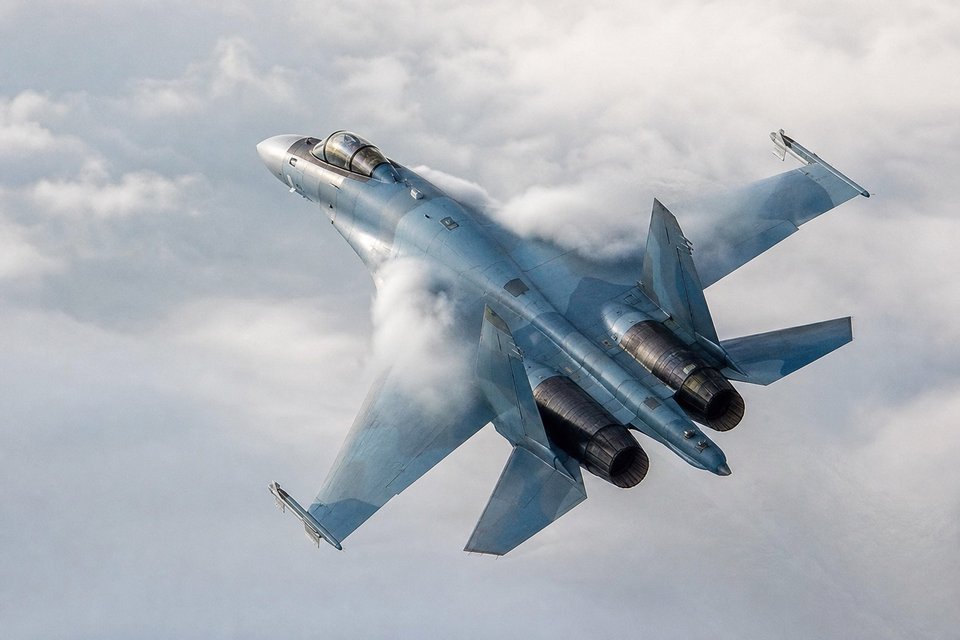
The Sukhoi Su-35 is a Russian twin-engine, single-seat fighter built around the airframe of the Su-27 "Flanker" family. Online references render the name several ways, including Su-35, Su 35, and occasionally Sukhoi 35, and all of them point back to the same programme, though not always to the same aircraft. Two genuinely different jets have carried the designation: a canard-equipped demonstrator from the early 1990s that never reached a frontline squadron, and the heavily reworked Su-35S that Russia has built in growing numbers since 2008.
This page covers both. It separates the Cold War-era Su-27M/Su-35 prototype line from the modern Su-35S "Flanker-E," lists the current Su-35 fighter's engines, radar and weapons, and works through where the type has been sold, flown and lost, including the Russo-Ukrainian war. Search engines, model-kit boxes and casual writing often drop the hyphen entirely, turning the name into Su 35, Sukhoi 35 or even Su 35 jet, but the aircraft underneath the spelling is unchanged.
Two Aircraft Named Su-35: From Su-27M to Su-35S
Sukhoi's design bureau began work on an improved Su-27 in December 1983, initially under the internal name Su-27M. The first prototype, factory code T-10M, flew on 28 June 1988 with test pilot Oleg Tsoi at the controls. It added canards ahead of the wing, a longer nose housing the new N011 Bars radar, and a heavier structure built from carbon fibre and aluminium-lithium alloy in place of some of the original aluminium skin. Sukhoi showed the jet to Western audiences at the 1992 Farnborough Airshow and, for export marketing, renamed it Su-35.
By 1995, fourteen of these aircraft existed: two converted prototypes, nine pre-production airframes and three production-standard jets, plus two static test hulls. Plans to build the type in quantity between 1996 and 2005 collapsed with Russia's post-Soviet economic crisis. Most of the surviving airframes ended up as testbeds for an even more radical derivative, the Su-37, which bolted thrust-vectoring nozzles onto the same canard airframe. Not one Su-27M or first-generation Su-35 ever reached a combat squadron. The most famous of the testbeds, the sole Su-37 "Terminator" prototype, kept flying air shows and demonstrating thrust-vectoring aerobatics until its tailplane broke off during a high-g test manoeuvre near Shatura, outside Moscow, on 19 December 2002. Pilot Yuri Vashuk ejected safely, but the sole airframe was destroyed and the programme ended with it; Sukhoi folded its canards, radar and thrust-vectoring work into the Su-30 and the Su-35S line instead of building a second Su-37.
Sukhoi returned to the name in December 2003, under a "deep modernization" programme coded T-10BM internally. This second Su-35 dropped the canards and the dorsal air brake entirely, relying on thrust-vectoring engines for the agility the 1990s design had used canards to reach. The first T-10BM prototype flew on 19 February 2008 with Sergey Bogdan at the controls, and the Russian air force ordered 48 production aircraft, designated Su-35S, at the MAKS air show the following year. Everything below describes this second-generation Su-35S unless a section says otherwise.
Su-35S Airframe, Engines and Thrust Vectoring
The Su-35S airframe keeps the Su-27 family's basic outline while reinforcing the structure for a heavier operating weight and a rated service life of roughly 6,000 flight hours or 30 years. Radar-absorbent coatings on the engine inlets and a reshaped nose section cut the aircraft's radar cross-section to a reported 1 to 3 square metres, nowhere near a genuine stealth design but noticeably smaller than a plain Su-27.
Power comes from two Saturn AL-41F1S turbofans, each rated at roughly 86 kN dry and about 137 kN with afterburner. Their exhaust nozzles pivot through two planes, giving the jet all-axis thrust vector control without the canards the earlier Su-35 needed for similar agility. The same engines let the Su-35S supercruise, sustaining speeds above Mach 1.1 without lighting the afterburners, which stretches range on longer patrol or escort sorties. Sukhoi and its Russian customers describe the combination of thrust vectoring and a reinforced airframe as what makes the Su-35S "supermaneuverable." It can still perform the tail-slide Pugachev's Cobra manoeuvre the Su-27 became known for, and sustain high-angle-of-attack turns that would depart a conventional Flanker.
Irbis-E Radar, OLS-35 and Avionics
The Su-35S's primary sensor is the Tikhomirov NIIP N035 Irbis-E, a passive electronically scanned array radar working in the X-band. Sukhoi's published figures credit it with detecting a large aerial target at up to 400 km, tracking around thirty targets at once, and guiding weapons against eight of them simultaneously. That is a real jump over the N001 radar carried by the original Su-27, though the Irbis-E is still a passive array rather than the active electronically scanned array fitted to newer Western fighters, which generally offers better resistance to jamming.
Ahead of the windscreen sits the OLS-35, an infrared search-and-track turret that can find and follow another aircraft passively, by its heat signature, without emitting a radar pulse the target could detect. Paired with the L175M Khibiny-M electronic countermeasures system built into the wingtips and tail fairing, the sensor suite is meant to let a Su-35 pilot find, track and engage an opponent while giving that opponent as little warning as possible. Two 9x12-inch multi-function displays, a head-up display and hands-on-throttle-and-stick controls round out the cockpit, run by a pair of digital mission computers.
Weapons and Hardpoints
A Su-35 fighter carries its weapons on twelve hardpoints, including two wingtip rails reserved for short-range missiles, plus one internal cannon. The table below lists the weapon classes Russian sources and open reporting have confirmed the aircraft carries operationally.
| Category | Weapon | Notes |
|---|---|---|
| Cannon | GSh-30-1, 30 mm | 150 rounds, internal, unchanged since the Su-27 |
| Short-range air-to-air | R-73, R-74 | Infrared-guided, high off-boresight |
| Medium-range air-to-air | R-27, R-77 | Semi-active radar and active radar homing |
| Long-range air-to-air | R-37M | Reported range beyond 300 km against large, non-manoeuvring targets |
| Anti-ship | P-800 Oniks, Kh-31, Kh-35U | Supersonic and subsonic anti-ship missiles |
| Anti-radiation | Kh-31P, Kh-58 | Target enemy radar emitters |
| Air-to-ground | Kh-29, Kh-38, KAB-500/1500 series | Guided bombs and stand-off missiles |
| Unguided | S-8/S-13 rocket pods, FAB-series bombs | Legacy ordnance still cleared for the airframe |
Maximum external load is generally quoted at 8,000 kg, the same figure the 1990s Su-35 claimed three decades earlier, even though the current airframe carries a considerably heavier and more varied mix of precision weapons than that first design ever fired.
Su-35 Fighter Specifications
The specifications below describe the current-production Su-35S. Some figures, especially range and radar cross-section, vary by a wide margin between Russian and Western sources; where that happens, a range is given rather than a single number presented as exact.
| Specification | Value |
|---|---|
| Length | 21.9 m (71 ft 10 in) |
| Wingspan | 15.3 m (50 ft 2 in) |
| Height | 5.9 m (19 ft 4 in) |
| Empty weight | 19,000 kg (41,900 lb) |
| Max takeoff weight | 34,500 kg (76,000 lb) |
| Engines | 2 x Saturn AL-41F1S, ~86 kN dry / ~137 kN afterburner each |
| Max speed | Mach 2.25 (~2,400 km/h) at altitude; ~1,400 km/h at sea level |
| Service ceiling | 18,000 m (59,000 ft) |
| Range | roughly 3,400-4,500 km unrefuelled depending on source and external tanks; combat radius about 1,600 km |
| Hardpoints | 12, including 2 wingtip rails |
| Crew | 1 (Su-35S); 2 on the Su-35UB trainer |
Two seats existed on the 1990s line too, in a single Su-35UB prototype built for weapons-system training, and Sukhoi carried that trainer concept forward into today's fleet under the same designation.
Su-35S vs Su-27, Su-30SM, F-15EX and Eurofighter Typhoon
None of these four aircraft compete in exactly the same role, but each is a jet Russia's air force, its export customers, or NATO air forces fly against or alongside a Su-35S. The table below lines up figures that are directly comparable across all five types.
| Aircraft | Origin | Engines | Max speed | Radar |
|---|---|---|---|---|
| Su-35S | Russia | 2x AL-41F1S, thrust-vectoring | Mach 2.25 | N035 Irbis-E, PESA |
| Su-27 | Soviet Union / Russia | 2x AL-31F | Mach 2.35 | N001, mechanically scanned |
| Su-30SM | Russia | 2x AL-31FP, thrust-vectoring | Mach 2.0 | N011M Bars, PESA |
| F-15EX Eagle II | United States | 2x F110-GE-129 | Mach 2.5+ | AN/APG-82(V)1, AESA |
| Eurofighter Typhoon | UK / Germany / Italy / Spain | 2x Eurojet EJ200 | Mach 2.0 | Captor or Captor-E, mechanical or AESA by tranche |
The plain Su-27 is actually rated slightly faster at altitude than the Su-35S, a reminder that top speed was never the point of the newer jet; its gains are in radar reach, sensor fusion and controllability at the edge of the flight envelope. The Eurofighter Typhoon and the American F-15EX both field active electronically scanned array radars as standard or near-standard equipment, a generation ahead of the Irbis-E's passive array in resistance to jamming, even though the Irbis-E's raw detection range figure is competitive on paper. Against a F-15 Eagle lineage aircraft or a Typhoon flown by a well-trained crew, most Western air forces expect the contest to turn on sensor fusion, training and missile performance well before either jet gets close enough for the Su-35's thrust vectoring to matter. None of the four rivals in the table is a stealth design, and neither is the Su-35S; against a genuine low-observable aircraft such as the F-22 Raptor or the F-35, the entire comparison changes, because the Su-35's radar and infrared sensors would likely detect a stealth opponent far later than it detects them.
Sukhoi Su-35 Operators and Export Orders
Russia's own air force remains the largest operator of the Su-35S by a wide margin, flying it from bases as far apart as Lipetsk, the Finnish border and the Pacific coast near Vladivostok, alongside the lighter single-engine MiG-29 Fulcrum and the long-range MiG-31 Foxhound interceptor in mixed fighter regiments. China signed a $2 billion contract for 24 Su-35s in November 2015, took its first four aircraft in December 2016, and completed deliveries in 2018; the type entered Chinese service that April, based in Guangdong province. No follow-on Chinese order has been placed since.
Algeria has become the largest confirmed operator of the Russian Su-35 outside Russia and China, with deliveries beginning in March 2025 under a contract reported in December 2019, including at least four airframes originally built for a different customer. That original customer was Egypt: Cairo ordered around 17 aircraft, and Sukhoi had built them by mid-2021, but Egypt shelved the deal in January 2022 after the United States threatened sanctions under CAATSA. The finished jets were later redirected to Algeria and Iran rather than scrapped.
Ethiopia has also appeared in leaked Rostec procurement documents as a prospective buyer of six aircraft, though no contract or delivery has been confirmed independently. Iran's purchase is the most recent large order for the Russian Su-35. Leaked Russian documents describe a deal worth roughly six billion euros for up to 48 aircraft, with deliveries running from 2026 into 2027 or 2028. Russian production had reportedly finished a first batch of about 20 airframes by mid-2026, held in Russia while Iran pays for their sustainment and repairs damage at the intended home base; as of this writing no Su-35 fighter has yet been physically handed over to Iranian pilots. Indonesia signed for 11 aircraft in 2018 and cancelled the order by the end of 2021, again citing CAATSA exposure alongside budget pressure. Egypt aside, no other prospective buyer, including Turkey, South Korea, Brazil, Venezuela and Malaysia, has converted interest in the Russian Su-35 into a completed contract.
Combat Record: Syria and Ukraine
The Sukhoi Su-35 first flew combat missions over Syria in January 2016, when Russia sent a small four-jet detachment that doubled as an operational test of the type's early avionics. Every Su 35 jet lost since has been tracked the same way open-source researchers follow the rest of the war: crash-site photographs, serial numbers and, occasionally, a captured pilot's own account. Confirmed intercepts followed for years afterward: two Su-35Ss forced a pair of Turkish F-16s to break off over Idlib in August 2019, a Su-35S intercepted Israeli aircraft over Damascus that November, and in 2023 a Su-35S reportedly shadowed a US MQ-9 Reaper drone in Syrian airspace. None of these incidents produced a shoot-down.
The Russo-Ukrainian war has been far costlier for the type. Ukrainian and Russian sources agree the Su-35 has scored genuine air-to-air kills against Ukrainian fighters and at least one helicopter since February 2022, but the aircraft has also suffered confirmed combat losses. Documented cases include a Su-35 shot down near Izyum on 3 April 2022 with its pilot captured, another lost near Kakhovka on 19 July 2022, two separate Patriot missile shoot-downs over Bryansk in May 2023, and a September 2023 friendly-fire loss near Tokmak to a Russian S-300 battery. Additional losses have been reported into 2025 and 2026, including a Patriot-system shoot-down near Mostky in Luhansk in July 2026. The open-source tracker Oryx had documented eight visually confirmed Su-35S losses as of late February 2026; the true figure, including aircraft damaged beyond photographic confirmation, is likely higher and cannot be stated more precisely from public evidence.
Production Numbers
Every Su-35S is built at the Komsomolsk-on-Amur Aircraft Plant in Russia's Far East, the same factory that assembles the Su-57, under the United Aircraft Corporation umbrella. Russian industry had delivered around 135 Su-35S airframes by the end of 2024 and roughly 155 by April 2026, a pace of some 15 to 20 new aircraft a year sustained through the war in Ukraine and Western sanctions on Russian aerospace suppliers. Not every delivered jet is necessarily flying combat sorties: some Western estimates put the number in frontline operational service somewhat below the total delivered, reflecting normal attrition, maintenance cycles and losses. Add the fourteen Su-27M/first-generation Su-35 airframes built in the 1990s, and total production across both aircraft that have carried the Su-35 name sits in the neighbourhood of 170 jets. Whether a headline calls it a Su 35, a Sukhoi 35 or a Su 35 jet, it is almost always describing the current Su-35S rather than the abandoned 1990s line; the Sukhoi Su-35 that matters operationally today is the one built at Komsomolsk-on-Amur, not the one that flew at Farnborough in 1992.
Su-35S specifications against other fighters
All 58 entries in the data table
Select a column heading to sort.
| Name | Nation | Class | Length (m) | Wingspan (m) | Max take-off (kg) | Max speed (km/h) | Range (km) | Ceiling (m) | Crew | Built | Compare |
|---|---|---|---|---|---|---|---|---|---|---|---|
| Grumman F-14A Tomcat | United States | fighter | 19.1 | 19.51 | — | 2,485 | 2,960 | 15,200 | 2 | — | |
| McDonnell Douglas F-15 Eagle | United States | fighter | 19.43 | 13.05 | — | 2,655 | — | 18,290 | — | — | |
| General Dynamics F-16A Fighting Falcon | United States | multirole | 15.06 | 9.96 | 13,558 | 2,121 | — | 16,764 | 1 | — | |
| McDonnell Douglas F/A-18C Hornet | United States | multirole | 17.1 | 12.3 | 23,537 | — | 2,844 | 15,240 | 1 | — | |
| Lockheed Martin F-22A Raptor | United States | stealth fighter | 18.92 | 13.56 | — | 2,410 | 3,220 | 20,000 | 1 | 195 | |
| Lockheed Martin F-35A Lightning II | United States | stealth multirole | 15.7 | 10.7 | — | — | 2,172 | 15,000 | 1 | — | |
| Lockheed F-117A Nighthawk | United States | stealth attack | — | — | — | 1,101 | — | 13,716 | 1 | 64 | |
| McDonnell Douglas F-4C Phantom II | United States | fighter | 17.73 | 11.76 | 26,308 | 2,253 | — | 18,166 | 2 | — | |
| Northrop F-20 Tigershark | United States | fighter | 14.17 | 8.13 | — | 2,232 | — | 16,764 | 1 | — | |
| Douglas A-4 Skyhawk | United States | attack | 12.22 | 8.38 | 11,113 | 1,078 | — | — | 1 | — | |
| Grumman A-6E Intruder | United States | attack | 16.69 | 16.15 | 27,397 | 1,030 | — | — | 2 | — | |
| Fairchild Republic A-10A Thunderbolt II | United States | attack | 16.26 | 17.53 | — | 724 | — | — | 1 | — | |
| Lockheed Martin AC-130J Ghostrider | United States | gunship | 29.79 | 40.41 | 74,389 | 669 | 4,828 | 8,534 | — | — | |
| Lockheed C-130H Hercules | United States | transport | 29.82 | 40.41 | 70,307 | 589 | 2,407 | — | — | — | |
| Boeing B-17G Flying Fortress | United States | bomber | 22.8 | 31.6 | 29,700 | 462 | 3,220 | 10,900 | 10 | — | |
| Consolidated B-24J Liberator | United States | bomber | 20.47 | 33.53 | 29,484 | 478 | 2,478 | 8,534 | 11 | 18,000 | |
| North American B-25J Mitchell | United States | bomber | 16.13 | 20.6 | — | 438 | 2,173 | — | 6 | 9,800 | |
| Martin B-26G Marauder | United States | bomber | — | — | — | 459 | 1,770 | 6,035 | — | 5,288 | |
| Boeing B-29 Superfortress | United States | bomber | 30.18 | 43.36 | — | — | — | — | 10 | 3,970 | |
| Boeing B-52H Stratofortress | United States | bomber | 48.5 | 56.4 | 221,353 | 1,046 | 14,162 | 15,240 | 5 | — | |
| Rockwell B-1B Lancer | United States | bomber | 44.5 | 41.8 | — | 1,368 | — | 15,000 | 4 | — | |
| Northrop Grumman B-2 Spirit | United States | stealth bomber | 21 | 52.4 | 152,634 | 1,010 | 11,100 | 15,240 | 2 | — | |
| Lockheed P-38L Lightning | United States | fighter | 11.53 | 15.85 | 7,938 | 666 | 1,770 | 12,192 | 1 | — | |
| Republic P-47D Thunderbolt | United States | fighter | 11.02 | 12.43 | 7,938 | 715 | 1,657 | 12,802 | 1 | — | |
| North American P-51D Mustang | United States | fighter | 9.83 | 11.28 | 5,489 | 703 | 1,609 | 12,771 | 1 | 15,686 | |
| Grumman F4F-3 Wildcat | United States | fighter | 8.76 | 11.58 | — | 515 | — | — | 1 | — | |
| Grumman F6F-5 Hellcat | United States | fighter | 10.24 | 13.06 | 6,991 | 604 | — | — | 1 | — | |
| Vought F4U Corsair | United States | fighter | 10.36 | 12.5 | — | 729 | 1,448 | — | 1 | — | |
| Douglas SBD Dauntless | United States | dive bomber | 10.08 | 12.65 | — | 410 | 1,245 | 7,782 | 2 | — | |
| Grumman TBF Avenger | United States | torpedo bomber | 12.5 | 16.5 | — | 443 | 1,609 | — | 3 | — | |
| Supermarine Spitfire Mk IX | United Kingdom | fighter | 9.46 | 11.23 | 3,402 | 657 | — | 13,106 | 1 | — | |
| Hawker Hurricane Mk IIC | United Kingdom | fighter | 9.83 | 12.19 | 3,950 | 547 | 966 | 11,000 | 1 | 8,000 | |
| de Havilland Mosquito | United Kingdom | fighter-bomber | 13.57 | 16.51 | 8,210 | 668 | — | — | 2 | — | |
| Avro Lancaster | United Kingdom | bomber | 21 | 31 | — | 450 | 2,670 | 7,500 | 7 | — | |
| Gloster Meteor F.8 | United Kingdom | fighter | 13.59 | 11.32 | — | 965 | — | 13,100 | 1 | — | |
| McDonnell Douglas/BAe AV-8B Harrier II | United States | attack | 14.12 | 9.25 | — | — | 3,300 | — | 1 | 340 | |
| Panavia Tornado IDS/GR1 | United Kingdom/West Germany/Italy | strike aircraft | 16.72 | 13.9 | 27,200 | 2,336 | 3,890 | — | 2 | 990 | |
| Messerschmitt Bf 109G-6 | Germany | fighter | 8.95 | 9.925 | 3,400 | 642 | 1,012 | — | 1 | 34,248 | |
| Focke-Wulf Fw 190A-8 | Germany | fighter | 8.95 | 10.51 | 4,900 | 652 | 950 | 10,350 | 1 | 20,000 | |
| Junkers Ju 87 Stuka | Germany | dive bomber | — | — | — | 340 | 715 | — | 2 | 6,000 | |
| Junkers Ju 88A-4 | Germany | bomber | 14.4 | 20 | 14,000 | 470 | 1,790 | 8,199 | 4 | 15,183 | |
| Heinkel He 111H-16 | Germany | bomber | 17.4 | 22.6 | 14,000 | 434 | 2,100 | 8,500 | 5 | 6,508 | |
| Messerschmitt Me 262A-1a | Germany | fighter | 10.6 | 12.6 | 7,130 | 900 | 1,050 | 11,450 | 1 | 1,430 | |
| Mitsubishi A6M2 Zero (Model 21) | Japan | fighter | 9.06 | 12 | 2,796 | 533 | 1,870 | — | 1 | 10,939 | |
| Ilyushin Il-2M3 Sturmovik | Soviet Union | attack | 11.65 | 14.6 | 6,360 | 410 | 765 | 4,525 | 2 | 36,183 | |
| Mikoyan-Gurevich MiG-15bis | Soviet Union | fighter | 10.86 | 10.08 | 6,045 | 1,074 | 1,859 | 15,500 | 1 | 17,310 | |
| Mikoyan-Gurevich MiG-21F-13 | Soviet Union | interceptor | 13.46 | 7.15 | 8,386 | 2,125 | — | 19,000 | 1 | 11,496 | |
| Mikoyan MiG-29 'Fulcrum-A' | Soviet Union | fighter | 17.32 | 11.36 | 18,500 | 2,445 | 2,100 | 17,000 | 1 | 1,600 | |
| Sukhoi Su-24MK Fencer | Soviet Union | attack | 22.53 | 17.64 | 43,755 | 1,654 | 2,775 | 11,000 | 2 | 1,400 | |
| Sukhoi Su-27S Flanker | Soviet Union | fighter | 21.94 | 14.7 | 28,000 | 2,500 | 3,900 | 18,500 | 1 | 680 | |
| Sukhoi Su-35S Flanker-E | Russia | fighter | 21.9 | 15.3 | 34,500 | 2,400 | 3,600 | 18,000 | 1 | 155 | |
| Sukhoi Su-57 | Russia | stealth fighter | 22 | 14.1 | 37,000 | 2,500 | 4,000 | 20,000 | 1 | 44 | |
| Eurofighter Typhoon | United Kingdom/Germany/Italy/Spain | multirole | 15.96 | 10.95 | 21,000 | 2,125 | — | — | 1 | 611 | |
| Kamov Ka-25 | Soviet Union | helicopter | 9.75 | 15.74 | 7,500 | 209 | 400 | 3,350 | 4 | 460 | |
| Boeing AH-64D Apache | United States | helicopter | 14.97 | 5.23 | 10,107 | 261 | 1,900 | 2,889 | 2 | 2,700 | |
| Bell AH-1G HueyCobra | United States | helicopter | 16.2 | 4.08 | 4,309 | 276 | 574 | 3,475 | 2 | 1,116 | |
| Boeing Vertol CH-46E Sea Knight | United States | helicopter | 13.66 | 15.24 | 11,022 | 267 | 1,019 | 5,182 | 5 | 524 | |
| Sikorsky CH-53D Sea Stallion | United States | helicopter | 20.58 | 22 | 19,051 | 315 | 1,000 | 5,105 | — | 267 |
Frequently asked questions
What is the Sukhoi Su-35?
The Sukhoi Su-35 is a Russian twin-engine, single-seat fighter derived from the Su-27 Flanker family. Two different aircraft have carried the name: a canard-equipped Su-27M/Su-35 demonstrator from the early 1990s that never entered service, and the current Su-35S "Flanker-E," in production since 2008 and flown by Russia, China and Algeria.
Is the Su-35 the same as the Su-27?
No. The Su-35S is a deep modernisation of the Su-27 airframe with thrust-vectoring AL-41F1S engines, the N035 Irbis-E radar, an OLS-35 infrared search-and-track sensor and a longer rated airframe life, but it keeps the Su-27's basic wing-body shape and is noticeably larger and heavier than the original 1980s Su-27.
What engines does the Su-35S use?
The Su-35S is powered by two Saturn AL-41F1S afterburning turbofans, each producing roughly 86 kN dry and about 137 kN with afterburner. Their nozzles pivot in two planes for thrust vector control, and the engines allow supercruise above Mach 1.1 without afterburner.
How far can the Irbis-E radar detect targets?
Sukhoi's published figures for the N035 Irbis-E radar credit it with detecting a large aerial target at up to 400 km, tracking around 30 targets simultaneously and engaging up to eight of them at once. It is a passive electronically scanned array, not an active array like the radars on newer Western fighters.
How many hardpoints does the Su-35 fighter have?
The Su-35S carries 12 hardpoints, including two wingtip rails reserved for short-range air-to-air missiles, plus one internal 30 mm GSh-30-1 cannon. Maximum external weapons load is around 8,000 kg.
Which countries operate the Su-35?
Russia is the largest operator. China took delivery of 24 Su-35s between 2016 and 2018, and Algeria began receiving aircraft in March 2025, including some airframes originally built for Egypt. Iran has a large order in progress, with a first batch of aircraft built but not yet delivered as of 2026.
Why did Egypt cancel its Su-35 order?
Egypt ordered around 17 Su-35s and Sukhoi had built them by mid-2021, but Cairo shelved the deal in January 2022 after the United States threatened sanctions under the CAATSA law over Egypt's broader defence relationship with Russia. The completed aircraft were later redirected to Algeria and Iran.
Has Iran received the Su-35 yet?
Not as of this writing. Leaked Russian documents describe an Iranian order for up to 48 Su-35s worth roughly six billion euros, with deliveries planned from 2026 into 2027 or 2028. Russia had reportedly finished building a first batch of about 20 aircraft by mid-2026, but they remained in Russia pending Iranian infrastructure and payment issues.
How many Su-35s has Russia lost in Ukraine?
The open-source tracker Oryx had visually confirmed eight Su-35S losses as of late February 2026, including aircraft downed near Izyum and Kakhovka in 2022, two Patriot missile shoot-downs over Bryansk in 2023, and a friendly-fire loss to a Russian S-300 near Tokmak. The true total, including unconfirmed losses, is likely higher.
How does the Su-35 compare to the F-15EX and Eurofighter Typhoon?
The Su-35S is broadly similar in speed and role to the F-15EX and Eurofighter Typhoon, but its N035 Irbis-E radar is a passive array while both Western jets use active electronically scanned array radars, generally giving them an edge in jamming resistance. The Su-35's main advantage is thrust-vectoring agility at close range.
How many Su-35 aircraft have been built?
Around 155 Su-35S aircraft had been delivered by April 2026, built at a rate of roughly 15 to 20 a year. Adding the 14 Su-27M/first-generation Su-35 airframes built in the 1990s, total production across both aircraft that have carried the name is around 170.
What happened to the original 1990s Su-35?
The Su-27M/Su-35 of the 1990s used canards and a new radar to add multirole capability to the Su-27, but Russia's post-Soviet economic crisis ended plans for series production after only 14 aircraft. Most surviving airframes became testbeds for the Su-37, whose sole prototype crashed in 2002, ending that line entirely.