Plate 016 — Naval
REF: BF-NAV-016US Navy Destroyers: Arleigh Burke, Spruance, Kidd and Zumwalt Class
US Navy destroyers run anti-submarine, anti-air and anti-surface missions from a single hull. This guide covers the active Arleigh Burke class and its Flight I-III variants, the retired Spruance and Kidd classes, the cut-down Zumwalt class, and how Aegis and vertical-launch missiles turned the type into the fleet's main strike ship.
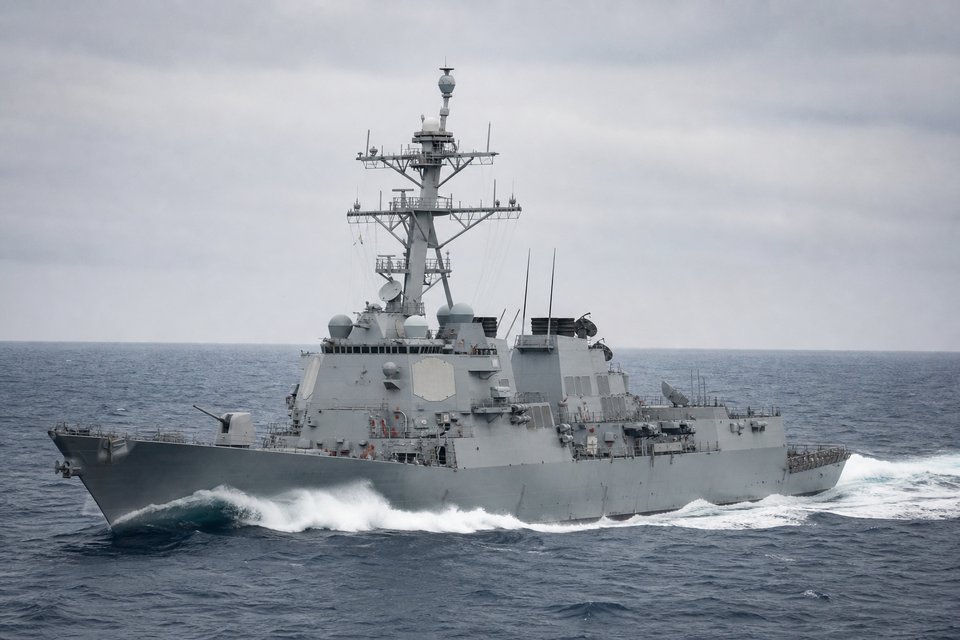
US Navy destroyers are the fleet's most numerous class of surface warship, fast enough to screen a carrier strike group and armed heavily enough to fight submarines, aircraft and other ships at the same time. The current standard is the Arleigh Burke class (DDG), an Aegis-equipped guided-missile destroyer design in continuous production since 1991. Two earlier classes, the gas-turbine Spruance (DD) and the Iran-ordered Kidd (DDG), carried the fleet through the late Cold War and are now fully retired, while a third, the stealth-hulled Zumwalt (DDG), was cut from a planned fleet of dozens down to just three ships.
What a Destroyer Does: ASW, AAW and ASuW
Destroyers and guided-missile destroyers work in support of carrier strike groups, surface action groups, amphibious ready groups and underway replenishment groups, and they can also operate independently. Older, gun-and-sonar destroyers were built mainly for anti-submarine warfare (ASW); the modern guided-missile destroyer is a genuine multi-mission combatant, expected to fight anti-air warfare (AAW), anti-submarine warfare and anti-surface warfare (ASuW) in the same engagement. Adding the Mark 41 Vertical Launch System, and on some Spruance-class ships armored box launchers for the Tomahawk cruise missile, pushed the destroyer well beyond escort duty and into land-attack strike warfare, a role once reserved for cruisers and battleships.
Anti-submarine work leans heavily on the ship's embarked helicopter. The Light Airborne Multi-Purpose System, LAMPS, puts an MH-60R Seahawk aboard every Flight IIA and Flight III Arleigh Burke, extending the destroyer's sonar and torpedo reach well beyond visual range; Flight I and Flight II hulls, built without a hangar, instead depend on land-based patrol aircraft or a carrier's own helicopters for that job. Anti-air warfare, by contrast, is fought mostly from the combat information center, where Aegis radar tracks and the vertical-launch magazine below deck matter more than anything visible on the weather decks.
From Torpedo-Boat Destroyer to Fleet Escort
The type began in the 1890s as the "torpedo-boat destroyer", a fast, lightly built ship whose job was to hunt down the cheap torpedo boats that threatened battle fleets; the Royal Navy formalized the design with the Havock and Daring classes of 1893-94. World War I turned destroyers into the fleet's anti-submarine arm, fitted with depth charges and hydrophones once Germany began unrestricted submarine warfare, and pressed into convoy escort duty from 1917 onward. By World War II, US Navy classes such as Fletcher, Allen M. Sumner and Gearing had grown into large, multi-purpose warships combining torpedoes, dual-purpose guns and heavy anti-aircraft batteries; the Fletcher class alone ran to 175 ships, each displacing about 2,050 tons standard and carrying five 5-inch guns and ten torpedo tubes, a jump in size and firepower driven directly by the Pacific war's carrier and kamikaze threats. The postwar arrival of surface-to-air and surface-to-surface missiles in the early 1960s created the guided-missile destroyer, and the Arleigh Burke class, in service since 1991, remains the direct descendant of that line.
US Navy Destroyer Classes
| Class | Ships built | Commissioned | Status (2026) |
|---|---|---|---|
| Arleigh Burke (DDG 51-) | 75 in commission, up to 117 planned | 1991-ongoing | Active, in production (Flight III) |
| Zumwalt (DDG 1000-1002) | 3 | 2016-2027 | Active / fitting out |
| Spruance (DD 963-997) | 31 | 1975-1983 | Retired; last decommissioned 2005 |
| Kidd (DDG 993-996) | 4 | 1981-1982 | Retired from USN 1998-99; sold to Taiwan as the Kee Lung class |
Arleigh Burke Class: the Navy's Standard Destroyer
Technological advances culminated in the Arleigh Burke (DDG 51) class, named for the Navy's most decorated destroyer squadron combat commander and three-time Chief of Naval Operations. USS Arleigh Burke was commissioned on 4 July 1991 as, at the time, the most powerful surface combatant ever put to sea. Like the larger Ticonderoga-class cruisers, her combat system centers on Aegis and the SPY-1D multi-function phased-array radar (SPY-6 on the newest Flight III ships); combined with the Vertical Launch System, an advanced anti-submarine suite, long-range anti-aircraft missiles and Tomahawk, the class replaced the older Charles F. Adams and Farragut-class guided-missile destroyers and has stayed in production for more than three decades.
The class incorporates all-steel construction, a decision driven by the 1975 collision of the cruiser USS Belknap (CG 26) with USS John F. Kennedy (CV 67), in which Belknap's aluminum superstructure suffered severe fire damage and heavy casualties; every US surface combatant since has returned to steel. Like most modern American warships, the Arleigh Burke class runs on gas-turbine propulsion. As of 2026 the class has grown to around 75 ships in four production groups, with a Flight III restart planned to bring the eventual total toward 117.
The class has since fought in earnest, not just on patrol. USS Cole (DDG 67) was moored in Aden harbor, Yemen, for a routine refuelling stop on 12 October 2000 when a small boat packed with explosives was detonated against her port side, killing 17 sailors and injuring 37 more; the ship survived the attack and was later repaired and returned to service. More than two decades on, the class proved its anti-air design under real fire again: on 19 October 2023, USS Carney (DDG 64) shot down four cruise missiles and fifteen drones over a nine-hour engagement while defending merchant shipping against Houthi attacks in the Red Sea, one of several such actions Arleigh Burke destroyers fought during that campaign.
| Flight | Hull numbers | Ships | Notable feature |
|---|---|---|---|
| Flight I | DDG 51-71 | 21 | Original Aegis/SPY-1D design, no helicopter hangar |
| Flight II | DDG 72-78 | 7 | Improved air-search radar and communications |
| Flight IIA (incl. Restart and Technology Insertion) | DDG 79-124, 127 | 46 | Added a hangar for two MH-60R Seahawk helicopters |
| Flight III | DDG 125- | 1 in service, 24 ordered | AN/SPY-6 radar, higher electrical power for future weapons |
Spruance Class: the Last All-Gun Destroyers
The Spruance class, the first large US Navy warships built around gas-turbine main propulsion, ran to 31 ships, the lead ship USS Spruance (DD 963) commissioned on 20 September 1975 and the last of the class commissioned in 1983. Many of the class received a mid-life upgrade adding the Mark 41 Vertical Launch System or Tomahawk armored box launchers, extending their role from anti-submarine escort into land-attack strike. All 31 ships were nonetheless decommissioned by 2005, the last leaving service on 21 September that year; most were later sunk in fleet gunnery and missile exercises or scrapped. A related design, ordered by the Shah of Iran before the 1979 revolution for Persian Gulf air-defense duty and completed instead for the US Navy as the four-ship Kidd class (USS Kidd, Callaghan, Scott and Chandler, DDG 993-996), added Mk 26 missile launchers for 68 Standard SM-2 missiles and heavier air-conditioning built for Gulf heat and sand, both features beyond a standard Spruance. All four served in the US Navy from 1981-82 until decommissioning in 1998-99, then were sold to Taiwan in 2001 and recommissioned as the Kee Lung class.
Zumwalt Class: a Cut-Down Stealth Destroyer
The Zumwalt class was meant to replace the naval gunfire support once provided by battleships, with a planned run that shrank from 32 ships to 24, then 7, and finally just 3 as costs rose. USS Zumwalt (DDG 1000) was commissioned in October 2016 and USS Michael Monsoor (DDG 1001) in January 2019; the third ship, USS Lyndon B. Johnson (DDG 1002), is expected to join the fleet in 2027. The class's distinctive tumblehome hull and composite deckhouse were built around two 155mm Advanced Gun Systems, but the cost of their guided shells rose to between $800,000 and $1 million per round, and the Navy cancelled the ammunition program; the guns are being removed in favor of hypersonic strike missiles.
Vertical Launch System and the Aegis Combat System
The Mark 41 Vertical Launch System replaced the exposed missile rails and single-arm launchers of earlier guided-missile destroyers with rows of missile cells built into the deck, each capable of holding a Standard surface-to-air missile, a Tomahawk cruise missile, an anti-submarine rocket or an Evolved Sea Sparrow, ready to fire in any sequence the fire-control system chooses. On a Flight IIA Arleigh Burke, 96 cells are split between a 32-cell forward module and a 64-cell aft module. The Aegis Combat System ties that launcher to the SPY radar and the ship's own sensors, letting one destroyer track and engage dozens of aircraft, missiles or surface contacts simultaneously, and letting a group of Aegis ships share targeting data as though they were a single, distributed air-defense network.
The Navy's planned successor, DDG(X), is meant to replace both the Ticonderoga-class cruisers and the oldest Arleigh Burke hulls from the early 2030s onward. At roughly 13,300 tons and 183 meters long, the design would carry a scaled-up AN/SPY-6 radar, three 32-cell VLS modules for a total of 96 missiles, and an integrated turboelectric power system built to leave enough spare electrical capacity for future weapons, lasers among them, that current destroyers cannot yet support.
Destroyers sit alongside the USN cruiser force and the smaller USN frigates in the surface fleet, and the doctrine that shapes their AAW and ASW missions is covered on the naval tactics reference. Their submarine-hunting role is the mirror image of the boats they are built to find, from Cold War-era SSN attack submarines back to the World War II German U-boats that first made a dedicated escort destroyer necessary, and the wider organization of the fleet they serve in is outlined on the United States Navy page.
Frequently asked questions
How many Arleigh Burke class destroyers are in service?
As of 2026, about 75 Arleigh Burke-class destroyers are in commission across four production groups: 21 Flight I, 7 Flight II, 46 Flight IIA (including the Restart and Technology Insertion sub-groups) and 1 Flight III, with 24 Flight III ships ordered in total. The Navy's long-term plan would grow the class toward roughly 117 hulls.
What is the difference between Flight I, II, IIA and III Arleigh Burke destroyers?
Flight I (DDG 51-71) introduced the original Aegis/SPY-1D design without a helicopter hangar. Flight II (DDG 72-78) added improved air-search radar and communications. Flight IIA (DDG 79 onward) added a hangar for two MH-60R Seahawk helicopters and grew in displacement. Flight III, starting with DDG 125, carries the more powerful AN/SPY-6 radar and extra electrical capacity for future weapons.
What happened to the Spruance class destroyers?
All 31 Spruance-class destroyers, commissioned between 1975 and 1983, were decommissioned by 2005, the last on 21 September that year. Most were expended as targets in fleet gunnery and missile exercises or scrapped for salvage; none remain in US Navy service. A related design built instead for Persian Gulf air defense became the four-ship Kidd class.
Why were the Kidd class destroyers originally built for Iran?
The Shah of Iran ordered six air-defense destroyers based on the Spruance hull for Persian Gulf duty in the early 1970s. The 1979 Iranian Revolution meant Iran never took delivery, so the four ships already under construction, USS Kidd, Callaghan, Scott and Chandler, were completed for the US Navy instead, entering service in 1981-82.
Why did the Navy only build three Zumwalt class destroyers?
The Zumwalt program was cut from a planned 32 ships to 24, then 7, and finally 3 as unit costs rose sharply. The final blow came when ammunition for its two Advanced Gun Systems reached $800,000 to $1 million per guided shell, an unaffordable price that led the Navy to cancel the rounds and later remove the guns for a hypersonic-missile conversion.
What is the Aegis Combat System?
Aegis is the integrated radar, computer and weapons-control system built around the SPY phased-array radar (SPY-1D on most Arleigh Burkes, SPY-6 on Flight III). It fuses a ship's own sensor picture with data from other Aegis ships and aircraft, then assigns and fires missiles from the Vertical Launch System automatically against multiple simultaneous air, missile or surface threats.
What roles do US Navy destroyers perform today?
A modern guided-missile destroyer fights anti-submarine warfare (ASW), anti-air warfare (AAW) and anti-surface warfare (ASuW) from the same hull, escorting carrier strike groups and amphibious forces or operating independently. Vertical-launch Tomahawk missiles also let destroyers strike land targets, a mission first proven when USS Carney shot down four cruise missiles and fifteen drones defending Red Sea shipping in October 2023.