Plate 008 — Armor
REF: BF-ARM-008M60 Patton Tank: US Main Battle Tank History and Variants
Developed from the M48 with a new 105 mm gun and diesel engine, the M60 Patton tank armed the US military for three decades and, in upgraded M60 tank variants, still equips several allied armies today.
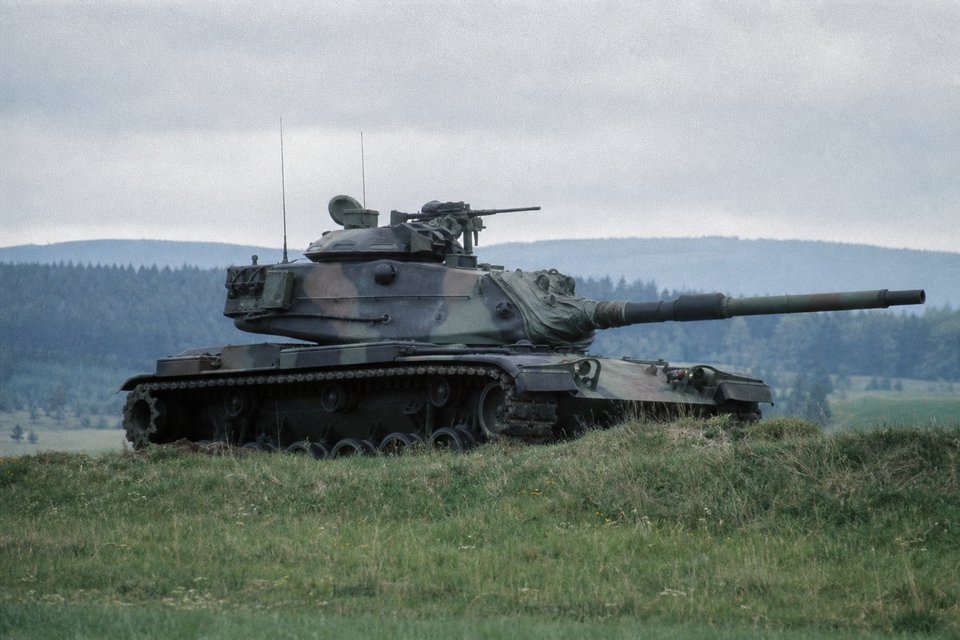
The M60 was the primary American main battle tank of the Cold War, armed with a 105 mm M68 rifled gun and powered by an air-cooled AVDS-1790 diesel engine, and it remained in United States Army and Marine Corps service from 1960 until it was retired from front-line American use after the 1991 Gulf War. "Patton" was never its official name: the tank's close visual resemblance to the M48A2 Patton it was developed from led some sources to informally label the original M60 a Patton tank, but the US Army designated it simply as the M60, and later variants carried their own suffixes rather than any Patton branding. More than 15,000 M60s of all variants were eventually built, and heavily upgraded examples remain in frontline service with several allied armies today.
The Patton name itself belongs to a naming tradition rather than to the M60. The US Army had named the preceding M46, M47 and M48 medium tanks after General George S. Patton, and because the M60 shared so much of the M48's hull and running gear, the habit carried over informally even though the Ordnance Department never issued the name officially; period manuals and unit records refer to the vehicle only as the M60, M60A1, M60A2 or M60A3.
Development from the M48
The M60's origins lie in a scare rather than a plan. In November 1956, during the Hungarian Revolution, a Soviet T-54A medium tank was driven onto the grounds of the British embassy in Budapest, and a British military attaché's inspection concluded that the Centurion's 20-pounder gun could not reliably defeat the T-54's frontal armour. The finding pushed Britain to fit the Centurion with a new 105 mm high-velocity gun, the Royal Ordnance L7, and the United States responded in September 1957 by starting development of what was initially called the XM60, an upgrade of the existing M48 Patton hull rather than a clean-sheet design. Comparative firing trials at the Aberdeen Proving Ground in 1958 tested six candidate main guns, including 90 mm, 105 mm and 120 mm designs, before the American-built version of the British L7, standardised as the 105 mm Cannon, M68, was selected for its combination of accuracy, rate of fire and ammunition maturity.
The new hull paired that gun with an AVDS-1790 air-cooled diesel engine in place of the M48's gasoline powerplant, trading some top speed for far greater operating range and a much lower fire risk if the tank was hit. The prototype hulls were referred to internally as the M68 through December 1958 before the Ordnance Department settled the tank's official designation as the M60 in March 1959, and production pilots began rolling off the Chrysler Corporation's Detroit Arsenal Tank Plant that summer. The M60 reached operational units of the US Army in Europe from December 1960, and production of the base model ran from 1959 to 1962 before giving way to the improved M60A1, continuing a postwar line of American medium and heavy tanks that had begun with the M46, M47 and M48 (see the full list of WW1, WW2 and modern tanks).
Unit costs climbed steadily as the tank grew more sophisticated. A base M60 cost the Army about $481,911 in 1962; an M60A1 RISE cost $703,278 by 1976; the missile-armed M60A2 cost $726,712 in 1974; and a fully modernised M60A3 TTS cost roughly $1.292 million by 1990, more than double the A2's price for a simpler, more reliable gun system.
Design and Specifications
| Specification | M60 | M60A1 | M60A2 | M60A3 |
|---|---|---|---|---|
| Length, gun forward | 9.3 m | 9.4 m | 7.3 m | 9.4 m |
| Combat weight | 46.3 t | 47.6 t | 51.7 t | 52.0 t |
| Main armament | 105 mm M68 | 105 mm M68 | 152 mm M162 gun/launcher | 105 mm M68E1 |
| Main gun ammunition | 57 rounds | 63 rounds | 46 rounds | 63 rounds |
| Engine | 750 hp AVDS-1790 diesel | 750 hp AVDS-1790 diesel | 750 hp AVDS-1790 diesel | 750 hp AVDS-1790 diesel |
| Top speed | 48 km/h | 48 km/h | 48 km/h | 48 km/h |
| Range | 480 km | 480 km | 450 km | 450 km |
| Crew | 4 | 4 | 4 | 4 |
Every production M60 carried a crew of four, a coaxial 7.62 mm machine gun and a .50 calibre M85 machine gun on the commander's cupola, and the same basic AVDS-1790 diesel and cross-drive transmission across every version, so upgrades focused almost entirely on the turret, armament and fire-control systems rather than the automotive package underneath.
M60 Tank Variants
| Variant | Key feature | Years |
|---|---|---|
| M60 | Baseline production tank, 105 mm M68 gun | 1959-1962 |
| M60A1 | Larger cast turret, improved armour and shock absorbers | 1962-1980 |
| M60A2 "Starship" | Low-profile turret, 152 mm gun/launcher for the Shillelagh missile | 1973-1975 (withdrawn 1981) |
| M60A3 / M60A3 TTS | Laser rangefinder, solid-state ballistic computer, thermal sight | 1978-1983 (conversions to 1990) |
| M728 CEV | Combat engineer vehicle, demolition gun, dozer blade, boom | Based on M60/M60A1 hull |
| M60 AVLB | Armoured vehicle-launched scissors bridge | Based on M60/M60A1 hull |
| Sabra Mk I/II/III | Israeli export upgrade, 105-120 mm gun options, new armour | Exported to Turkey and other users |
| M60T | Turkish modernisation built on the Sabra Mk II package | In Turkish Land Forces service |
| Magach 6 / Magach 7 | Israeli domestic upgrades, Blazer ERA, Urdan cupola | Israel Defense Forces |
| M60 Phoenix | Jordanian upgrade, 120 mm RUAG smoothbore gun | Jordan Armed Forces, from 2004 |
The M60 was the baseline production tank, built from 1959 to 1962 with the original hemispherical turret and no separate cupola weapon on early examples. The M60A1, approved for development in early 1960 and produced from 1962 to 1980, replaced that turret with a larger, better-shaped casting that improved ballistic protection and moved the gun mount five inches forward to free up crew space; the tank grew out of an internal test vehicle designated the M60E1, whose first pilots were completed in May and June 1961. Later A1 production, known as M60A1 RISE (Reliability Improved Selected Equipment), added thermal sleeves and other reliability upgrades, and additional Shillelagh-missile development work in the early 1960s is sometimes referenced under further "E"-suffix designations for the experimental turret configurations involved, though none of these test vehicles ever reached service in their own right.
The M60A2, built from 1973 to 1975, replaced the gun entirely with a 152 mm M162 gun/launcher capable of firing both conventional rounds and the Shillelagh anti-tank guided missile, mounted in a distinctive low-profile turret with a commander's cupola on top. The system proved too complex for reliable field use: the missile's guidance electronics depended on fragile vacuum tubes, unburnt propellant fouled the barrel and caused pre-detonation of following rounds, and the tank earned the unofficial nickname "Starship" for how technologically ambitious, and troublesome, it was. The Shillelagh/M60A2 combination was withdrawn from active units by 1981, and most surviving hulls were rebuilt as M60A3s, M728 combat engineer vehicles or AVLB bridge layers.
The M60A3, developed from 1976 in response to the M60A2's problems and advances in Soviet armour, kept the reliable 105 mm M68E1 gun but added a laser rangefinder, a solid-state M21 fire-control computer and non-flammable turret hydraulics; the improved M60A3 TTS variant added a Tank Thermal Sight for night and poor-visibility engagements. New-build and conversion orders continued into the mid-1980s, with the last major order, 94 tanks for Egypt, completed in 1986, by which point total M60-series production across all variants had passed 15,000 units.
Two specialised engineering variants used the M60 chassis without its gun turret. The M728 Combat Engineer Vehicle carried a 165 mm demolition gun, a hydraulic dozer blade and a boom for obstacle clearance and battlefield engineering work, seeing service in Vietnam and later conflicts in a fire-support and breaching role. The M60 Armored Vehicle Launched Bridge carried a scissors-type bridge capable of spanning gaps for following armour, and both variants remained in limited US and allied service long after the gun tank itself was retired.
Combat History
The M60's first combat use came in Vietnam, where the M60 AVLB and M728 CEV, rather than the gun tank itself, were the only M60-series vehicles deployed; the CEV supported fire missions, base security and direct assault of fortified positions, while the AVLB gave armoured columns a way to cross gaps the enemy had blown or dug. M60A1s later took part in the 1983 invasion of Grenada, where four tanks from a Marine assault unit landed at Grand Mal Bay, knocked out a Grenadian BRDM-2 armoured car and helped overwhelm the defenders of Fort Frederick.
The tank's first major tank-versus-tank combat came with Israel during the 1973 Yom Kippur War, where it fought under the Hebrew designation Magach 6 against Egyptian and Syrian armour, including the Soviet-supplied T-62, and performed well enough that President Nixon authorised Operation Nickel Grass, an emergency airlift of additional M60s to Israel, on 12 October 1973. Israel used upgraded M60s again during the 1982 Lebanon War, fitted with explosive reactive armour that proved effective against Syrian and Palestinian anti-tank missiles.
M60s delivered to Iran before the 1979 revolution saw limited, ad hoc use during the Iran-Iraq War of the 1980s; six Iranian M60A1s were captured in 1980 and handed over to Jordan, and the type was never officially fielded by Iraq itself. The largest American deployment of the M60 came during the 1991 Gulf War, where US Marine Corps M60A1s of Task Force Ripper led the drive on Kuwait International Airport: on the first day of fighting, a single platoon of D Company, 3rd Tank Battalion destroyed 15 Iraqi tanks and 25 armoured personnel carriers and took 300 prisoners, and the division went on to destroy roughly 30 to 40 dug-in Iraqi T-72 tanks defending the airport itself. The M60 was formally withdrawn from American front-line service afterward in favour of the M1 Abrams, though a few M60A3s stayed on with US Air Force explosive-ordnance-disposal units at Doha, Qatar, for runway-clearance work into the 1990s.
Since then, upgraded M60-series tanks have continued fighting in other hands: Turkish M60T and Sabra-upgraded M60A1/A3 tanks have taken part in Turkey's military interventions in the Syrian civil war, and Saudi Arabian M60A3s, alongside Yemen's own ageing M60A1 fleet, have seen use in the Yemeni civil wars, including the Saudi-led intervention against Houthi forces that began in 2015.
Foreign Upgrades
Because the M60 remained in first-line service with poorer or non-NATO-standard armies long after the United States moved on, several countries developed their own upgrade packages rather than buying new tanks outright. Israel's domestic Magach series, built from M60s of various sub-types, added the low-profile Urdan cupola and Blazer explosive reactive armour in the Magach 6, then a more powerful engine, additional passive armour and Merkava-derived tracks in the Magach 7. Israel Military Industries packaged similar improvements for export as the Sabra: Sabra Mk I kept the original 105 mm gun with a more powerful engine, while Sabra Mk II replaced it with a 120 mm smoothbore gun, a new Elbit fire-control system and modular reactive and passive armour; roughly 170 Turkish M60A1s received the Sabra Mk II package. Turkey's own further-modernised tanks, built on that Israeli upgrade, entered service as the M60T.
Jordan pursued a different route with the M60 Phoenix, a modular upgrade of the M60A3 TTS developed by the King Abdullah II Design and Development Bureau together with Raytheon from 2004, replacing the original gun with a RUAG Land Systems 120 mm smoothbore weapon and adding an independent fire-control system, passive spaced armour and infrared jammers. Egypt took the opposite approach of buying more M60A3s outright rather than deeply modifying existing hulls, and by the mid-2010s had become the largest M60 operator in the world, with more than 1,700 upgraded M60A3s in service alongside smaller fleets in Turkey and Saudi Arabia.
Retirement from US Service
Through the 1970s and 1980s, M60s were a fixture of the Cold War standoff in Europe, deploying to West Germany for annual REFORGER exercises and Berlin's Armed Forces Day parades and to South Korea for the biannual Team Spirit manoeuvres, both of which continued until 1991. Age and maintenance strain caught up with the fleet before combat did: a 1987 report found that 10 percent of the US M-60 fleet was inoperable because of counterfeit bolts that had entered the supply chain, a reminder of how large and logistically stretched the M60 force had become by the time the Cold War ended. FORSCOM withdrew the M60 series from US combat units once Operation Desert Storm concluded, replacing it on a one-for-one basis with the M1 Abrams, and the surplus tanks freed up by that transition were absorbed into allied fleets or transferred under the Conventional Forces in Europe Treaty rather than scrapped outright.
M60 Operators Today
According to the most recently published tallies, from 2023, the M60 remains in active service well beyond the countries that fought with it during the Cold War. Egypt fields roughly 300 M60A1 and 850 M60A3 tanks, the largest fleet of any operator; Turkey operates around 100 M60A1, 650 M60A3 TTS and 165 M60T tanks; and Saudi Arabia keeps roughly 370 M60A3s. Smaller operators include Jordan (182 M60A3), Morocco (220 M60A1 and 120 M60A3 TTS), Taiwan (460 M60A3 TTS, plus the related CM11 hybrid), Thailand, Tunisia, Bahrain, Brazil, Oman and Bosnia and Herzegovina. Israel, which fielded 1,350 M60s and Magach variants at its peak in 2005, has since replaced its gun tanks with the Merkava and retains only M60-based AVLB bridge layers, while the United States itself withdrew the M60 from Army and Marine Corps front-line units after the 1991 Gulf War in favour of the M1 Abrams.
Compare tanks side by side
All 43 entries in the data table
Select a column heading to sort.
| Name | Nation | Class | Weight (t) | Length (m) | Width (m) | Height (m) | Main gun (mm) | Max armor (mm) | Engine (hp) | Road speed (km/h) | Range (km) | Crew | Built | Compare |
|---|---|---|---|---|---|---|---|---|---|---|---|---|---|---|
| M2 Light Tank | United States | light tank | 11.6 | 4.42 | 2.46 | 2.64 | 37 | 25 | 250 | 58 | 320 | 4 | 698 | |
| M3/M5 Stuart | United States | light tank | 12.9 | 4.84 | 2.29 | 2.57 | 37 | 51 | 220 | 58 | 160 | 4 | 22,744 | |
| M22 Locust | United States | airborne tank | 7.4 | 3.94 | 2.16 | 1.85 | 37 | 12.5 | 165 | 64 | 217 | 3 | 830 | |
| M24 Chaffee | United States | light tank | 18.4 | 5.56 | 3 | 2.77 | 75 | 38 | 220 | 56 | 160 | 5 | 4,731 | |
| M2 Medium Tank | United States | medium tank | 18.7 | 5.38 | 2.59 | 2.82 | 37 | 51 | 400 | 42 | 210 | 5 | 112 | |
| M3 Lee/Grant | United States | medium tank | 27.2 | 5.64 | 2.72 | 3.12 | 75 | 51 | 400 | 42 | 193 | 7 | 6,258 | |
| M4A1 Sherman (75 mm) | United States | medium tank | 30.3 | 5.84 | 2.62 | 2.74 | 75 | 76 | 400 | 39 | 193 | 5 | 6,281 | |
| M4A3 76 mm (W) Sherman | United States | medium tank | 33.7 | 7.54 | 3 | 2.97 | 76 | 64 | 450 | 42 | 160 | 5 | 1,925 | |
| M4A3E2 Jumbo | United States | medium tank | 38.1 | — | — | — | 75 | 152 | 450 | 35 | 146 | 5 | 254 | |
| M4A3E8 Sherman "Easy Eight" | United States | medium tank | 33.6 | 5.92 | 2.54 | 2.74 | 76 | 64 | 450 | 47 | 160 | 5 | 2,617 | |
| M6 Heavy Tank | United States | heavy tank | 57.4 | 8.43 | 3.12 | 3 | 76 | 101 | 825 | 35 | 160 | 6 | 40 | |
| M26 Pershing | United States | heavy tank | 41.9 | — | — | — | 90 | 102 | 500 | 48 | 160 | 5 | 2,202 | |
| M10 Wolverine | United States | tank destroyer | 29.6 | 6.83 | 3.05 | 2.9 | 76 | 57 | 375 | 48 | 320 | 5 | 6,406 | |
| M18 Hellcat | United States | tank destroyer | 17 | 6.65 | 2.87 | 2.57 | 76 | 25 | 400 | 89 | 160 | 5 | 2,507 | |
| M36 Jackson | United States | tank destroyer | 29 | 7.47 | 3.05 | 3.28 | 90 | 76 | 450 | 42 | 240 | 5 | 1,772 | |
| Panzer III | Germany | medium tank | 22.7 | 6.28 | 2.95 | 2.5 | 50 | 50 | 300 | 40 | 155 | 5 | 5,774 | |
| Panzer IV (Ausf. H) | Germany | medium tank | 25 | 7.02 | 2.88 | 2.68 | 75 | 80 | 296 | 40 | 235 | 5 | 2,324 | |
| Panther (Ausf. G) | Germany | medium tank | 45.5 | 8.86 | 3.4 | 2.98 | 75 | 120 | 690 | 46 | 200 | 5 | 3,126 | |
| Tiger I | Germany | heavy tank | 57 | 8.45 | 3.56 | 3 | 88 | 120 | 690 | 45 | 195 | 5 | 1,347 | |
| Tiger II | Germany | heavy tank | 69.8 | 10.29 | 3.75 | 3.09 | 88 | 185 | 690 | 42 | 190 | 5 | 492 | |
| Panzer VIII Maus | Germany | super-heavy tank | 188 | 10.2 | 3.71 | 3.63 | 128 | 220 | 1,200 | 20 | 160 | 6 | 2 | |
| T-34/76 | Soviet Union | medium tank | 26.5 | 6.68 | 3 | 2.46 | 76 | 45 | 500 | 53 | 330 | 4 | 35,120 | |
| T-34/85 | Soviet Union | medium tank | 32.4 | 6.68 | 3 | 2.46 | 85 | 90 | 500 | 55 | 300 | 5 | 48,950 | |
| KV-1 | Soviet Union | heavy tank | 45 | 6.75 | 3.32 | 2.71 | 76 | 90 | 600 | 35 | 250 | 5 | 5,219 | |
| IS-2 | Soviet Union | heavy tank | 46 | 9.9 | 3.09 | 2.73 | 122 | 132 | 520 | 37 | 240 | 4 | 3,854 | |
| T-35 | Soviet Union | heavy tank | 45 | 9.72 | 3.2 | 3.43 | 76 | 30 | 500 | 30 | 150 | 10 | 60 | |
| ISU-152 | Soviet Union | assault gun | 45 | 9.18 | 3.07 | 2.48 | 152 | 120 | 520 | 37 | 230 | 5 | 4,635 | |
| Matilda II | United Kingdom | infantry tank | 25 | 5.61 | 2.59 | 2.51 | 40 | 78 | 190 | 24 | 257 | 4 | 2,987 | |
| Churchill Mk VII | United Kingdom | infantry tank | 40.7 | 7.44 | 2.74 | 3.45 | 75 | 152 | 350 | 20 | 145 | 5 | 1,600 | |
| Cromwell | United Kingdom | cruiser tank | 28 | 6.35 | 2.908 | 2.49 | 75 | 76.7 | 600 | 64 | 270 | 5 | 4,016 | |
| T-54 | Soviet Union | main battle tank | 36 | 9 | 3.37 | 2.4 | 100 | 200 | 520 | 48 | 325 | 4 | 35,000 | |
| T-55 | Soviet Union | main battle tank | 36 | 9 | 3.37 | 2.4 | 100 | 200 | 580 | 50 | 500 | 4 | 27,500 | |
| T-62 | Soviet Union | main battle tank | 37 | 9.34 | 3.3 | 2.4 | 115 | 242 | 620 | 50 | 450 | 4 | 22,700 | |
| T-72 (Ural/A) | Soviet Union | main battle tank | 41 | 9.73 | 3.59 | 2.23 | 125 | — | 780 | 60 | 500 | 3 | 25,000 | |
| T-80 (B/U) | Soviet Union | main battle tank | 44.25 | 9.9 | 3.4 | 2.202 | 125 | — | — | 70 | 335 | 3 | 5,500 | |
| T-90 | Russia | main battle tank | 46.5 | 9.63 | 3.78 | 2.22 | 125 | — | 840 | 60 | 550 | 3 | 4,000 | |
| M48 Patton | United States | main battle tank | 45 | 9.3 | 3.65 | 3.1 | 90 | 110 | 825 | 48 | 499 | 4 | 12,000 | |
| M60A1 | United States | main battle tank | 47.7 | 9.45 | 3.63 | 3.25 | 105 | 258 | 750 | 48 | 500 | 4 | 15,000 | |
| M60A3 | United States | main battle tank | 47.7 | 9.44 | 3.63 | 3.28 | 105 | 258 | 750 | 48 | 500 | 4 | 1,052 | |
| M1 Abrams (M1A2) | United States | main battle tank | 61.3 | 9.77 | 3.7 | 2.44 | 120 | — | 1,500 | 67 | — | 4 | 10,300 | |
| Leopard 2A4 | Germany | main battle tank | 55.2 | 9.97 | 3.7 | 2.8 | 120 | — | 1,500 | 70 | 340 | 4 | 3,600 | |
| Challenger 2 | United Kingdom | main battle tank | 64 | 8.3 | 3.5 | 2.49 | 120 | — | 1,200 | 59 | 550 | 4 | 447 | |
| Merkava Mk 4 | Israel | main battle tank | 65 | 7.6 | 3.72 | 2.66 | 120 | — | 1,500 | 64 | 500 | 4 | 700 |
Frequently asked questions
Is the M60 officially called the "Patton tank"?
No. The US Ordnance Department designated the tank simply the M60, and later variants used their own suffixes. The Patton label stuck informally because the M60 shared much of its hull and running gear with the M48 Patton it replaced, and because the US Army had already named three earlier tanks, the M46, M47 and M48, after General George S. Patton.
What are the main M60 tank variants?
The core lineage runs M60, M60A1, M60A2 and M60A3, plus the M60A3 TTS with a thermal sight. Specialised versions on the same chassis include the M728 combat engineer vehicle and the M60 armoured vehicle-launched bridge. Foreign operators added their own upgrades, including Israel's Sabra and Magach series, Turkey's M60T and Jordan's M60 Phoenix.
What happened to the M60A2 "Starship"?
The M60A2 replaced the standard gun with a 152 mm gun/launcher that could fire the Shillelagh anti-tank missile, but the system proved unreliable: fragile vacuum-tube guidance electronics and propellant fouling in the barrel earned it the unofficial nickname Starship. It was withdrawn from active units by 1981, and most surviving hulls were rebuilt as M60A3s, M728s or bridge layers.
Which countries still use the M60 tank?
Egypt operates the largest fleet, with roughly 300 M60A1 and 850 M60A3 tanks, according to the most recently published tallies from 2023. Turkey, Saudi Arabia, Jordan, Morocco and Taiwan also field several hundred each, and smaller numbers remain in service with Thailand, Tunisia, Bahrain, Brazil, Oman and Bosnia and Herzegovina, decades after the tank left frontline US service.
How did the M60 perform in the 1991 Gulf War?
US Marine Corps M60A1s of Task Force Ripper led the drive on Kuwait International Airport during Operation Desert Storm. On the first day of fighting, a single platoon destroyed 15 Iraqi tanks and 25 armoured personnel carriers, and the division went on to destroy 30 to 40 dug-in Iraqi T-72 tanks defending the airport itself, before the M60 was withdrawn in favour of the M1 Abrams.
What is the M60T?
The M60T is Turkey's extensively modernised M60, built on the Israeli Sabra Mk II upgrade package. It replaces the original 105 mm gun and fire control with a more capable system and adds passive and reactive armour, and it remains in front-line service with the Turkish Land Forces today.
What is the difference between the M60A3 and the M60A3 TTS?
Both use the same 105 mm M68E1 gun, laser rangefinder and solid-state ballistic computer introduced on the M60A3 from 1978. The TTS suffix marks the later addition of a Tank Thermal Sight, which let gunners engage targets at night and in poor visibility, and most surviving M60A3s worldwide have since been upgraded to this TTS standard.