Plate 019 — Armor
REF: BF-ARM-019The T-55 Tank: Variants, Modernized T-55AM Upgrades and Combat History
The T-55 tank succeeded the T-54 in 1958 with added NBC protection and became the most-produced tank in history. This guide covers its variants, T-55AM modernization, D-10T gun, armor, production and combat record from Hungary 1956 to Ukraine.
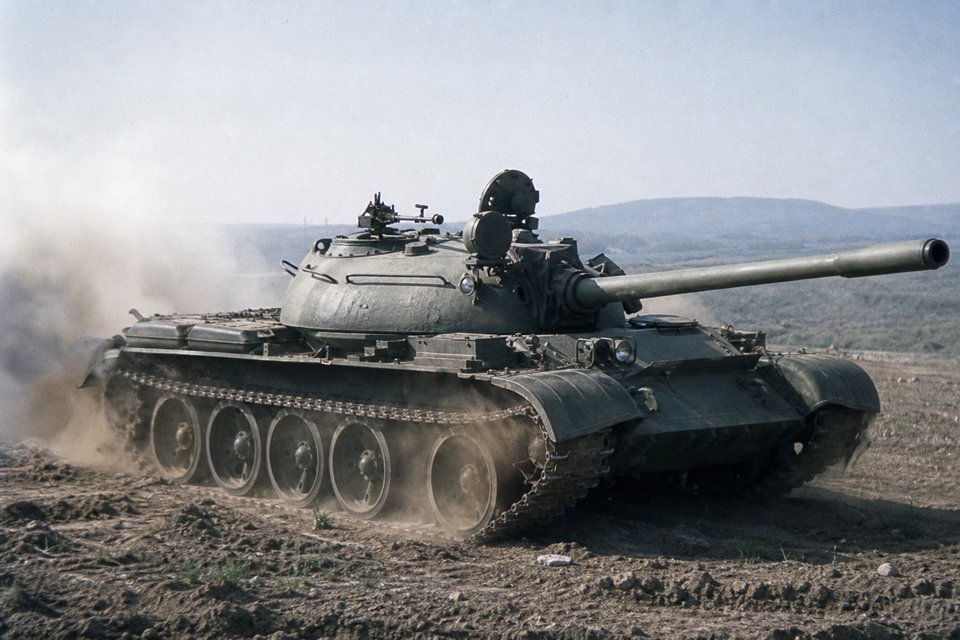
The T-55 tank is a Soviet main battle tank that entered production in 1958 as an upgrade of the earlier T-54, itself a successor to the World War Two-era T-34. English-language sources spell the name several ways: T-55, T 55, or simply T55, and all of them describe the same vehicle family. Together, the T-54 and T-55 make up the most-produced tank series in history, and despite being obsolete by modern standards, the type is still in service with dozens of armies decades after the last factory-new example rolled off a production line.
This page traces the T-55 tank from its origins in the T-44 and T-54, through its armor, gun and variants, to the modernization packages that keep it in service today and the wars it has fought in, from Hungary in 1956 to Ukraine's reactivated reserves after 2023.
From T-44 to T-54 to T-55: Development History
The Soviet Union's T-44 medium tank, completed in only small numbers with around 200 built by the end of 1945, introduced a transverse engine layout and a lower hull than its T-34 predecessor. Soviet designers used that hull as the basis for a heavier-gunned successor: fitting a 100 mm gun and enlarging the turret ring produced the vehicle that entered service in April 1946 as the T-54. By the standards of the late 1940s the T-54 was excellent, better armed and armored than its Western counterparts, the British Centurion and the American M26 Pershing, while remaining smaller and lighter than either.
The T-54 went through several running production changes (T-54-1, T-54-2, T-54-3, then T-54A and T-54B) before the Soviet army ordered a more thorough redesign in 1958. The trigger was nuclear survivability testing: trials showed a T-54 could survive a 2 to 15 kiloton blast at a range of just over 300 metres, but the crew's odds of survival only became reasonable beyond roughly 700 metres. The redesigned tank, the T-55, added an overpressure nuclear-biological-chemical (NBC) protection system, a thicker turret casting, a more powerful V-55 engine, greater fuel and ammunition capacity, and dropped the T-54's bow-mounted machine gun. Soviet factories built the T-55 until 1981, alongside licensed and derivative production in several other countries.
Armor, the D-10T Gun and Characteristics
The T-55's turret front armor measures around 205 mm of cast steel, sloped to increase its effective thickness against incoming rounds; the hull front is roughly 100 to 120 mm at a steep 60-degree angle, depending on production year. None of this was applied armor bolted onto a lighter hull, unlike many of the tank's later foreign upgrades; the base T-55's protection came entirely from the shape and thickness of the original casting and welded plate.
Main armament is the D-10T 100 mm rifled gun, carried over from the T-54 and later fitted with the STP-2 "Tsiklon" two-plane stabilizer for firing on the move. The gun fires armor-piercing, high-explosive and (on later ammunition batches) armor-piercing fin-stabilized discarding sabot rounds, with roughly 43 rounds carried internally. A 7.62 mm coaxial machine gun and, on many production batches, a 12.7 mm DShK anti-aircraft machine gun on the turret roof round out the armament. Combined with a four-man crew, a combat weight around 36 to 40 tonnes depending on variant, and a 500-horsepower V-55 diesel engine (later boosted to nearly 700 hp in some upgrade packages), the T-55 tank was a reliable, mechanically simple design that crews in dozens of countries learned to maintain with minimal outside support.
| Specification | Value (base T-55) |
|---|---|
| Crew | 4 |
| Combat weight | ~36 tonnes |
| Length (gun forward) | 9.00 m |
| Width | 3.37 m |
| Height | 2.40 m |
| Armor, turret front | ~205 mm cast |
| Armor, hull front | ~100-120 mm at 60 degrees |
| Main gun | D-10T, 100 mm rifled, ~43 rounds |
| Engine | V-55 V-12 diesel, ~500-580 hp |
| Max road speed | 50 km/h |
| Range | ~325 km internal fuel; ~500-610 km with external tanks |
T-55 Variants: T-55A, T-55K and Beyond
Soviet production alone produced a long list of running variants before any foreign programme touched the design. The table below summarizes the main lines; many armies mixed and matched features between them depending on what upgrade kits were available.
| Variant | Key change |
|---|---|
| T-55 | Base 1958 production: NBC protection, new turret casting, no bow machine gun |
| T-55A | 1963 onward: added anti-radiation lining against nuclear fallout, visibly bulging turret hatches |
| T-55K | Command variant with an extra radio and generator |
| T-55M / T-55AM | Cold War-era fire-control and armor upgrade package, see below |
| T-55AMV | T-55AM fitted with explosive reactive armor instead of applique "browmor" bands |
| T-55AD | T-55AM fitted with the Drozd active protection system |
| Czechoslovak- and Polish-built T-55/T-55A | Licensed local production, largely to Soviet specification |
| Chinese Type 59 / Type 69 | Reverse-engineered T-54A copy (Type 59) and its upgraded derivative (Type 69) |
| Israeli Tiran-4 / Tiran-5 | Captured T-54s and T-55s rearmed with the NATO-standard 105 mm L7 gun |
| Pakistani Al-Zarrar | Deep upgrade of Chinese Type 59 hulls with a 125 mm smoothbore gun and composite armor |
| Romanian TR-77-580 (TR-580) | Indigenous redesign sharing little more than optics and ammunition with the Soviet T-55 |
A few of these deserve more detail. The Israeli Tiran series began with roughly 200 T-54s and T-55s captured from Egypt and Syria in the 1967 Six-Day War; Israel rearmed them with the same 105 mm L7 gun fitted to its Centurions and Pattons, giving three very different tank families a shared logistics chain. Some Tiran hulls were later stripped of their turrets entirely and rebuilt as the Achzarit heavy armored personnel carrier, while others, redesignated Ti-67, were converted outright into troop carriers used by Israel's local allies in southern Lebanon into the 1990s. The Al-Zarrar, fielded by Pakistan since 2004, is arguably the most thorough T-55-derived rebuild still in frontline service anywhere: a new 125 mm smoothbore gun, a 730 hp engine, composite and reactive armor, and a fire-control system replace almost everything on the original Chinese Type 59 hull except its basic dimensions.
Outside the Soviet Union, licence and derivative production kept the line running for decades after Moscow's own factories switched to newer designs. Czechoslovakia and Poland built their own T-55 and T-55A batches largely to Soviet specification, mainly for their own Warsaw Pact forces and for export to Soviet client states in Africa and the Middle East. China's Type 59, reverse-engineered from a small number of T-54As supplied in the 1950s before the Sino-Soviet split, became the basis for an entire domestic tank industry; the upgraded Type 69 that followed it was sold in the thousands to Iraq and Iran during their war in the 1980s, sometimes to both sides of the same conflict within a few years of each other.
Modernized: T-55AM, T-55AMV and Later Upgrade Packages
The Soviet Union's own modernization programme, fielded from the late 1970s, produced the T-55M and its export-oriented sibling the T-55AM. Both added a laser rangefinder, an improved ballistic computer, a gun-launched anti-tank guided missile capability fired through the existing 100 mm barrel, a more powerful engine, and a distinctive band of applique "browmor" armor across the turret front and glacis. The T-55AMV replaced that applique band with first-generation Kontakt explosive reactive armor tiles, and the T-55AD added the Drozd hard-kill active protection system, one of the first fielded anywhere, to intercept incoming anti-tank rockets before they struck.
Outside the Soviet Union, a T55 modernized for export or for a cash-strapped domestic army usually meant some combination of a bigger gun (120 mm or 125 mm smoothbore in place of the original 100 mm rifled piece), a Western or Israeli fire-control system, a laser rangefinder, thermal sights, and reactive or composite armor add-ons. Slovenia's M-55S programme for Ukraine, using NATO-standard 105 mm L7 guns and upgraded armor, and Pakistan's Al-Zarrar both follow this pattern. Decades after the type went out of first-line Soviet service, a T55 modernized this way remains, for a low-budget army, a cheaper way to field a working main gun and a diesel engine than buying anything built after 1980.
T-55 Tank Production Numbers
The T-54/T-55 series is generally described as the most-produced tank family in history, though the exact total depends on which derivatives are counted. Soviet factories alone are credited with more than 35,000 T-54 variants between 1946 and 1958 and more than 27,500 T-55 variants between 1958 and 1981. Czechoslovakia added roughly 11,000 T-54/T-55s of its own between 1957 and 1983, Poland around 10,000 between 1956 and 1979, and China some 13,000 Type 59/69/79 tanks from 1958 into the 1980s. Adding smaller production runs in Romania and elsewhere, most reference works put total worldwide production somewhere between 86,000 and 100,000 hulls; no single, universally agreed figure exists, and any number quoted without that range should be treated with caution.
Combat History: Hungary 1956 to Ukraine
Soviet T-54s first saw combat suppressing the Hungarian Revolution in 1956, where a handful were knocked out by improvised anti-tank weapons in Budapest's streets. The T-54/55 went on to fight in nearly every major conflict of the Cold War and after: Warsaw Pact tanks rolled into Czechoslovakia in 1968; Egyptian and Syrian T-55s faced Israeli armor in the 1967 Six-Day War and the 1973 Yom Kippur War, in which roughly 2,250 Arab tanks were destroyed or captured against 1,063 disabled Israeli tanks; Indian T-55s destroyed nine Pakistani M47/M48 tanks without loss at the Battle of Nainakot during the 1971 war; and Iraqi and Iranian T-55s, alongside the newer T-62, fought in some of the largest tank engagements of the 1980–88 Iran–Iraq War.
The type also fought through the Vietnam War, ending with a North Vietnamese T-54 crashing through the gates of the Presidential Palace in Saigon on 30 April 1975, and through the Yugoslav wars of the 1990s, where the T-55 was the most numerous tank in Yugoslav People's Army service but proved vulnerable to infantry anti-tank rockets in urban fighting. Iraqi T-55s and Chinese-derived Type 59/69s fought again, with little success, against coalition forces in the 1991 Gulf War and again in 2003. Syria's government forces relied heavily on T-55s through its long civil war beginning in 2011, often up-armored in the field with improvised cage and slat armor welded on to trigger rocket-propelled grenades before they could reach the hull.
Most recently, Russia has pulled T-54s and T-55s out of long-term storage to replace losses in its invasion of Ukraine: the first reactivated T-55s reached the front in the summer of 2023, and by February 2026 open-source researchers had visually confirmed 24 Russian T-54/55 losses. Lacking modern thermal sights or fire control, these reactivated tanks are typically used for indirect fire support well behind the front line rather than in the assault role a modern main battle tank would normally fill. Ukraine, meanwhile, fielded Slovenian-supplied M-55S tanks, themselves T-55 hulls rebuilt with NATO guns and armor, against the very same Russian T-55s their shared ancestor once equipped on opposite sides of the Cold War.
T-55 vs M48 Patton, M60 Patton and Centurion
The T-55's most direct Cold War rivals were the American M48 and M60 Patton series and the British Centurion, all three of which it met in combat, mostly in the hands of Israel and its Arab neighbors.
| Tank | Origin | Main gun | Max speed |
|---|---|---|---|
| T-55 | Soviet Union | 100 mm D-10T rifled | 50 km/h |
| M48 Patton (M48A5) | United States | 105 mm M68 rifled | 48 km/h |
| M60 Patton (M60A1) | United States | 105 mm M68 rifled | 48 km/h |
| Centurion | United Kingdom | 105 mm L7 rifled (late models) | 35 km/h |
On paper the T-55's 100 mm gun and armor were competitive with the early Patton and Centurion when all three entered service in the 1950s. By the time they actually met in combat, in 1967 and again in 1973, the balance had shifted: Israeli M48s, M60s and Centurions carried the larger, harder-hitting 105 mm L7 gun and benefited from better crew training and superior night-fighting and fire-control equipment, and Egyptian and Syrian T-55 crews paid for that gap heavily. During the Yom Kippur War, roughly 105 Israeli Centurions of the 7th Armoured Brigade and 20 more of the 188th Brigade blunted an advance by some 500 Syrian T-55s and T-62s on the Golan Heights, a battle Israeli accounts still cite as proof that crew skill and fire control mattered more than any single number on a specifications sheet.
Where the T-55 Still Serves Today
Sources vary on an exact figure, but the T-55 tank remains on the books of up to roughly 50 armed forces worldwide, concentrated in countries that never had the budget to replace Cold War-era Soviet equipment: Vietnam, Angola, Ethiopia, Syria, Yemen, Cuba and North Korea among them. A Russian T55 pulled from long-term storage in 2023 or 2024 differs little in firepower from one built forty years earlier, since Russia's reactivated tanks generally skip the fire-control and armor upgrades that keep other countries' T-55 fleets militarily relevant. Photographs documenting each knocked-out Russian T55 have circulated since the reactivated tanks first reached the front in 2023, the same open-source method used to track losses across the rest of the war. Collectors and wargamers shorten the designation the same way modelers do, writing T 55 without a hyphen on kit boxes and price lists, decades after Soviet planners moved first-line units on to the T-72, the T-80 and the T-90.
Pakistan's upgraded Al-Zarrar fleet and Slovenia's M-55S conversions for Ukraine represent the opposite end of the scale from a tank left in storage: a T-55 hull is cheap to acquire and simple to maintain, which is exactly why armies with limited budgets keep choosing to rebuild one instead of buying a modern design like the M1 Abrams.
T-55 against its contemporaries
All 43 entries in the data table
Select a column heading to sort.
| Name | Nation | Class | Weight (t) | Length (m) | Width (m) | Height (m) | Main gun (mm) | Max armor (mm) | Engine (hp) | Road speed (km/h) | Range (km) | Crew | Built | Compare |
|---|---|---|---|---|---|---|---|---|---|---|---|---|---|---|
| M2 Light Tank | United States | light tank | 11.6 | 4.42 | 2.46 | 2.64 | 37 | 25 | 250 | 58 | 320 | 4 | 698 | |
| M3/M5 Stuart | United States | light tank | 12.9 | 4.84 | 2.29 | 2.57 | 37 | 51 | 220 | 58 | 160 | 4 | 22,744 | |
| M22 Locust | United States | airborne tank | 7.4 | 3.94 | 2.16 | 1.85 | 37 | 12.5 | 165 | 64 | 217 | 3 | 830 | |
| M24 Chaffee | United States | light tank | 18.4 | 5.56 | 3 | 2.77 | 75 | 38 | 220 | 56 | 160 | 5 | 4,731 | |
| M2 Medium Tank | United States | medium tank | 18.7 | 5.38 | 2.59 | 2.82 | 37 | 51 | 400 | 42 | 210 | 5 | 112 | |
| M3 Lee/Grant | United States | medium tank | 27.2 | 5.64 | 2.72 | 3.12 | 75 | 51 | 400 | 42 | 193 | 7 | 6,258 | |
| M4A1 Sherman (75 mm) | United States | medium tank | 30.3 | 5.84 | 2.62 | 2.74 | 75 | 76 | 400 | 39 | 193 | 5 | 6,281 | |
| M4A3 76 mm (W) Sherman | United States | medium tank | 33.7 | 7.54 | 3 | 2.97 | 76 | 64 | 450 | 42 | 160 | 5 | 1,925 | |
| M4A3E2 Jumbo | United States | medium tank | 38.1 | — | — | — | 75 | 152 | 450 | 35 | 146 | 5 | 254 | |
| M4A3E8 Sherman "Easy Eight" | United States | medium tank | 33.6 | 5.92 | 2.54 | 2.74 | 76 | 64 | 450 | 47 | 160 | 5 | 2,617 | |
| M6 Heavy Tank | United States | heavy tank | 57.4 | 8.43 | 3.12 | 3 | 76 | 101 | 825 | 35 | 160 | 6 | 40 | |
| M26 Pershing | United States | heavy tank | 41.9 | — | — | — | 90 | 102 | 500 | 48 | 160 | 5 | 2,202 | |
| M10 Wolverine | United States | tank destroyer | 29.6 | 6.83 | 3.05 | 2.9 | 76 | 57 | 375 | 48 | 320 | 5 | 6,406 | |
| M18 Hellcat | United States | tank destroyer | 17 | 6.65 | 2.87 | 2.57 | 76 | 25 | 400 | 89 | 160 | 5 | 2,507 | |
| M36 Jackson | United States | tank destroyer | 29 | 7.47 | 3.05 | 3.28 | 90 | 76 | 450 | 42 | 240 | 5 | 1,772 | |
| Panzer III | Germany | medium tank | 22.7 | 6.28 | 2.95 | 2.5 | 50 | 50 | 300 | 40 | 155 | 5 | 5,774 | |
| Panzer IV (Ausf. H) | Germany | medium tank | 25 | 7.02 | 2.88 | 2.68 | 75 | 80 | 296 | 40 | 235 | 5 | 2,324 | |
| Panther (Ausf. G) | Germany | medium tank | 45.5 | 8.86 | 3.4 | 2.98 | 75 | 120 | 690 | 46 | 200 | 5 | 3,126 | |
| Tiger I | Germany | heavy tank | 57 | 8.45 | 3.56 | 3 | 88 | 120 | 690 | 45 | 195 | 5 | 1,347 | |
| Tiger II | Germany | heavy tank | 69.8 | 10.29 | 3.75 | 3.09 | 88 | 185 | 690 | 42 | 190 | 5 | 492 | |
| Panzer VIII Maus | Germany | super-heavy tank | 188 | 10.2 | 3.71 | 3.63 | 128 | 220 | 1,200 | 20 | 160 | 6 | 2 | |
| T-34/76 | Soviet Union | medium tank | 26.5 | 6.68 | 3 | 2.46 | 76 | 45 | 500 | 53 | 330 | 4 | 35,120 | |
| T-34/85 | Soviet Union | medium tank | 32.4 | 6.68 | 3 | 2.46 | 85 | 90 | 500 | 55 | 300 | 5 | 48,950 | |
| KV-1 | Soviet Union | heavy tank | 45 | 6.75 | 3.32 | 2.71 | 76 | 90 | 600 | 35 | 250 | 5 | 5,219 | |
| IS-2 | Soviet Union | heavy tank | 46 | 9.9 | 3.09 | 2.73 | 122 | 132 | 520 | 37 | 240 | 4 | 3,854 | |
| T-35 | Soviet Union | heavy tank | 45 | 9.72 | 3.2 | 3.43 | 76 | 30 | 500 | 30 | 150 | 10 | 60 | |
| ISU-152 | Soviet Union | assault gun | 45 | 9.18 | 3.07 | 2.48 | 152 | 120 | 520 | 37 | 230 | 5 | 4,635 | |
| Matilda II | United Kingdom | infantry tank | 25 | 5.61 | 2.59 | 2.51 | 40 | 78 | 190 | 24 | 257 | 4 | 2,987 | |
| Churchill Mk VII | United Kingdom | infantry tank | 40.7 | 7.44 | 2.74 | 3.45 | 75 | 152 | 350 | 20 | 145 | 5 | 1,600 | |
| Cromwell | United Kingdom | cruiser tank | 28 | 6.35 | 2.908 | 2.49 | 75 | 76.7 | 600 | 64 | 270 | 5 | 4,016 | |
| T-54 | Soviet Union | main battle tank | 36 | 9 | 3.37 | 2.4 | 100 | 200 | 520 | 48 | 325 | 4 | 35,000 | |
| T-55 | Soviet Union | main battle tank | 36 | 9 | 3.37 | 2.4 | 100 | 200 | 580 | 50 | 500 | 4 | 27,500 | |
| T-62 | Soviet Union | main battle tank | 37 | 9.34 | 3.3 | 2.4 | 115 | 242 | 620 | 50 | 450 | 4 | 22,700 | |
| T-72 (Ural/A) | Soviet Union | main battle tank | 41 | 9.73 | 3.59 | 2.23 | 125 | — | 780 | 60 | 500 | 3 | 25,000 | |
| T-80 (B/U) | Soviet Union | main battle tank | 44.25 | 9.9 | 3.4 | 2.202 | 125 | — | — | 70 | 335 | 3 | 5,500 | |
| T-90 | Russia | main battle tank | 46.5 | 9.63 | 3.78 | 2.22 | 125 | — | 840 | 60 | 550 | 3 | 4,000 | |
| M48 Patton | United States | main battle tank | 45 | 9.3 | 3.65 | 3.1 | 90 | 110 | 825 | 48 | 499 | 4 | 12,000 | |
| M60A1 | United States | main battle tank | 47.7 | 9.45 | 3.63 | 3.25 | 105 | 258 | 750 | 48 | 500 | 4 | 15,000 | |
| M60A3 | United States | main battle tank | 47.7 | 9.44 | 3.63 | 3.28 | 105 | 258 | 750 | 48 | 500 | 4 | 1,052 | |
| M1 Abrams (M1A2) | United States | main battle tank | 61.3 | 9.77 | 3.7 | 2.44 | 120 | — | 1,500 | 67 | — | 4 | 10,300 | |
| Leopard 2A4 | Germany | main battle tank | 55.2 | 9.97 | 3.7 | 2.8 | 120 | — | 1,500 | 70 | 340 | 4 | 3,600 | |
| Challenger 2 | United Kingdom | main battle tank | 64 | 8.3 | 3.5 | 2.49 | 120 | — | 1,200 | 59 | 550 | 4 | 447 | |
| Merkava Mk 4 | Israel | main battle tank | 65 | 7.6 | 3.72 | 2.66 | 120 | — | 1,500 | 64 | 500 | 4 | 700 |
Frequently asked questions
What is the T-55 tank?
The T-55 is a Soviet main battle tank that entered production in 1958 as an NBC-protected redesign of the earlier T-54, itself a successor to the World War Two T-34. The T-54/T-55 series is generally considered the most-produced tank family in history, built in the Soviet Union and under licence or as derivatives in several other countries.
What is the difference between the T-54 and the T-55?
The T-55, introduced in 1958, added an overpressure NBC protection system, a thicker turret casting, a more powerful V-55 engine, greater fuel and ammunition capacity, and dropped the T-54's bow-mounted machine gun. The two tanks look very similar and are often hard to tell apart visually.
What gun does the T-55 use?
The T-55 carries the D-10T 100 mm rifled gun, the same weapon fitted to the T-54, later stabilized for firing on the move and eventually able to fire a gun-launched anti-tank guided missile on the modernized T-55M/AM. It carries roughly 43 rounds internally.
What does T-55AM mean?
T-55AM is the Soviet modernization package fielded from the late 1970s, adding a laser rangefinder, an improved fire-control computer, a more powerful engine and a band of applique armor across the turret front and glacis. The T-55AMV variant replaced that applique band with explosive reactive armor.
How many T-55 tanks were built?
Estimates vary because so many countries built their own versions, but most reference works put total worldwide production of the T-54/T-55 family, including Chinese Type 59/69 and other derivatives, somewhere between 86,000 and 100,000 vehicles.
Is the T-55 still in service?
Yes, in a reduced role. The T-55 remains on the books of up to roughly 50 armed forces worldwide, mostly countries that never had the budget to replace Cold War-era Soviet equipment, and Russia has pulled T-55s out of long-term storage for use in its invasion of Ukraine since 2023.
What is the Al-Zarrar tank?
The Al-Zarrar is Pakistan's deep upgrade of its Chinese-built Type 59 (a T-54 derivative), fitted since 2004 with a 125 mm smoothbore gun, a 730 hp engine, composite and reactive armor, and a modern fire-control system. It remains Pakistan's most numerous tank.
What is the Israeli Tiran tank?
Tiran-4 and Tiran-5 are Israeli designations for T-54s and T-55s captured from Egypt and Syria in the 1967 Six-Day War, rearmed with the NATO-standard 105 mm L7 gun also used on Israel's Centurions and Pattons. Some hulls were later converted into the turretless Achzarit armored personnel carrier.
How does the T-55 compare to the M48 and M60 Patton?
The T-55's 100 mm gun and armor were roughly competitive with the early M48 and M60 Patton and the Centurion when all entered service in the 1950s, but by the time they met in combat in 1967 and 1973, Western tanks armed with the 105 mm L7 gun and better fire control generally had the advantage.
Why was the T-55 used in the Iran-Iraq War?
Both Iran and Iraq inherited or purchased large numbers of T-55s and Chinese Type 59/69 derivatives before their 1980-88 war, and the tank saw some of the largest armored engagements of the conflict, including one of its biggest tank battles in early 1981.
Why has Russia reactivated old T-55 tanks for Ukraine?
Heavy losses of newer tanks in Russia's invasion of Ukraine led its military to pull T-54s and T-55s out of long-term storage from 2023 onward. Lacking modern thermal sights and fire control, these tanks are typically used for indirect fire support rather than front-line assaults.
What replaced the T-55 in Soviet and Russian service?
The Soviet Union moved its first-line units on to the T-64, T-72 and later the T-80, and Russia today fields the T-90 as its main production tank, though older T-55s remained in reserve storage for decades after leaving front-line service.